Generative Engine Optimization (GEO): Google Settled the Debate
For a year, nobody could agree on what GEO actually was or whether it required a whole new playbook. In May and June 2026, Google answered the question directly. Here’s what generative engine optimization really is, what Google said, and what to actually do about it.
What Is Generative Engine Optimization (GEO)?
Generative engine optimization is the practice of structuring content so AI systems (Google AI Overviews, AI Mode, ChatGPT, Perplexity, and Claude) cite or reference it when generating an answer.
It's also been called AEO (answer engine optimization), LLMO, or AI SEO, depending on who's selling it to you.
The main difference from traditional SEO is supposed to be the goal:
SEO earns you a position in a ranked list of links.
GEO is meant to earn you a place inside the answer of an LLM itself, sometimes with no link at all.
As AI Overviews started appearing on roughly half of commercial Google searches by early 2026, and as ChatGPT alone began processing well over a billion queries a month, being the source an AI cites started to matter as much as being the page someone clicks.
Is Generative Engine Optimization a New Discipline?
The answer has several parts because GEO indeed felt like a new discipline, and the confusion had a real cause.
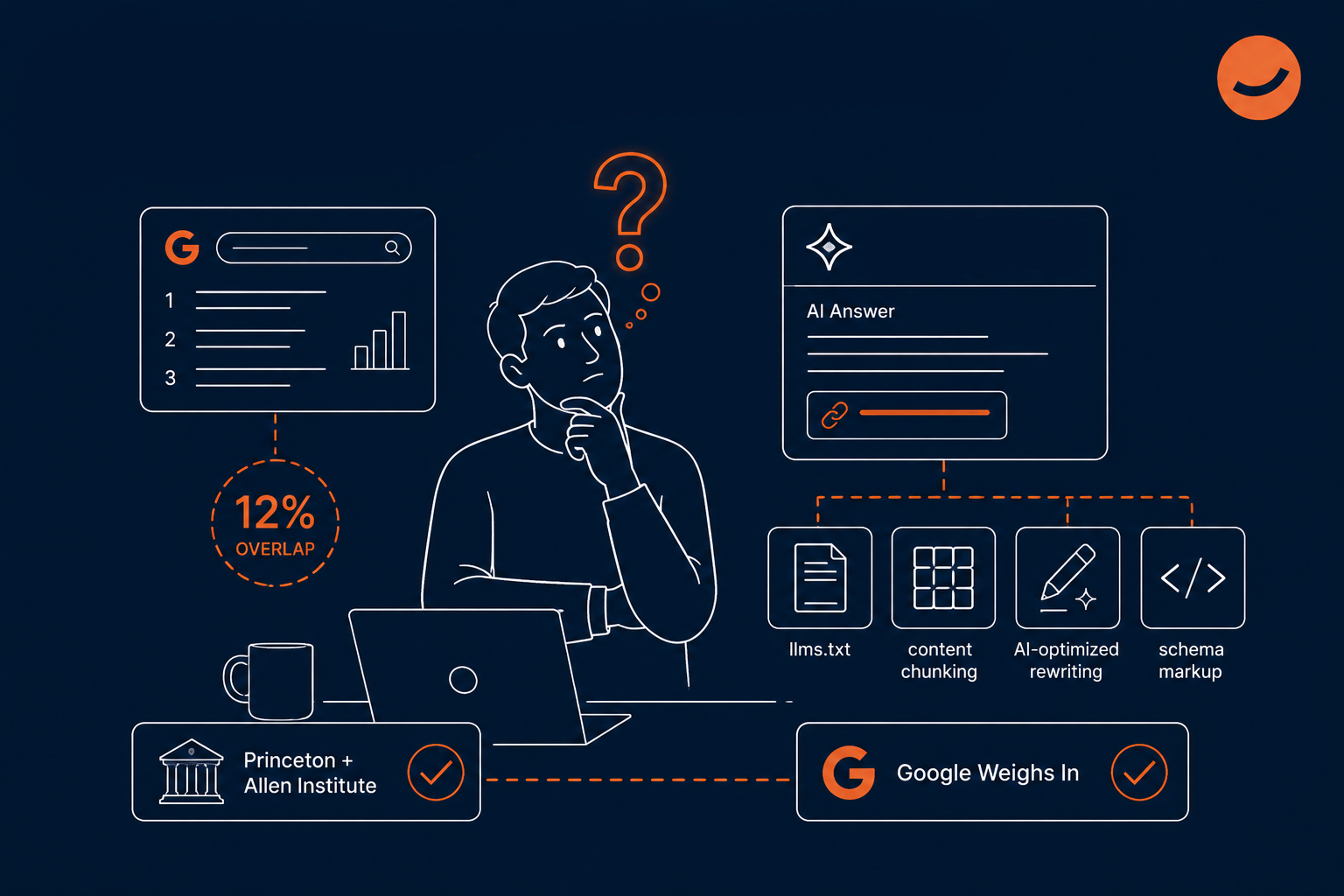
AI answer engines don't behave like traditional search rankings. Multiple studies in early 2026 found that the overlap between what ranks on Google and what gets cited by AI tools was surprisingly small.
📊 One widely cited analysis by Ahrefs of 15,000 queries across ChatGPT, Gemini, Copilot, and Perplexity found only about 12% of the cited URLs also ranked in Google's top 10 for the same query.
That gap is what created an entire industry. If ranking #1 on Google didn't guarantee a citation in an AI answer, then logically there had to be a separate set of rules for winning the citation.
Vendors filled that gap fast: llms.txt files, content chunking services, "AI-optimized" rewriting tools, schema markup sold specifically as a GEO requirement.
Genuine research, including a Princeton and Allen Institute study presented at KDD 2024, did find that certain structural changes meaningfully increased how often AI systems pulled from a source. So the urgency wasn't completely manufactured.
But it also wasn't independently verified at the scale the marketing implied, until Google weighed in directly.
What Did Google Say About Generative Engine Optimization?
On May 15, 2026, Google published "Optimizing your website for generative AI features on Google Search," a standalone guide addressing AI Overviews and AI Mode directly.
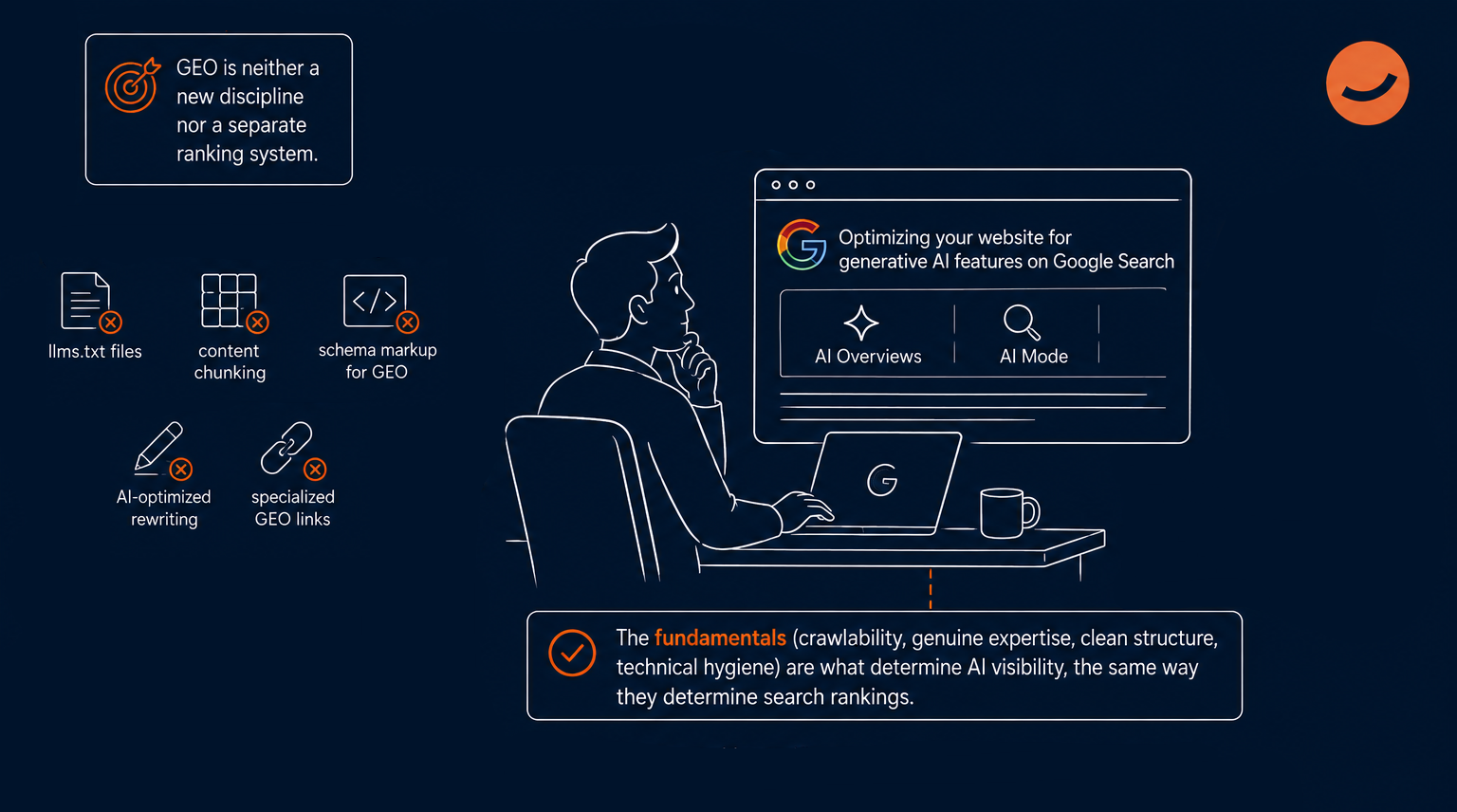
📌 From Google's perspective, optimizing for generative AI search is optimizing for the search experience, and is therefore still SEO. I.e., GEO is neither a new discipline nor a separate ranking system.
Three weeks later, on June 5, Google published a guide on vetting third-party SEO tools and services, explicitly naming AEO and GEO as service categories, and handing site owners a framework for telling a credible GEO vendor from one selling vapor.
→ The fundamentals (crawlability, genuine expertise, clean structure, technical hygiene) are what determine AI visibility, the same way they determine search rankings.
Google's May guide specifically named several tactics being actively sold as GEO solutions and said they aren't necessary for its AI features:
Tactic | Google's stated position |
|---|---|
llms.txt files | Not used or required by Google's generative AI features |
Content chunking | Google's systems understand text across a full page without needing content broken into AI-specific chunks |
AI-specific rewriting | Google's systems understand synonyms and general meaning; no need to write differently for AI than for people |
Special schema markup | No dedicated schema.org markup exists or is needed for generative AI features specifically |
Chasing inauthentic mentions | Seeking artificial brand mentions across forums and blogs isn't effective; core ranking systems prioritize quality, and spam systems catch the rest |
"Approved by Google" tool claims | No third-party tool has special access to Google's ranking systems or an official endorsement; vendors implying otherwise should be treated with caution |
📌 Google’s framing is being read two ways in the industry. The dismissive read is “GEO is hot hair,” but Google didn’t say generative AI visibility doesn’t matter; it said the visibility runs on the same foundation as everything else you were already supposed to be doing.
Does This Apply Outside Google?
Google was talking about Google. AI Overviews and AI Mode run on Google's own retrieval and ranking systems, which is why strong SEO maps cleanly onto AI visibility there.
📊 seoClarity found that 94% of AI Overviews cite at least one page from the organic top 20, meaning that ranked authority is still the foundation.
ChatGPT, Perplexity, and Claude work differently. They rely on retrieval-augmented generation (RAG), pulling and reassembling specific passages rather than working from a full ranked index.
Research on RAG-based citation behavior shows structural choices (answer-first paragraphs, clear headings, and self-contained sections) produce a measurable, independent lift in citation rates there, separate from Google rank.
→ In short, the structural habits tied to "GEO" are good practice everywhere, but they carry more weight on non-Google platforms specifically.
📌 For mos small businesses, the volume still favors Google by a wide margin. AI referral traffic exists but is small by comparison, though it tends to convert at a noticeably higher rate when it shows up.
Does Google Search Console Show AI Visibility Reports?
On June 3, 2026, Google shipped something the SEO industry had been asking for since AI Overviews launched: a dedicated AI visibility report inside Search Console.
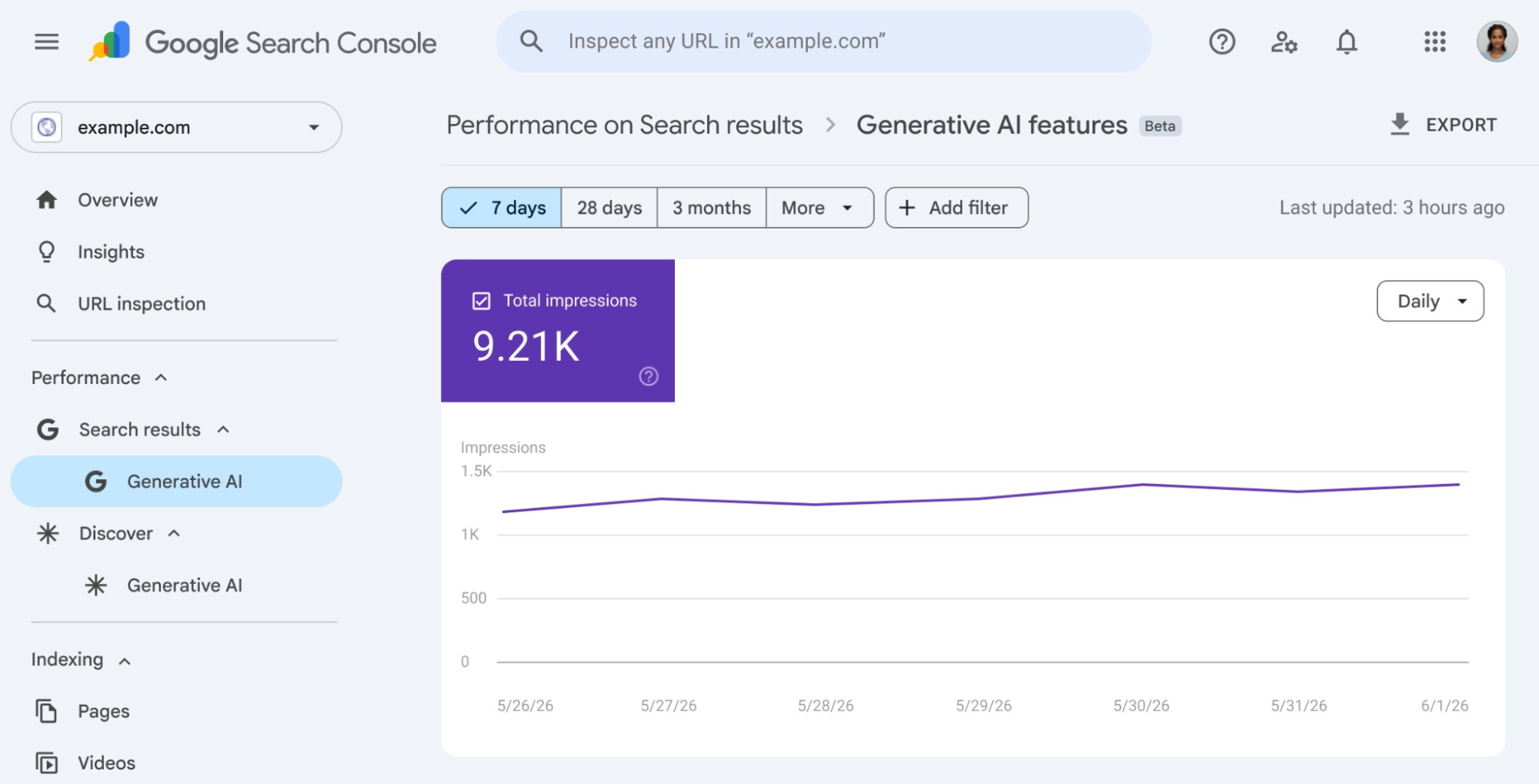
It's a separate view from the standard Performance report, covering three surfaces: AI Overviews, AI Mode, and generative AI features inside Discover. It currently shows:
Impressions: how often your URLs appeared inside generative AI features.
Pages: which specific URLs are showing up.
Countries and devices: where and how that visibility breaks down.
Date granularity: hourly through monthly trends.
What it doesn't show yet: clicks, click-through rate, or query-level data. Google has said more metrics are coming but hasn't committed to a timeline.
📌 The rollout itself is also limited; it started with a subset of sites in the UK before expanding globally, so most site owners won't see it in their account yet. If you open Search Console and don't see a generative AI section, that's expected. It’s not a sign anything is broken.
Google also added a toggle letting site owners block their content from appearing in AI Overviews, AI Mode, and Discover's AI features entirely. Opting out forfeits AI impressions and traffic, but Google has confirmed it doesn’t affect rankings in standard organic search.
⚠️ For most small businesses, opting out isn't the right move. It removes you from the fastest-growing visibility surface in search at the exact moment it became measurable, in order to protect a traffic pattern that's already shifting regardless.
Are Third-Party GEO Tools Still Useful?
A wave of GEO-specific platforms launched over the past year claiming the ability to track, predict, and optimize your visibility across AI engines.
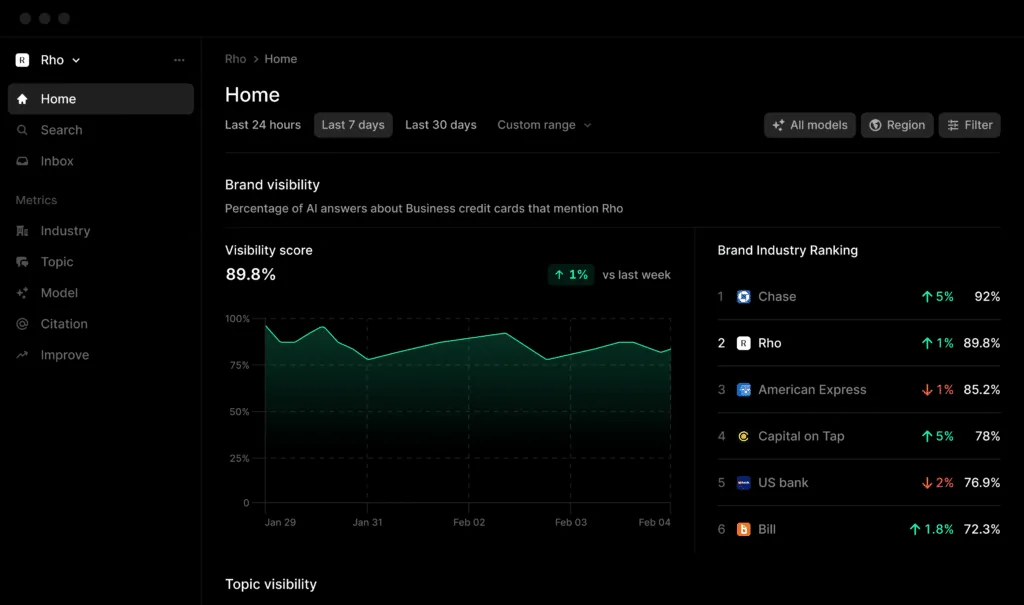
Tracking whether ChatGPT or Perplexity mention your brand is something Search Console doesn't cover at all, since it only reports on Google's own AI surfaces.
But Google's own June 2026 guidance confirms that no third-party tool has access to Google's internal ranking signals, and any vendor implying official endorsement or guaranteed performance should be treated with suspicion.
Most third-party GEO scoring is modeled and predictive; it’s built from observed patterns and sampled queries, not a direct read of any platform's actual retrieval logic. That's not necessarily a scam; it's closer to a forecast than a fact.
The one tool that gives you a direct, first-party signal for Google's own AI features is Search Console's new report (once it's rolled out to your account).
For visibility on ChatGPT, Perplexity, and other non-Google platforms, using GEO tools is currently the only option, but it's worth treating the numbers as estimates rather than verified counts.
👍 We cover a list of trustworthy GEO tools in a separate guide.
What Should You Actually Do in 2026?
With the separate-discipline myth cleared up, the practical answer is shorter than a year of GEO marketing made it sound.
Keep Doing the SEO Fundamentals
Crawlable pages, genuine expertise, clean technical hygiene, and a strong backlink and authority profile remain the foundation for both Google rankings and Google's AI citations. They’re practically 80% of the work.
If your SEO is broken, no amount of "AI optimization" fixes the underlying problem.
Write Answer-First, Regardless of the Platform
Lead each section with a direct, self-contained answer in the first sentence or two, then expand. This isn't a special AI trick; it's good writing that happens to also be exactly what passage-based retrieval systems extract cleanly, on Google and elsewhere.
Keep Structuring Content Clearly
Google says it doesn't require special chunking. Other platforms reward it independently. Doing it well costs nothing and helps in both directions, which is why it remains standard advice rather than a "GEO hack."
Don't Buy llms.txt, Special Schema, or AI-Rewriting Services
Google has explicitly said these aren't required for its features. Spending budget here for Google visibility specifically is no longer defensible advice.
Set Up Search Console’s New Report the Moment It’s Available to You
Search Console is the only first-party signal you'll get for AI visibility. Even with impressions-only data for now, a clean baseline beats no baseline, so start tracking the day it appears rather than wondering later what your trend used to look like.
Treat Third-Party Geo Scores as Directional, Not Definitive
Third-party GEO tools are useful for spotting trends and gaps, not something to optimize toward as if it were a verified ranking factor.
What GEO Means for Small Businesses
If you spent the past year worried you needed a separate AI optimization strategy on top of your SEO, you can let that go. Good SEO, applied consistently with clear structure and direct answers, already serves AI retrieval. It’s the same work, just with another reason to do it well.
The harder part is execution. Knowing the fundamentals matter is different from auditing your site, writing the content, and keeping it current as algorithms shift. That gap, not a missing GEO strategy, is what actually trips most small businesses up.
Alex, Zaturn’s SEO agent, builds every audit and blog post around the same SEO fundamentals that now serve both Google rankings and AI citations. If the gap is execution rather than understanding, that’s the part he handles. See how he works in the SEO AI agent guide.