6 Best SEO Tools for Small Businesses in 2026 (Full Comparison)
Most SEO tools were built for giant marketing teams with even bigger budgets. For a small business owner, that usually means paying for complex data you don't have the time to use. This guide compares the top tools for 2026 that actually do the work for you without costing a fortune. Find the right fit for your budget and finally move the needle on your rankings.
The majority of SEO tools were built for agencies managing dozens of clients or enterprise teams with dedicated SEO departments. Small businesses end up paying for features they’ll never use and data they don’t know how to act on.
This guide covers the best SEO tools for small businesses. We compare them on pricing, what they do well, and which one goes further than the rest by not just telling you what to fix but automatically executing the work.
✅ Why Trust This Review
Zaturn is an AI marketing platform for small businesses, which means we've researched, tested, and in some cases competed directly with every tool on this list. We know what these platforms actually do versus what their pricing pages suggest.
Every tool here was selected on the same criteria we'd use if we were recommending one to a friend: transparent pricing, genuine usefulness for a small team, and honest trade-offs. Where Zaturn competes directly with another tool, we've said so, and we've been straight about where the other tools do things better.
Short Answer
The best SEO tool for a small business depends on what you actually need.
If you want deep research and competitive intelligence, Semrush and Ahrefs lead the field.
If you want an affordable, complete toolkit, Mangools and Ubersuggest deliver more than their price suggests.
If you want an automated execution (a tool that audits your site, writes optimized content, and tracks your rankings without you doing the work), Zaturn’s AI SEO agent, Alex, is in a different category from everything else on this list.
What Should a Small Business Look For in an SEO Tool?
Before comparing tools, it helps to be clear about what actually matters for a small business. The criteria that matter for an agency or enterprise team are different from what you need.
Criteria | Why it matters for small businesses |
|---|---|
Ease of use | You probably don't have a dedicated SEO person. The tool needs to make sense without a steep learning curve. |
Keyword research quality | Finding the right keywords (ones you can actually rank for) is the foundation of everything else. |
Rank tracking | You need to know whether what you're doing is working. Rank tracking tells you if your pages are moving. |
Site audit capabilities | Technical issues quietly kill rankings. A good audit surfaces what's broken so you can fix it. |
Execution vs. analysis | Most tools tell you what to do. Only a few actually do it. Know which type you're evaluating. |
Transparent pricing | SEO tools have a habit of burying costs. Look for clear per-plan pricing without surprise add-ons. |
One distinction worth making before you read the reviews: research tools and execution tools are different categories. Semrush and Ahrefs are research tools. They give you excellent data and tell you what to do with it. Zaturn's Alex is an execution tool; he does the work. For most small businesses, the bottleneck isn't knowing what to do. It's having the time and resources to actually do it.
6 Best SEO Tools for Small Businesses: At a Glance
Before we get to the individual reviews, here’s a quick overview of the tools we recommend small businesses to use for their SEO tasks.
Tool | Starting Price | Type | Best For | Free Trial |
|---|---|---|---|---|
Zaturn (Alex) | $69/mo. | AI agent — automated execution | Businesses that want SEO done for them, not just reported on | 14 days, no credit card |
Semrush | $199/mo. | Research and analytics platform | Deep competitive intelligence and keyword research | None on paid plans |
Ahrefs | $129/mo. (Lite) | Research and analytics platform | Backlink analysis and competitor research | Free tier available |
Moz Pro | $99/mo. | Research platform with local SEO focus | Beginners and local businesses | 30-day free trial |
Mangools | $30.50/mo. | Affordable all-in-one toolkit | Budget-conscious small teams | 10-day free trial |
Ubersuggest | $12/mo. | Budget-friendly research tool | Solo owners and single-site businesses | Free tier available |
1. Zaturn (Alex) — Best for Automated SEO Execution
Zaturn is a dedicated AI marketing platform. It’s the only tool on this list that doesn’t just tell you what to fix. It fixes it, writes the content, and tracks the result, all from a single conversation.
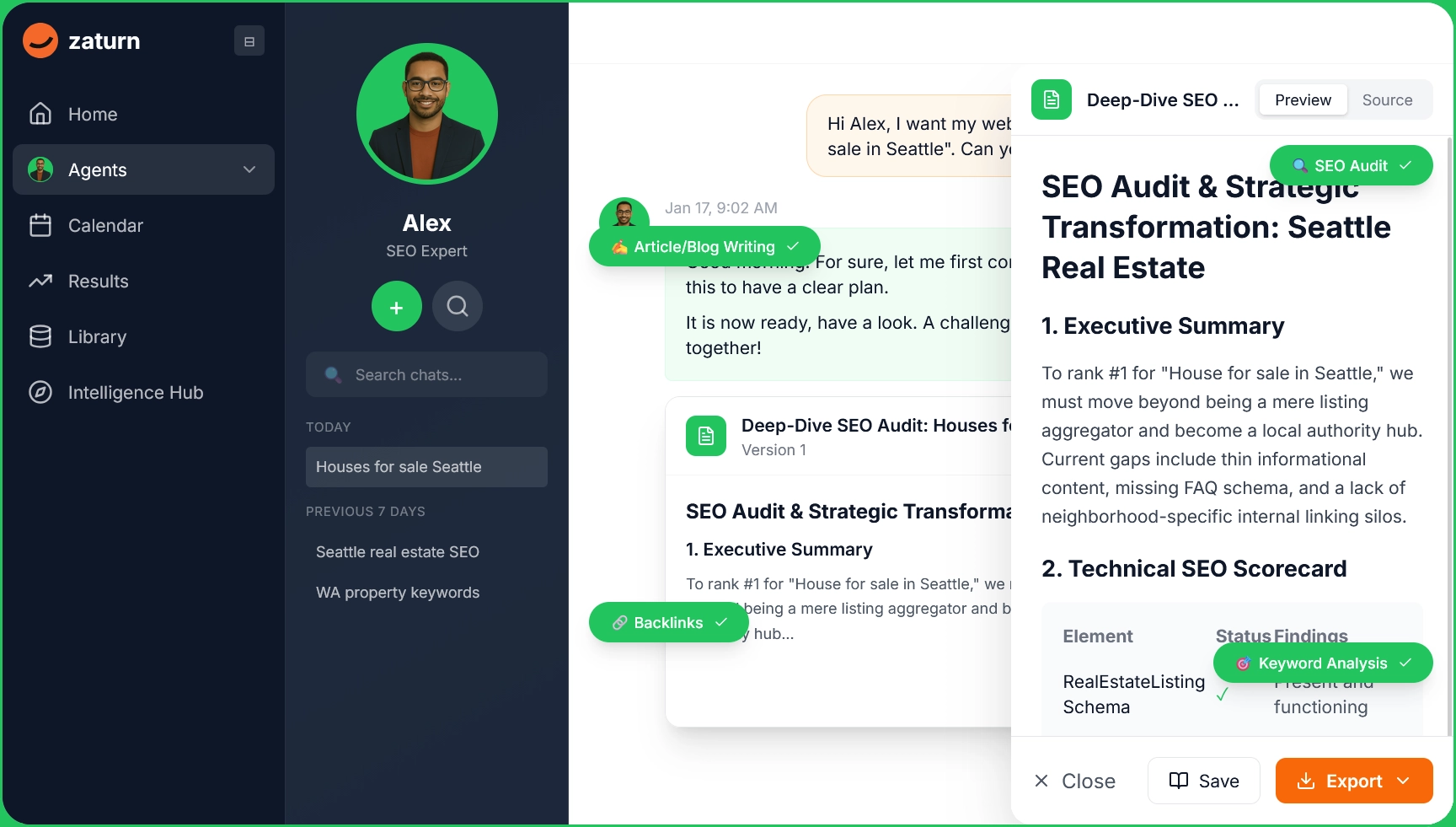
Most SEO tools hand you a list of recommendations and leave the implementation to you. Alex connects to your Google Search Console, audits your site, identifies the keywords worth targeting, writes full optimized blog posts, and tracks your rankings over time, with your approval before anything goes live.
For small businesses without a dedicated SEO resource, Alex becomes the SEO person. The bottleneck is rarely knowing what to do. It's having the time and expertise to actually do it.
Notable Features
Automated site audit: Technical SEO scorecard covering schema markup, internal linking, meta tags, page speed, and more, with a prioritized fix list, not just a data dump.
Full blog post creation: Alex writes 800+ word posts optimized for your target keywords, with proper structure and internal links. Export as PDF, Word, Markdown, or HTML..
Google Search Console integration: Pulls real ranking data (clicks, impressions, average position, and top queries) so tracking is based on actual Google data, not estimates.
Chloe handoff: After publishing a post, Alex passes it to Chloe who turns it into social media content. SEO and social working together without extra effort.
Conversational setup: No technical knowledge needed. Tell Alex what you want to rank for in plain language and he builds the strategy from there.
Pros and Cons
Pros | Cons |
|---|---|
✅ Executes the work — writes and tracks, doesn't just recommend | ❌ Lighter on raw research depth compared to Semrush or Ahrefs |
✅ No SEO expertise needed to get results | ❌ No standalone backlink analysis tool |
✅ GSC integration gives real ranking data, not estimates | |
✅ Works across all six marketing channels from one platform |
Pricing
Plan | Monthly Price | Perks |
|---|---|---|
Starter | $69/mo. | Alex + all 5 other agents, GSC integration, unlimited blog posts, site audit, 14-day free trial |
Growth | $129/mo. | Everything in Starter, 3 workspaces, 3 users, priority support, onboarding call |
Custom | Talk to Sales | Unlimited campaigns, dedicated success manager, custom integrations |
📌 Zaturn is the right choice if the SEO bottleneck in your business is execution, not knowledge. If you need deep backlink research or competitive intelligence at scale, pair it with one of the research tools below.
2. Semrush — Best for Deep Competitive Intelligence
Semrush is the most comprehensive SEO research platform available, and the most expensive entry point on this list.
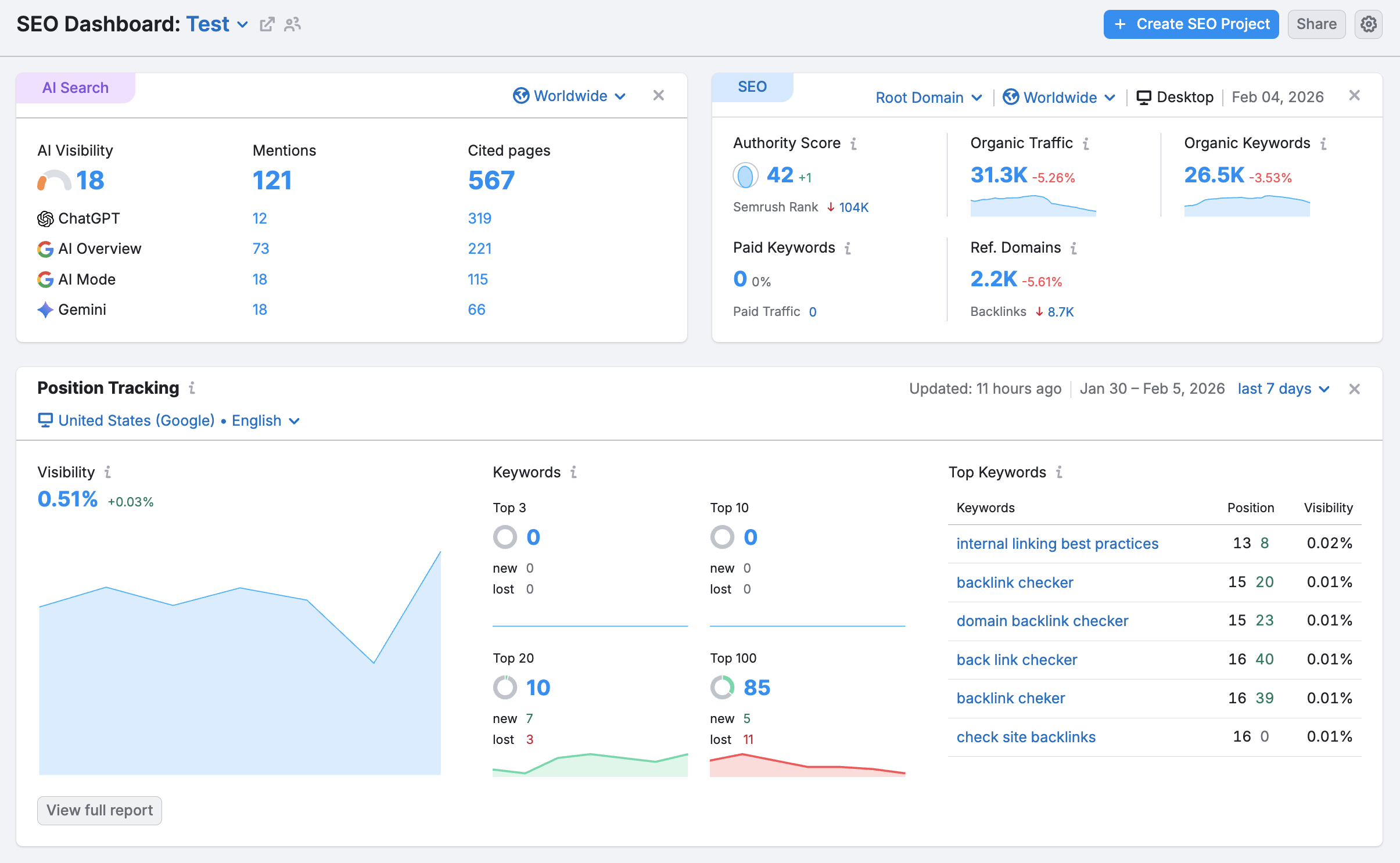
Semrush is the benchmark against which most other SEO tools are measured. Its keyword database, competitor analysis, and site audit capabilities are genuinely best-in-class. For businesses where organic search is a primary growth channel and competitive intelligence matters, there's no closer rival.
The caveat for small businesses is the price. At $199/mo. for the entry Semrush One plan, it's the most expensive starting point on this list. It's also a research tool rather than an execution platform; Semrush tells you what needs to be done, but the implementation is still on you.
Notable Features
Keyword research: One of the largest keyword databases available (25+ billion), with difficulty scores, search volume, and intent classification.
Competitor analysis: See exactly which keywords competitors rank for, their top pages, and where their traffic comes from.
Site audit: Comprehensive technical SEO audit covering 140+ checks with prioritized issue lists.
AI Visibility Toolkit: Tracks how your brand appears in ChatGPT, Google AI Overviews, and other AI-powered search results. This is increasingly important as zero-click searches grow.
Rank tracking: Daily position tracking across locations, devices, and competitors.
Pros and Cons
Pros | Cons |
|---|---|
✅ Best-in-class keyword and competitor research | ❌ Research only — doesn't execute or publish anything |
✅ Comprehensive site audit with actionable issue lists | ❌ Steep learning curve for beginners |
✅ AI visibility tracking is ahead of most competitors | ❌ Can feel overwhelming for a single-person team |
✅ Trusted by marketing professionals globally | ❌ Most expensive entry point on this list at $199/mo. |
Pricing
Plan | Monthly Price | Perks |
|---|---|---|
Starter | $199/mo. | Keyword research, site audit, rank tracking, competitor analysis, AI visibility |
Pro+ | $299/mo. | Everything in Starter with higher limits |
Advanced | $549/mo. | Full access with agency-level limits and reporting |
📌 Semrush is worth the price if competitive research is central to your SEO strategy. For small businesses with a tight budget, the research depth is genuinely hard to replicate, but pair it with an execution tool like Zaturn to actually implement what it recommends.
3. Ahrefs — Best for Backlink Analysis
Ahrefs is Semrush’s closest rival, with a slight edge on backlink data and a more accessible free tier.
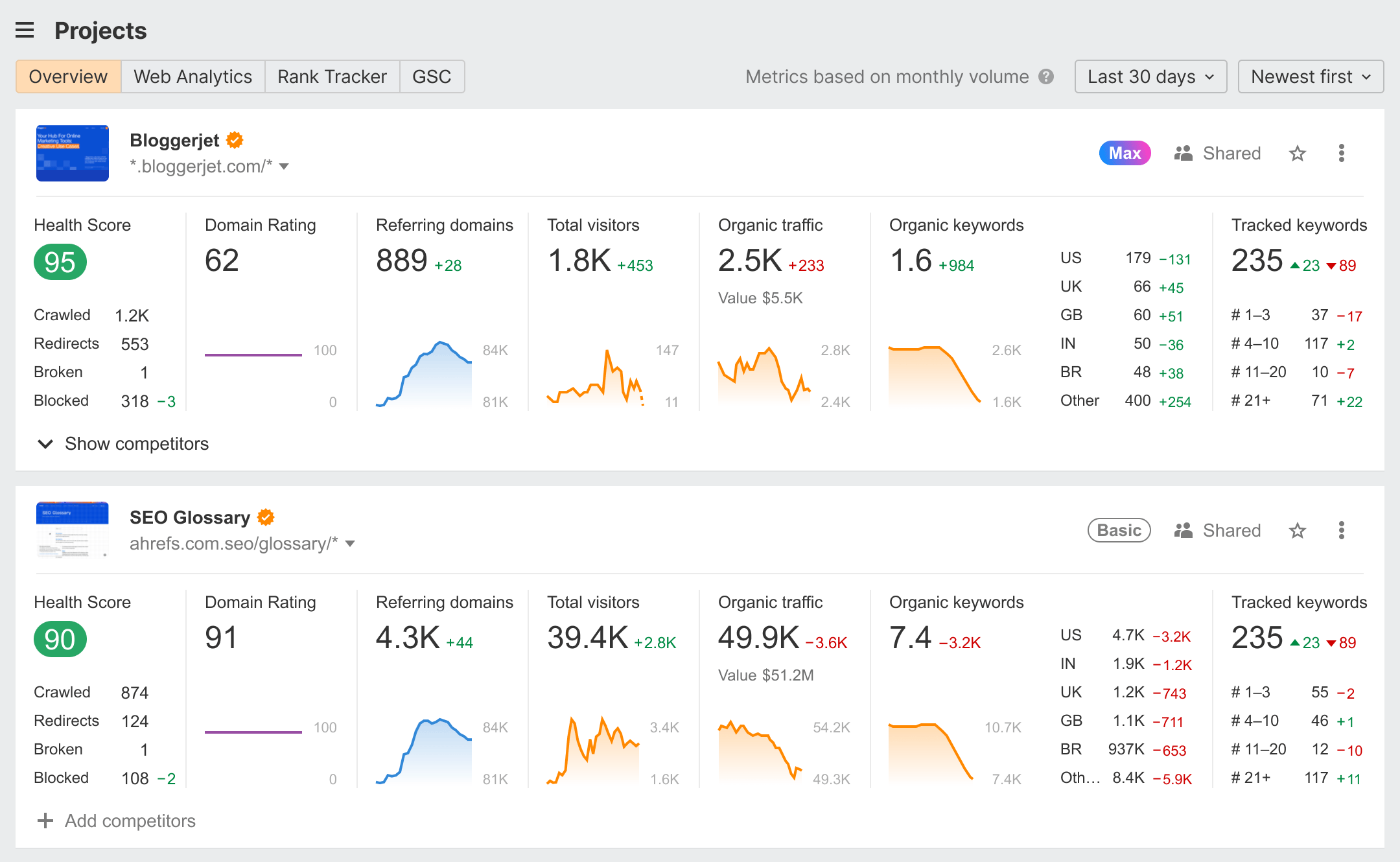
Ahrefs is considered by many to be a direct replacement to Semrush, and the comparison between them comes down to emphasis. Ahrefs has the stronger backlink database and is generally preferred by SEO professionals who care most about link analysis.
Its Keywords Explorer and Site Audit tools are excellent, and the free tier gives small businesses a genuine taste of the platform before committing.
Like Semrush, Ahrefs is a research and analytics platform. It surfaces opportunities and identifies issues; the implementation is still yours to handle.
Notable Features
Site Explorer: Deep backlink analysis, organic search data, and paid traffic research for any domain.
Keywords Explorer: Keyword research with click-through rate data, traffic potential estimates, and SERP analysis.
Site Audit: Crawls your site and identifies technical issues, with an always-on audit option on Lite and above.
Rank Tracker: Monitors keyword positions over time across locations and devices.
Free tier: Ahrefs Free gives you access to real data on your own site. It’s useful before committing to a paid plan.
Pros and Cons
Pros | Cons |
|---|---|
✅ Strongest backlink database of any tool on this list | ❌ Research only — no execution capabilities |
✅ Cleaner interface than Semrush for many users | ❌ No free trial on paid plans beyond the free tier |
✅ Free tier provides genuine value before you pay | ❌ Lite plan ($129/mo.) is the realistic starting point — Starter is quite limited |
✅ Constantly updated with new features | ❌ Backlink focus means less depth on local SEO |
Pricing
Plan | Monthly Price | Perks |
|---|---|---|
Free | Free | Basic site data for your own domain — a useful starting point |
Starter | $29/mo. | Limited access — good for occasional research, not ongoing SEO management |
Lite | $129/mo. | 5 projects, 750 tracked keywords, 100K crawl credits, 6 months historical data |
Standard | $249/mo. | 20 projects, 2,000 tracked keywords, 500K crawl credits, 2 years historical data |
Advanced | $449/mo. | 50 projects, 5,000 tracked keywords, 1.5M crawl credits, 5 years historical data |
Enterprise | $1,499/mo. | Unlimited API access, SSO and enterprise-grade security, unlimited historical data, personalized limits |
📌 Ahrefs is the better choice if backlink analysis is central to your SEO strategy. For general keyword research and competitive analysis, the gap between Ahrefs and Semrush is smaller than their marketing suggest. Choose based on price and interface preference.
4. Moz Pro — Best for Beginners and Local SEO
Moz is the most beginner-friendly of the major SEO platforms, with strong local SEO tools and a growing GEO tracking suite.
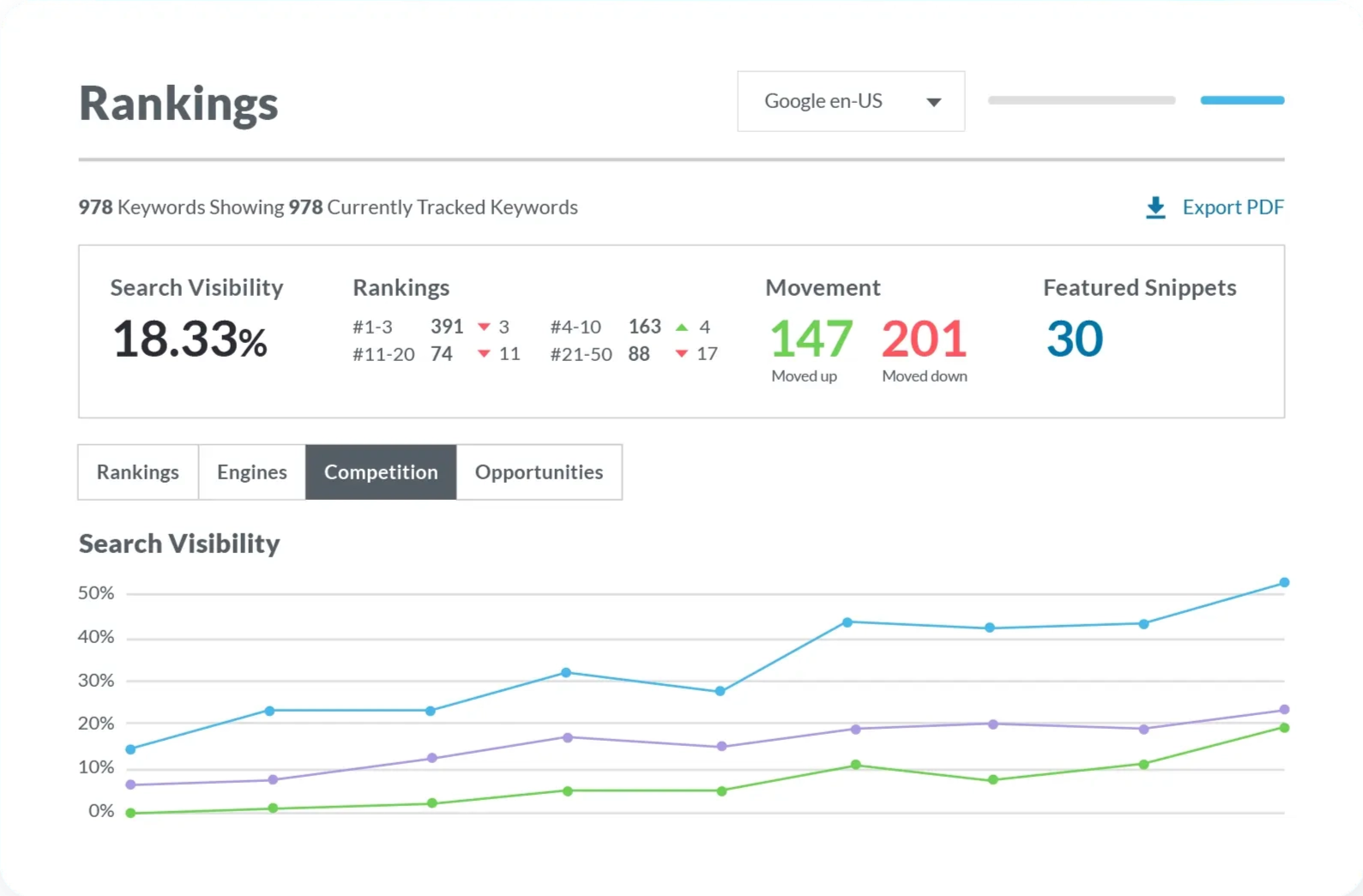
Moz has always been the more accessible alternative to Semrush and Ahrefs. It has a cleaner interface, a gentler learning curve, and is historically strong on local SEO. For small businesses serving a local market, Moz Pro's local search features and Google Business Profile integration are genuinely useful.
What's newer and worth noting is Moz's push into GEO (Generative Engine Optimization). From the Medium plan up, you get AI Visibility Dashboards that track how your brand appears in ChatGPT and Gemini responses, plus tracked prompts and AI Content Briefs.
For small businesses starting to think about visibility in AI-powered search, this is ahead of where most competitors are.
Notable Features
Keyword research: Solid keyword explorer with difficulty scores, opportunity ratings, and SERP analysis.
Rank tracking: Tracks up to 300 keywords on Standard, 1,500 on Medium, with location-specific tracking.
Site audit: Crawls your site for technical issues with prioritized recommendations.
Local SEO tools: Google Business Profile integration, local rank tracking, and citation management, making it strong for location-based businesses.
GEO tracking (Medium and above): AI Visibility Dashboards, tracked prompts across ChatGPT and Gemini, and AI Content Briefs for optimizing visibility in AI-powered search results.
Pros and Cons
Pros | Cons |
|---|---|
✅ Most beginner-friendly major SEO tool | ❌ GEO features only unlock from Medium ($179/mo.) upward |
✅ GEO tracking is genuinely ahead of most competitors | ❌ Backlink database smaller than Ahrefs |
✅ Strong local SEO and Google Business Profile tools | ❌ Standard plan limits are quite tight — 300 keywords, 3 sites |
✅ 30-day free trial on Medium plan | ❌ Research only — no execution or content creation |
Pricing
Plan | Monthly Price | Perks |
|---|---|---|
Standard | $99/mo. | 1 user, 3 sites, 300 tracked keywords, 400K pages crawled. Core SEO features only |
Medium | $179/mo. | 2 users, 10 sites, 1,500 keyword. Unlocks AI Visibility, 100 tracked AI prompts, AI Content Briefs |
Large | $299/mo. | 3 users, 25 sites, 3,000 keywords. 200 tracked prompts, 50 AI Content Briefs |
📌 Moz Pro is the right starting point if you’re new to SEO tools or if local search visibility is your primary concern. The Standard plan is accessible, and the GEO tracking features at Medium are worth the upgrade if AI search visibility matters to your business.
5. Mangools — Best Budget-Friendly SEO Toolkit
Mangools bundles five solid SEO tools at a price that makes professional-grade research accessible to very small teams, and every plan includes AI search monitoring.
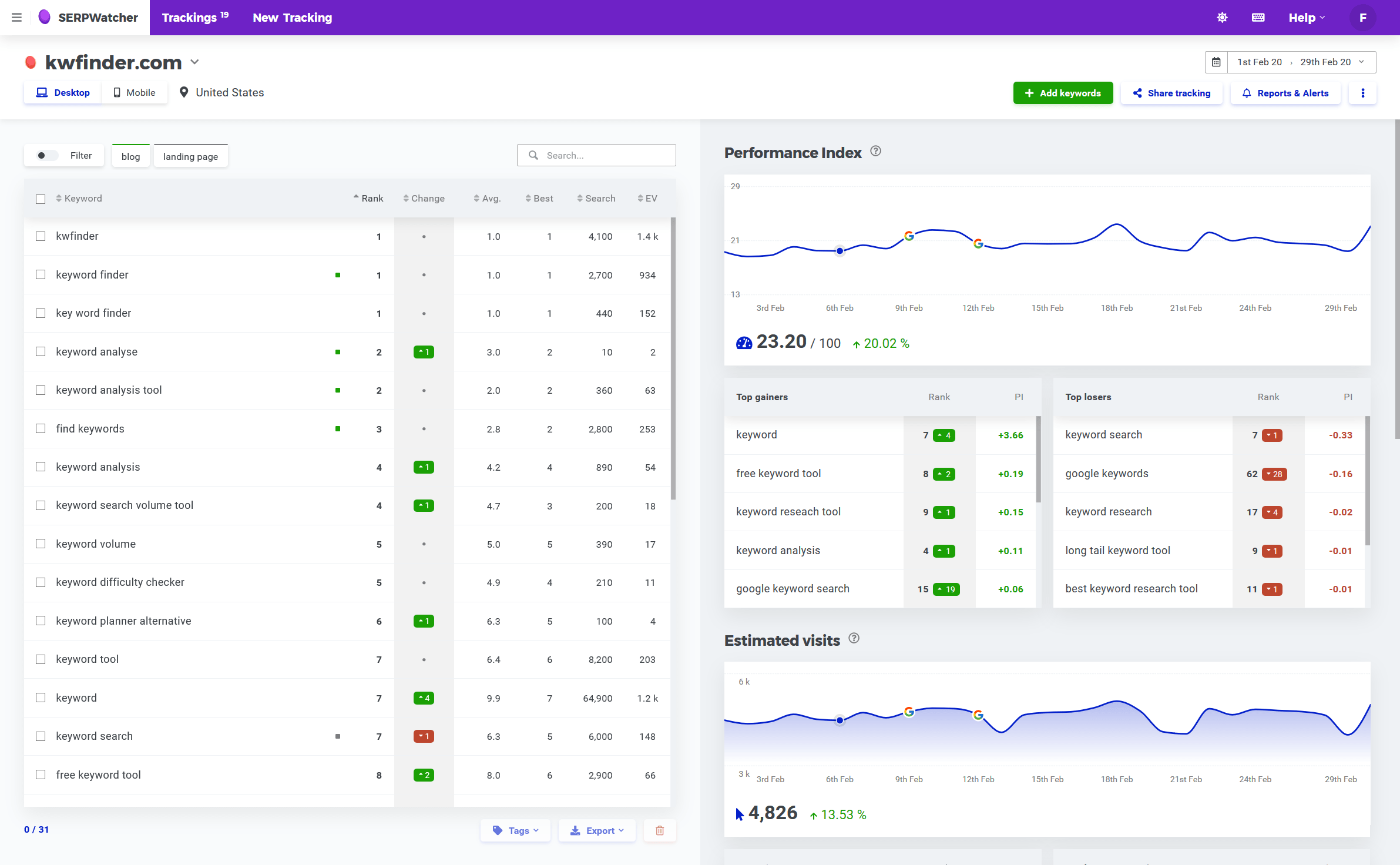
The five tools it offers are the following:
KWFinder (keyword research),
SERPChecker (SERP analysis),
SERPWwatcher (rank tracking),
LinkMiner (backlink analysis), and
SiteProfiler (domain overview)
The plans start at $30.50/mo. For a small business or solo operator who needs a complete SEO toolkit without paying Semrush prices, the value is hard to argue with.
Every Mangools plan also includes AI Search Watcher PRO, which monitors 500 prompts across ChatGPT, Claude, Gemini, and other LLMs. For a tool at this price point, that’s a meaningful addition. Most competitors charge significantly more for similar GEO monitoring capabilities.
Notable Features
KWFinder: Clean, intuitive keyword research with difficulty scores that many users find more accurate than larger platforms.
Rank tracking: 200 tracked keywords on Basic, 700 on Premium. It’s solid for most small business use cases.
AI Search Watcher PRO (included on all plans): Monitors 500 prompts across ChatGPT, Claude, Gemini, and more at an impressive price point.
Backlink analysis: 100K backlinks per month on Basic, 500K on Premium. It’s lighter than Ahrefs but functional for most SMB needs.
Clean interface: Consistently praised in user reviews for being the most approachable tool in its category.
Pros and Cons
Pros | Cons |
|---|---|
✅ Most affordable complete SEO toolkit on this list | ❌ Smaller keyword database than enterprise tools |
✅ No extra seats on Basic — solo users only | ❌ Lighter on raw data volume than Semrush or Ahrefs |
✅ AI Search Watcher PRO included on every plan | |
✅ Clean, intuitive interface — beginner-friendly |
Pricing
Plan | Monthly Price | Perks |
|---|---|---|
Basic | $30.50/mo. | 1 user, 100 keyword research req/24h, 200 tracked keywords, 100K backlinks/mo., AI Search Watcher PRO |
Premium | $40.50/mo. | 3 extra seats, 500 keyword req/24h, 700 tracked keywords, 500K backlinks/mo., AI Search Watcher PRO |
Agency | $70.50/mo. | 5 extra seats, 1,200 keyword req/24h, 1,500 tracked keywords, 1.2M backlinks/mo., AI Search Watcher PRO |
📌 Mangools is the best value SEO toolkit for small businesses that need more than Ubersuggest but can't justify Semrush or Ahrefs prices. The AI Search Watcher inclusion makes it particularly good value for businesses starting to monitor their visibility in AI-powered search.
6. Ubersuggest — Best for Budget-Conscious Solo Owners
Ubersuggest is the most affordable entry point on this list. It’s a solid starting tool for single-site owners and small businesses just getting started with SEO.
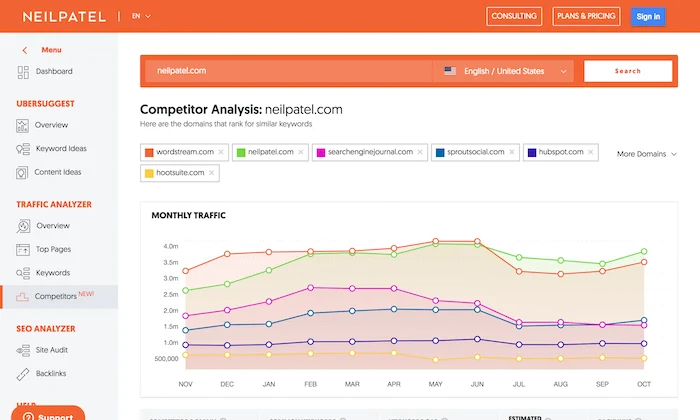
Neil Patel's Ubersuggest is designed for the absolute beginning of the SEO journey. At $12/mo. for the Individual plan (or $120 for a lifetime license), it covers keyword research, rank tracking, site audits, and basic competitor analysis at a price almost any business can absorb. All plans include ChatGPT and Gemini AI features, which is a genuine addition at this price tier.
Trade-offs exist, however. Ubersuggest's keyword database and backlink data are lighter than Mangools, let alone Semrush or Ahrefs. The search limits (150 searches per day on Individual) can feel restrictive once you're doing regular research.
But as a starting point for a business that's never used an SEO tool before, it's an accessible and honest choice.
Notable Features
Keyword research: Solid for finding keyword ideas and checking difficulty, but note the limited volume compared to larger platforms.
Site audit: Up to 1,000 page scans per domain on Individual, with actionable issue reports.
Rank tracking: 125 tracked keywords on Individual. It’s enough for a focused small business SEO campaign.
AI features (all plans): AI Topics, AI prompt ideas, and ChatGPT/Gemini integration included across all tiers.
Competitor tracking: 5 competitors per domain on Individual, which is useful for keeping an eye on the local competition.
Pros and Cons
Pros | Cons |
|---|---|
✅ Cheapest paid plan on this list at $12/mo. | ❌ Search limits feel restrictive for active research (150/day on Individual) |
✅ AI features included on all plans | ❌ Lighter keyword database than Mangools or larger tools |
Pricing
Plan | Monthly Price | Lifetime Price | Perks |
|---|---|---|---|
Individual | $12/mo. | $120 | 1 user, 1 domain, 125 tracked keywords, 1,000 page scans, 5 competitors, 150 searches/day |
Business | $20/mo. | $200 | 2 users, 7 domains, 150 tracked keywords, 5,000 page scans, 10 competitors, 300 searches/day |
Enterprise | $40/mo. | $400 | 5 users, 15 domains, 300 tracked keywords, 10,000 page scans, 15 competitors, 900 searches/day |
📌 Ubersuggest is the right starting point if you’ve never paid for an SEO tool before. Once you’ve outgrown the search limits or need deeper backlink analysis, Mangools is the natural next step without a significant price jump.
Which SEO Tool Is Right for Your Business?
Not sure which tool among these is right for your business? We’ve created a quick decision matrix for you.
Your situation | Best choice |
|---|---|
You want SEO done for you (audits, content, and tracking) without doing it yourself | Zaturn (Alex) — $69/mo. |
You're serious about competitive research and can justify the price | Semrush — $199/mo. |
Backlink analysis is central to your SEO strategy | Ahrefs Lite — $129/mo. |
You're new to SEO or run a local business that needs local search focus | Moz Pro Standard — $99/mo. |
You need a complete toolkit at an affordable price | Mangools Basic — $30.50/mo. |
You're just getting started and want the lowest possible entry point | Ubersuggest Individual — $12/mo. |
You want research depth plus automated execution | Semrush or Ahrefs + Zaturn |
You need to monitor AI search visibility on a budget | Mangools (AI Search Watcher included) |
Before You Start: Set Up Google Search Console
Google Search Console (GSC) is free, provided by Google, and gives you the most accurate data available about how your site performs in search: clicks, impressions, average position, and the exact queries bringing people to your pages.
No paid tool can replicate first-party Google data. Semrush and Ahrefs estimate traffic; GSC shows you the actual numbers. Before you spend anything on an SEO tool, GSC should be set up and verified on your site.
Try Zaturn's Alex free for 14 days—no credit card is required. Connect your Google Search Console, tell Alex what you want to rank for, and have your first site audit and optimized blog post ready to review in your first session.