AI Marketing Platform: How to Choose One and the Best Options For SMEs (2026)
An AI marketing platform schedules posts, executes campaigns, manages ads, and tracks performance across channels. Here's how to find one for your business.
Most small businesses using AI for marketing are using the wrong kind. They have a tool that writes captions and schedules posts, and they call it “done.” But those are AI tools, not AI marketing platforms.
The difference matters a lot, and it’s costing businesses hours every week and results they should already be getting. A true AI marketing platform doesn’t just help; it executes. It posts content launches campaigns, updates SEO, and sends emails, all tracked in one place.
For an SME owner or solopreneur, that’s the difference between having a tool and having a marketing team. This guide will show you how to pick the right AI marketing platform for your business needs.
What Is an AI Marketing Platform?
An AI marketing platform is a system that plans, executes, and optimizes marketing campaigns across multiple channels automatically and on your behalf.

It connects directly to the platforms where your marketing lives (social media, ad networks, email tools, and search consoles) and takes real actions, not just suggestions.
That’s the key word: actions. Not drafts sitting in a queue. Not recommendations waiting for you to act on them. The platform actually publishes, launches, adjusts, and reports with your approval before anything goes live.
What Does an AI Marketing Platform Do?
What separates an AI marketing platform from a simple AI tool are the following functionalities:
Publishing content across social channels (LinkedIn, Instagram, Facebook, and TikTok) directly from the platform.
Launching and managing ad campaigns on Google Ads and Meta Ads without you logging into each separately.
Handling SEO tasks like updating metadata, monitoring rankings, and flagging opportunities through Google Search Console and Analytics.
Sending email campaigns via connected tools like Mailchimp or Brevo.
Tracking performance across all of the above in one unified dashboard.
According to McKinsey, AI adoption in marketing and sales functions is producing some of the most measurable productivity gains of any business area, with organizations reporting 15–40% improvements in efficiency when AI moves from assisting to executing.
Pro Tip: The easiest way to tell if something is a real AI marketing platform is to ask whether it can take an action on an external platform (post, launch, or send) on your behalf or whether it only creates content for you to do that yourself. Most tools fall into the second category.
What Is the Difference Between an AI Tool, AI Software, and an AI Marketing Platform?
These three terms get used interchangeably, but they describe very different things.

Here’s how to tell them apart:
AI Tool | AI Marketing Software | AI Marketing Platform | |
|---|---|---|---|
What it does | Generates content (copy, images, ideas) | Automates specific marketing tasks | Executes full marketing operations across channels |
Who acts on it | You do, manually | Partly automated, partly manual | The platform acts on your behalf, with approval |
Channel coverage | Usually one (e.g. writing) | One or two channels | Multi-channel: social, ads, SEO, email |
Connected to platforms? | ❌ No direct integrations | ⚠️ Limited integrations | ✅ Direct integrations with live platforms |
Best for | Content creation tasks | Specific automation needs | Running your full marketing operation |
Examples | ChatGPT, Canva AI | Mailchimp automation, Buffer | Zaturn AI |
Most “AI marketing tools” on the market today are firmly in the first or second column. True AI platforms in the third column are still relatively rare, which is why choosing carefully matters.
Pro Tip: When vendors say their tool “uses AI,” they often mean it has a GPT-powered writing feature added on top of an existing scheduler. That’s not a platform; it’s a feature update. Look for platforms where AI is the primary operating logic, not a bolt-on.
What Should You Look for in an AI Marketing Platform?
Not all platforms are equal, and the wrong choice wastes both money and time.

Here are the factors that separate platforms worth paying for from ones that overpromise:
1. Does It Actually Execute, or Just Suggest?
The most important question is whether the platform acts on your behalf (publishing posts, launching ads, sending emails, etc.). This saves dramatically more time than one that generates content for you to post yourself.
Look for direct integrations with ad networks, social platforms, and email tools, not just a content editor.
2. How Many Channels Does It Cover?
Single-channel tools are easy to find. Platforms that handle social, paid ads, SEO, and email under one roof are much rarer (and much more valuable). Every channel you manage separately is another login, another dashboard, and another set of reports to reconcile.
Look for these important integrations:
Social Media | Paid Advertising | SEO | |
|---|---|---|---|
Google Ads | Mailchimp | Google Search Console | |
Meta Ads | Brevo | Google Analytics | |
LinkedIn Ads | Gmail | CMS Integrations (WordPress, Shopify, Webflow) | |
TikTok | TikTok Ads | Outlook |
Pro Tip: Multichannel platforms compound in value over time. The more channels the AI has visibility into, the better it gets at understanding what’s working and why. Single-channel tools can’t replicate this.
3. Can You Stay in Control?
Autonomous execution is only useful if you trust what’s going out. Look for platforms with approval workflows, where the AI proposes and you confirm before anything goes live.
This is the feature most solopreneurs and SME owners actually need, and it’s surprisingly uncommon in tools that market themselves as “automated.”
4. Does It Understand Your Brand?
AI that doesn’t know your business generates generic content. The best platforms give you a way to upload brand assets, tone guidelines, audience details, and business context and use that information across every piece of content and campaign they produce.
Zaturn’s Intelligence Hub does exactly this: it acts as a central workspace where everything the platform needs to represent your brand accurately is stored and applied consistently across all six AI marketing assistants.
5. Is the Pricing Model Honest?
Some platforms charge per seat, per contact, per credit, or per channel. These costs escalate fast. Look for transparent pricing that reflects how your business actually uses the platform. A solopreneur running three social channels and one email list shouldn’t be paying enterprise-tier rates.
Here’s what to pay attention to:
Check whether the plan includes actual execution (posting and launching) or just content generation.
Watch for platforms that charge separately for analytics, integrations, or additional users.
Free trials are standard; use them with real campaigns, not test content.
Pro Tip: Before signing up for any platform, run this test: try to get it to actually post something to one of your social profiles or send a real email. If that requires jumping through hoops or isn’t possible on the trial, that tells you everything about how autonomous it really is.
What Are the Best AI Marketing Platforms for SMEs?
These are the AI marketing platforms worth evaluating in 2026, based on what they actually do (not just what they claim). For a full breakdown of each, including detailed feature lists, pros, cons, and pricing, see our AI marketing guide.
Platform | Primary Focus | Autonomous Execution | Best For |
|---|---|---|---|
Zaturn AI | 6 specialized AI Marketing Assistants (social, ads, SEO, email, website, assistant) | ✅ Yes | SMEs wanting a full AI marketing team with direct platform execution |
Sintra AI | Broad AI workforce (multiple business functions) | ⚠️ Partial | Multi-function AI across business areas |
Blaze | Email, SMS, social segmentation and personalization | ⚠️ Partial (✅ on Done-For-You plans) | Complex, audience-segmented campaigns |
HubSpot Marketing Hub | AI inside a full CRM | ⚠️ Partial | CRM-connected marketing automation |
Jasper | Full content lifecycle, including pipelines, agents, brand intelligence | ⚠️ Partial | Marketing teams needing scalable, brand-consistent content |
1. Zaturn AI - Best for SMEs Wanting Full Execution Across All Channels
Zaturn offers 6 specialized AI marketing assistants that take direct actions on connected platforms, with user approval on every step. It’s the closest thing to an actual AI marketing team available to SMEs.
Its six assistants connect directly to the platforms they specialize in. Chloe posts to Instagram, LinkedIn, and TikTok; Gabriel launches campaigns on Google Ads and Meta; and Emma sends emails via Mailchimp or Brevo. All of this happens with your approval before it goes live.
The Intelligence Hub stores brand context centrally, so every assistant works with the same understanding of your business. The Calendar View gives a unified timeline of all marketing activity across every channel, something that typically requires a dedicated analyst to piece together.
→ Zaturn AI starts at $69/mo for the Starter plan.
2. Sintra AI - Best for Businesses That Need AI Across Multiple Functions
Sintra AI unleashes a broad AI workforce covering marketing, operations, and customer support. It’s good if marketing isn’t your only pain point.
The platform covers more ground than a dedicated marketing platform, which is both its strength and its trade-off. Marketing is one of several functions rather than the primary focus, so the depth you get in social algorithms and optimization isn’t quite what a specialized platform delivers.
But if you need AI assistance across your whole business, Sintra makes that easier without managing multiple tools.
→ Sintra AI starts at $97/mo for the 1-month plan. However, longer commitments bring the monthly cost down to $52/mo (12-month plan).
3. Blaze - Best for Teams Running Complex Segmented Campaigns
Blaze offers strong multichannel campaign management with advanced segmentation. Done-For-You plans add a human strategist for full execution.
The platform’s strength is audience segmentation and personalization. It’s built for businesses managing different messaging for different audience segments across email, SMS, and social.
The self-serve plans require more manual setup than agent-based platforms, but the Done-For-You plans (where a human strategist handles execution alongside the AI) make it a genuinely autonomous option for businesses that can afford it.
→ Blaze’s DIY plans start at $69/mo. Done-For-You plans start from $999/mo but require a 6-month commitment at minimum.
4. HubSpot Marketing Hub - Best for Businesses Using HubSpot
HubSpot’s Marketing Hub is a full CRM with built-in AI marketing features. It’s powerful if you’re already a HubSpot customer but hard to justify if you’re not.
The platform connects marketing directly to CRM data, so campaigns are informed by exactly where contacts are in the sales pipeline. That’s a genuine advantage for businesses with complex sales cycles.
But the cost escalates quickly (the Professional plan starts at $1,000/mo, plus a mandatory $3,000 onboarding fee), and for businesses without a CRM need, most of that value disappears.
→ HubSpot’s Marketing Hub starts at $1,000/mo for the Professional plan. The Enterprise plan starts from $3,800/mo. A mandatory, one-time $3,000 fee for professional onboarding is required.
5. Jasper - Best for Marketing Teams That Prioritize Content Volume
Jasper is a comprehensive content platform with pipelines, brand intelligence, and agents. It’s built for teams producing content at scale.
The platform has evolved well beyond an AI writing tool. Its Content Pipelines system connects data, creativity, and distribution in one workflow, powered by five components:
Agents (autonomous execution)
Studio (no-code AI app builder)
Canvas (collaborative workspace)
Grid (spreadsheet-style content production)
Image Suite (on-brand visual generation)
Jasper IQ stores brand voice, visual guidelines, and marketing context so everything the platform produces stays consistent.
Where Jasper differs from Zaturn is scope: it's primarily a content execution platform, not a full-channel marketing operator. It doesn't manage ad campaigns or take direct actions on ad platforms. For content-heavy marketing teams, that's fine. For SMEs that also need ads, SEO, and email handled in the same place, it's a gap.
→ Jasper’s Pro plan starts at $69/mo per seat. Business pricing is available upon request.
How Does an AI Marketing Platform Compare to an Agency or Freelancer?
Cost is one of the clearest arguments for AI marketing platforms, but only when you look at what you’re actually getting for the price.
Option | Typical Monthly Cost | What's Included | Scalability |
|---|---|---|---|
Full-service marketing agency | $5,000–$20,000+ | Broad team across channels | Limited by retainer scope |
In-house marketing hire | $3,500–$8,000+ | One specialist | Scales with headcount |
Freelancers (per function) | $1,000–$5,000+ | Narrow, project-based | Inconsistent |
Zaturn AI (Starter) | $69/month | 6 AI assistants across 6 channels | Unlimited within plan limits |
Zaturn AI (Growth) | $129/month | 6 AI assistants + advanced analytics | 150 social posts, 10 ad campaigns/mo |
The comparison isn’t quite apples to apples because a good agency brings strategic thinking that AI platforms don’t fully replicate yet. However, for businesses that need consistent execution across social, ads, SEO, and email, a platform like Zaturn delivers 80–90% of that execution capacity at roughly 1–2% of the agency cost.
The hidden cost of not using a platform: most SMEs spending 10+ hours per week on marketing tasks aren’t accounting for the opportunity cost of that time. At even a modest hourly rate, that’s often $1,500–$3,000/mo in founder time being spent on execution rather than growth.
Is an AI Marketing Platform Right for Your Business?
The honest answer is that it depends on where you are and what you actually need. Here’s a quick way to think about it:
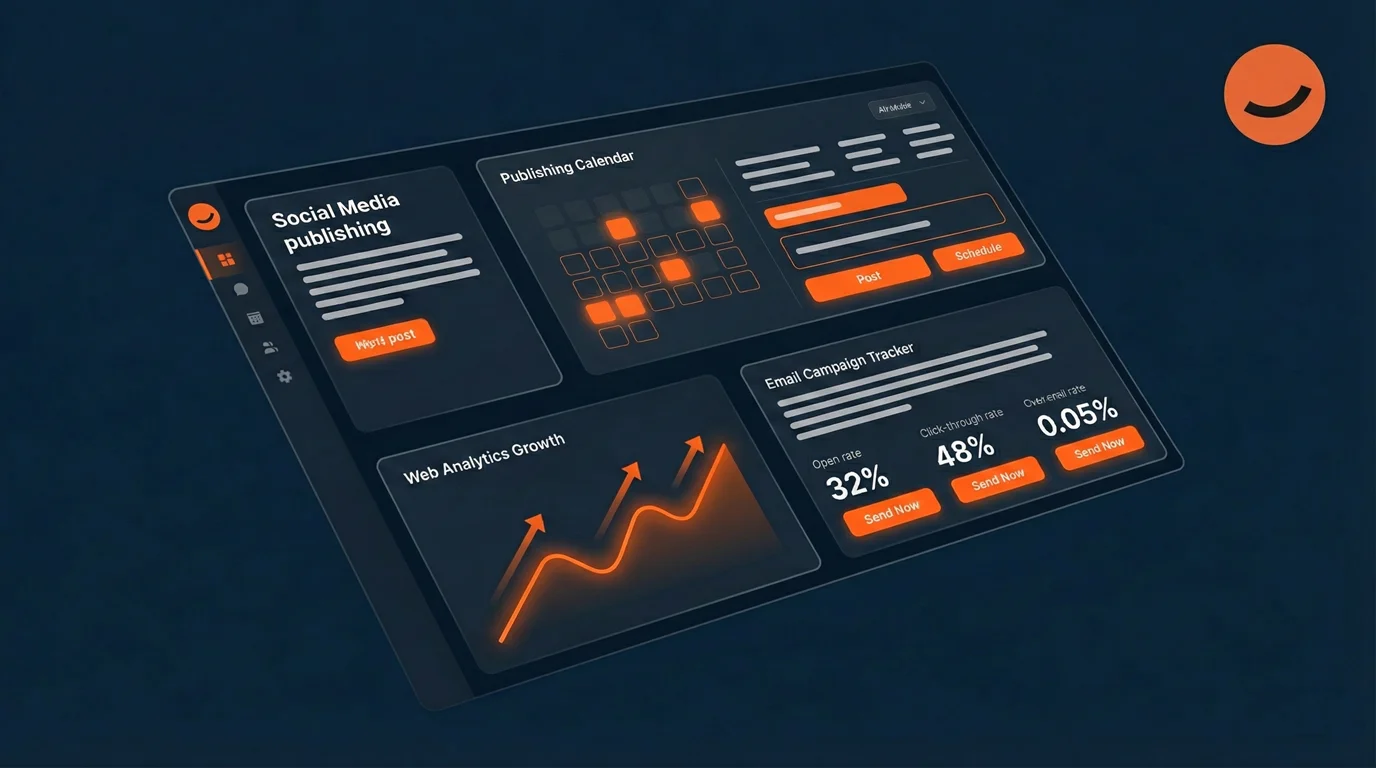
An AI marketing platform is a strong fit if:
You’re spending 6+ hours a week on marketing tasks you’d rather delegate.
You’re posting inconsistently because you don’t have time to be consistent.
You’re paying an agency or multiple freelancers and wondering if you’re getting value.
You want to run ads, social, email, and SEO but don’t have specialists for each.
You want full visibility over your marketing without logging into five different dashboards.
It might not be the right time if:
You don’t have a clear brand voice or strategy yet. AI amplifies what’s there; it doesn’t create it from scratch.
Your business is in a highly regulated industry where every piece of content needs legal review before publishing.
You’re pre-revenue and need strategy help, not execution help.
For most SMEs and solopreneurs who are past that foundation stage, the question isn’t really whether a platform makes sense. It’s about which one fits their specific channels, budget, and need for control.
Pro Tip: The businesses that get the most out of AI marketing platforms are the ones that come in with clarity (a defined audience, a clear offer, and at least a rough sense of their brand voice). The platform handles the execution; the human still needs to own the strategy.
The Bottom Line
Most AI marketing platforms on the market are tools dressed up as something bigger. A real platform executes; it connects to the places where your marketing actually lives and takes action there, with you staying in control of what goes out.
For SMEs and solopreneurs who need consistent marketing across multiple channels without the agency bill, Zaturn AI’s six specialized AI marketing assistants are built precisely for that: real actions, real channels, and approval at every step.
Ready to see what a real AI marketing platform looks like in practice? Try Zaturn and run your first AI-powered campaign, no agency required.