AI Marketing: What It Is, How It Works, and the Best Tools for SMEs
AI marketing automates campaigns, cuts costs, and drives results. Learn how SMEs and solopreneurs use AI marketing assistants to compete without agency budgets.
Most SMEs know they should be marketing more. They also know they don’t have the time, the budget, or a full team to make it happen consistently.
AI marketing exists to close that gap, and it goes well beyond scheduling posts or generating captions. Today’s AI marketing assistants plan campaigns, launch ads, post across channels, and track performance, all on your behalf.
This guide breaks down what AI marketing actually is, how it works under the hood, and which platforms are genuinely built for growing businesses rather than enterprise teams with six-figure tech budgets.
What Is AI Marketing?
AI marketing uses machine learning and predictive analytics to automate everything from generating social content to adjusting ad bids in real time.
But the distinction that matters is between tools that assist and tools that act. Most people assume marketing automation stops at scheduling: you write the post, set the time, and the tool publishes it. That’s not AI marketing.
True AI platforms make decisions and execute campaigns on your behalf based on live audience signals.
→ This shift from “assist” to “act” is exactly why McKinsey reports productivity improvements of up to 15% for marketing teams adopting generative AI.
In short, AI marketing doesn’t replace what makes your brand worth following. It removes the grind that keeps you from showing up consistently.
Why AI Marketing Matters More for SMEs Than Anyone Else
Large enterprises have entire marketing departments. They have paid specialists for SEO, social media managers, ad buyers, email strategists, and analysts. For them, AI is an efficiency gain on top of an already-functioning machine.
For an SME owner or solopreneur, the math is different: it’s about access. The challenges are real and specific:
Time: According to Social Media Examiner, over 58% of marketers spend at least 6 hours per week on social media marketing alone, and 34% spend more than 11 hours. For a founder also handling sales, operations, and clients, that’s time that simply doesn’t exist.
Cost: Full-service marketing agency retainers typically run $5,000 to $20,000 per month. An in-house marketing hire adds $3,500 to $8,000 per month in salary alone before benefits or management overhead.
Skill gaps: Deep expertise in paid advertising, SEO, email deliverability, and analytics isn’t something most founders naturally carry, and hiring for each specialization separately isn’t realistic at the SME level.
Inconsistency: When marketing depends on finding time and headspace between everything else, it gets irregular. Consistent posting drives 5x more engagement compared to sporadic activity, but “consistent” is exactly what breaks down first under pressure.
AI marketing platforms give SMEs access to a full marketing function (social, ads, SEO, and email) at a fraction of what a single agency contract costs.
How AI Marketing Actually Works
Understanding AI marketing means looking beyond the surface features. Here’s what’s happening across the primary functions:
Content Creation
AI systems trained on large language models can generate platform-appropriate content (social posts, ad copy, email sequences, and blog drafts) at scale. Good AI marketing tools factor in brand voice, audience, platform norms, and content goals.
→ Instead of spending two hours writing five LinkedIn posts, a marketer can produce a week’s worth of content in minutes, review and approve what resonates, and let the assistant handle publishing.
Predictive Analytics and Audience Targeting
AI analyzes historical campaign data to predict which audience segments are most likely to convert, at what time, and with what messaging. This moves targeting from educated guesswork to data-informed decisions.
Platforms that integrate with ad accounts and CRM data can continuously refine targeting as new performance signals come in.
→ The results compound over time: Most marketers now use AI for audience segmentation, but the execution gap remains. Many still copy recommendations back into ad platforms manually.
→ The platforms that close that gap, that act on insights rather than just surface them, are where the real gains live.
Autonomous Campaign Execution
This is where the generation of AI marketing tools diverges sharply.
→ Scheduling tools post content you’ve already created.
→ AI marketing assistants go further: they draft, optimize, and with your approval, launch ad campaigns, adjust bids, and respond to performance data in real time.
Zaturn’s AI marketing assistants, for example, take direct actions on connected platforms: posting to social channels, launching campaigns on Facebook and Google Ads, and updating SEO configurations, all based on briefings and approvals from the user.
You retain the option to review all major actions before they go live, which adds a quality layer that pure automation can’t replicate.
Performance Tracking and Optimization
AI marketing platforms run campaigns and measure and adapt. Built-in analytics dashboards track results across channels in real time, with visualization tools that make it easy to see what’s working without logging into five separate dashboards.
Zaturn’s Calendar view, for example, gives a single-screen overview of every marketing action taken across all channels. That level of clarity typically requires a dedicated analyst to assemble.
The 5 Best AI Marketing Tools for SMEs
Not every AI marketing platform is built with SMEs in mind. Some are enterprise-heavy, some are narrow in scope, and some are scheduling tools dressed up as AI. Here’s a quick comparison between the leading options:
Platform | Primary Focus | Autonomous Execution | Best For |
|---|---|---|---|
Zaturn AI | 6 specialized AI marketing assistants (social, ads, SEO, email, website, assistant) | ✅ Yes | SMEs wanting a full AI marketing team with direct platform execution |
Sintra AI | Broad AI workforce (multiple business functions) | ⚠️ Partial | Multi-function AI across business areas |
Blaze | Email, SMS, social, and segmentation and personalization | ✅ Done for You Plans | Complex, audience-segmented campaigns |
HubSpot Marketing Hub | AI inside a full CRM | ⚠️ Partial | CRM-connected marketing automation |
Jasper | Full content lifecycle, including pipelines, agents, brand intelligence, and image generation | ⚠️ Partial | Marketing teams needing scalable, brand-consistent content at the enterprise level |
…And here’s an honest look at each:
1. Zaturn AI
Zaturn AI offers purpose-built AI marketing assistants for social media, advertising, SEO, email, and more, with full user control over every action before it goes live.
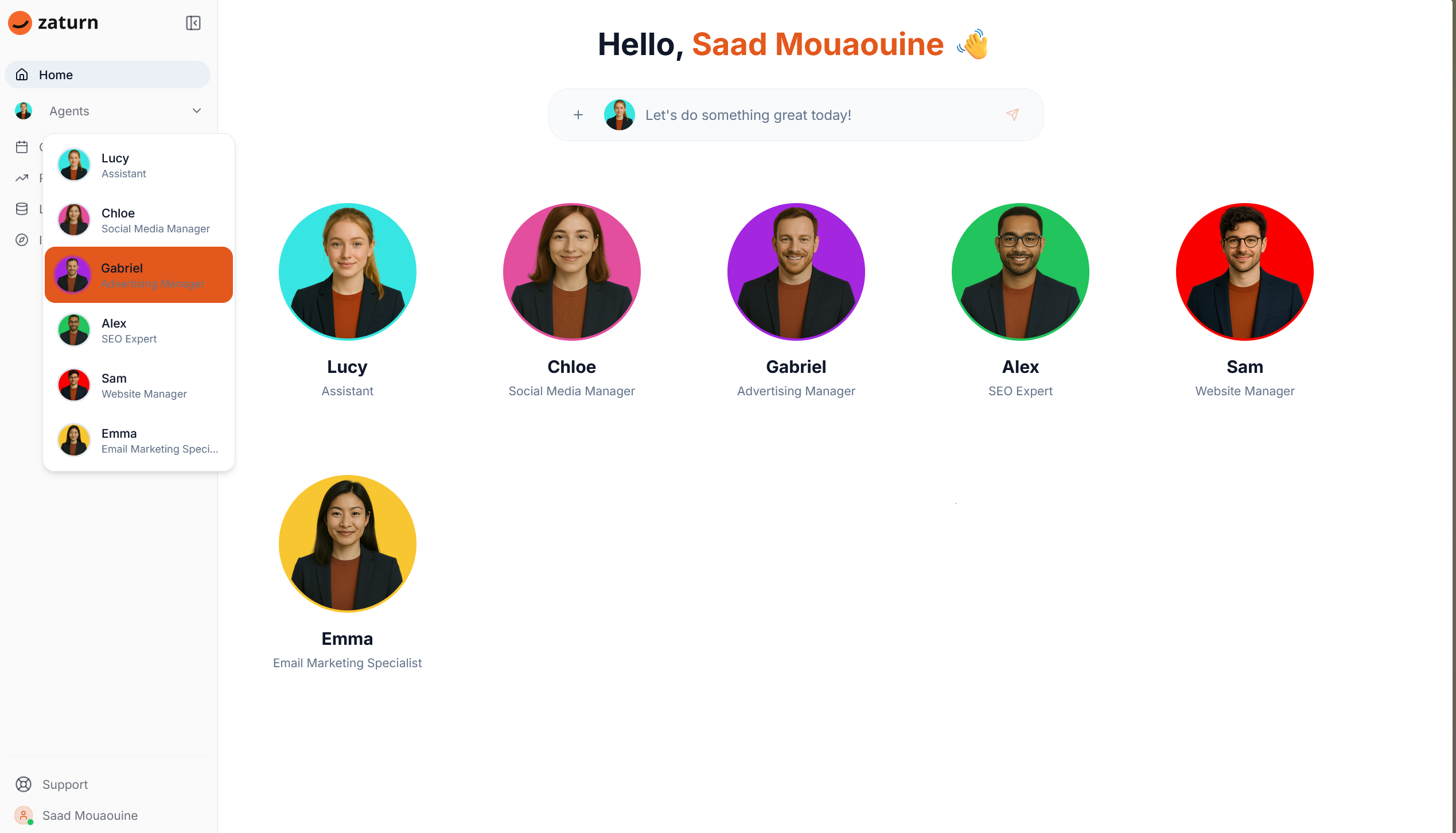
Zaturn is built specifically for the SME and solopreneur market. Rather than offering a broad AI platform that handles a bit of everything, it deploys 6 specialized AI marketing assistants (general assistant, social media, advertising, SEO, website, and email marketing) that take direct actions on connected platforms on the user’s behalf.
Think of them less as content tools and more as colleagues who handle execution while you focus on the business. Before any action goes live, whether it’s a post to Instagram or an ad campaign on Google, the user reviews and approves it.
The Intelligence Hub centralizes brand assets, project briefs, website links, and tool integrations, giving every assistant the context it needs to produce relevant, consistent work across all channels.
Notable Features
6 specialized AI marketing assistants: Lucy (assistant), Chloe (social media), Gabriel (ads), Alex (SEO), Sam (website), and Emma (email).
Assistants take direct actions on platforms (post, launch, and optimize) after user approval.
Connects to Facebook, Instagram, LinkedIn, TikTok, Google Ads, Meta Ads, Google Analytics, Search Console, Mailchimp, and more.
Intelligence Hub: A centralized workspace for brand assets, campaign files, and tool integrations.
Calendar view for a single-screen overview of all marketing activity across channels.
Content Library keeping all created assets organized in one place.
Integrated analytics dashboard tracking real-time performance across all channels.
Pros and Cons
✅ Full execution across 6 channels in one platform
✅ User controls every approval; nothing goes live without sign-off
✅ Purpose-built for SMEs and solopreneurs, not a scaled-down enterprise tool
✅ Calendar view gives rare all-channel visibility on one screen
❌ Newer platform, meaning fewer third-party integrations than established tools
Pricing
Starter ($69/mo) | Growth ($129/mo) | Custom |
|---|---|---|
6 AI Agents | 6 AI Agents | 6 AI Agents |
50 social posts/month | 150 social posts/month | Unlimited posts |
2 ad campaigns | 10 ad campaigns | Unlimited ad campaigns |
5 email sequences | Unlimited email sequences | Multi-brand engagement |
Basic analytics | Advanced analytics and reporting | Dedicated success manager |
2. Sintra AI
Sintra AI offers a broad AI workforce covering multiple business functions, with marketing as one of several areas.
Rating: ★★★★☆ (Trustpilot: 4.5/5 - 7,800+)
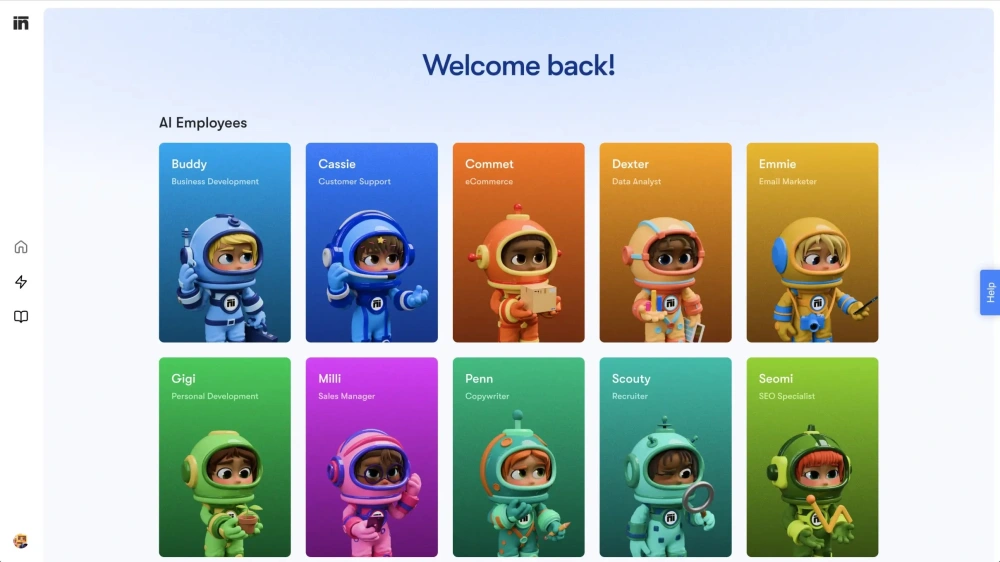
Sintra AI positions itself as a general-purpose AI workforce, covering marketing alongside operations, customer support, and other business areas. For businesses that want a single AI system managing multiple departments, it’s a viable choice.
The trade-off is depth: because marketing is one of several functions rather than the primary focus, the specialization that drives real campaign performance (the kind built around social algorithms, ad auction dynamics, or email deliverability) is less pronounced.
Notable Features
AI assistants across marketing, operations, personal development, SEO, customer support, and more.
Content creation for social media, email, and ad copy.
Single platform for multiple business areas, which reduces the need for separate tools.
Pros and Cons
✅ Covers multiple business functions, not just marketing
✅ Good fit if you want one AI platform across the whole business
❌ Marketing specialization is shallower than dedicated platforms
❌ Less suited to businesses where marketing performance is the primary goal
Pricing
1-Month ($97/mo) | 3-Month ($59/mo) | 12-Month ($52/mo) |
|---|---|---|
All 12 helpers | All 12 helpers | All 12 helpers |
250 monthly credits | 250 monthly credits | 250 monthly credits |
15+ integrations | 15+ integrations | 15+ integrations |
24/7 support | 24/7 support | 24/7 support |
3. Blaze
Blaze is a multichannel marketing suite with strong audience segmentation and personalization. It’s best for teams running complex campaigns.
Rating: ★★★★☆ (G2: 4.6/5 - 140+)
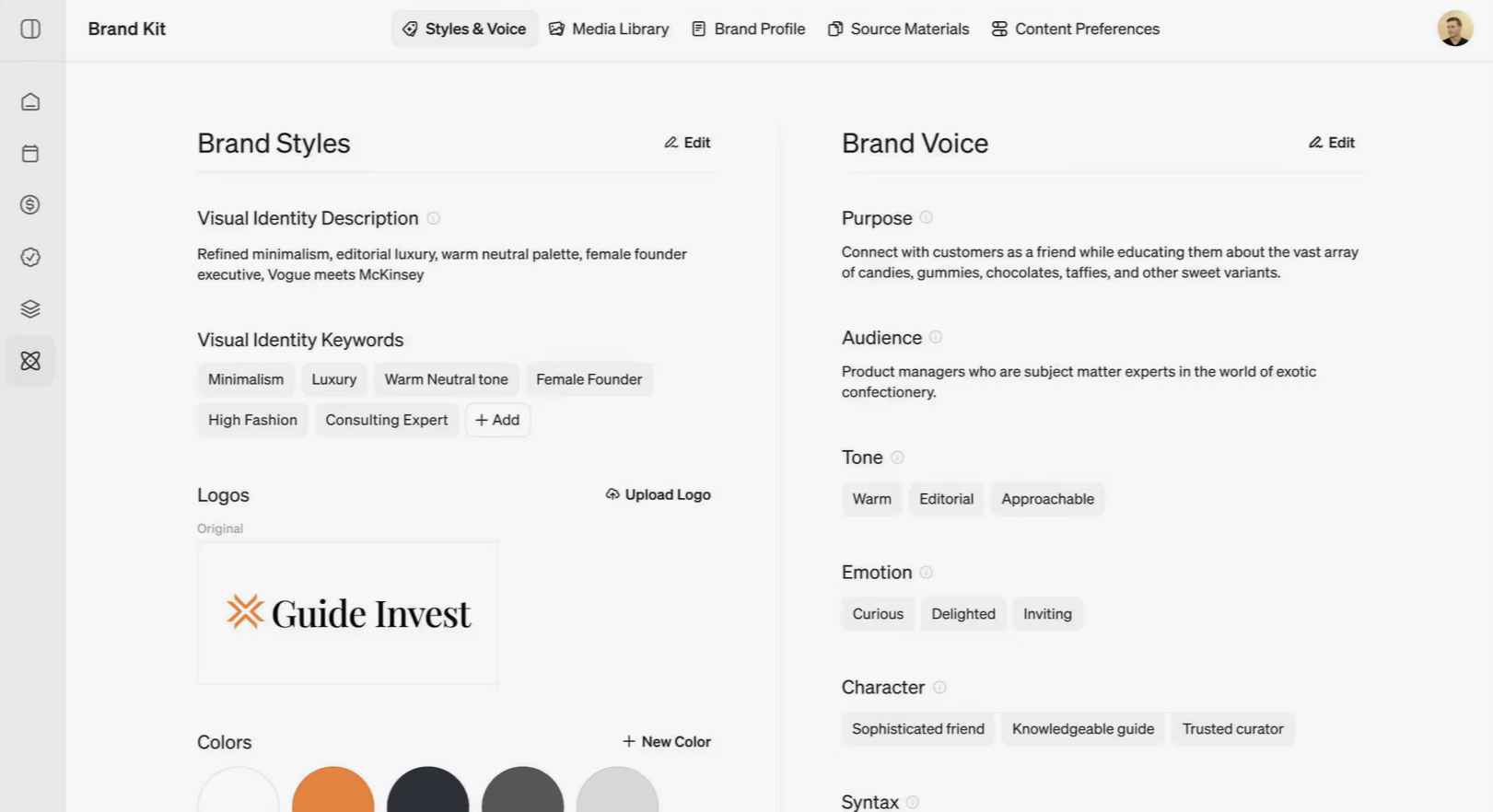
Blaze focuses on email, SMS, and social media campaign management, with strong segmentation and personalization capabilities.
It’s particularly well-suited to businesses running complex, audience-segmented campaigns where personalization is a priority. It’s less autonomous in execution than platforms like Zaturn (requiring more manual input on campaign setup), but its analytics and segmentation tools are effective for teams that have the time to work with them.
Notable Features
Email, SMS, and social media campaigns from a single platform.
Advanced audience segmentation and personalization tools.
Analytics for tracking campaign performance across channels.
Pros and Cons
✅ Strong segmentation and personalization capabilities
✅ Good for teams running complex, multi-audience campaigns
❌ Requires more manual setup; it’s less autonomous than agent-based platforms
❌ May be overkill for solopreneurs or very small teams with simpler needs
Pricing
Blaze offers two types of subscriptions: the cheaper DIY plans and the DFY plans, where an expert human strategist handles your AI marketing.
Starter ($69/mo) | Growth ($149/mo) | Organic Growth ($999/mo) | Search Ads + Organic Growth ($2,499/mo) | Search & Social Ads + Organic Growth ($5,999/mo) |
|---|---|---|---|---|
Do It Yourself | Do It Yourself | Done for You | Done for You | Done for You |
3 posting accounts | 10 posting accounts | Up to 4 organic channels | Full Google Ads management | Full Meta ads management |
500 generation credits | 1,200 generation credits | Monthly check-ins | Weekly check-ins | Creative and copy testing |
Unlimited posts/week | Unlimited seats | Expert strategist | Top-priority email support | Media buying and optimization |
1 seat | Multi-user workflow |
4. HubSpot Marketing Hub
HubSpot Marketing Hub adds AI marketing features into its full CRM ecosystem. It’s most valuable if you’re already using HubSpot to manage customers.
Rating: ★★★★☆ (G2: 4.4/5 - 14,450+)
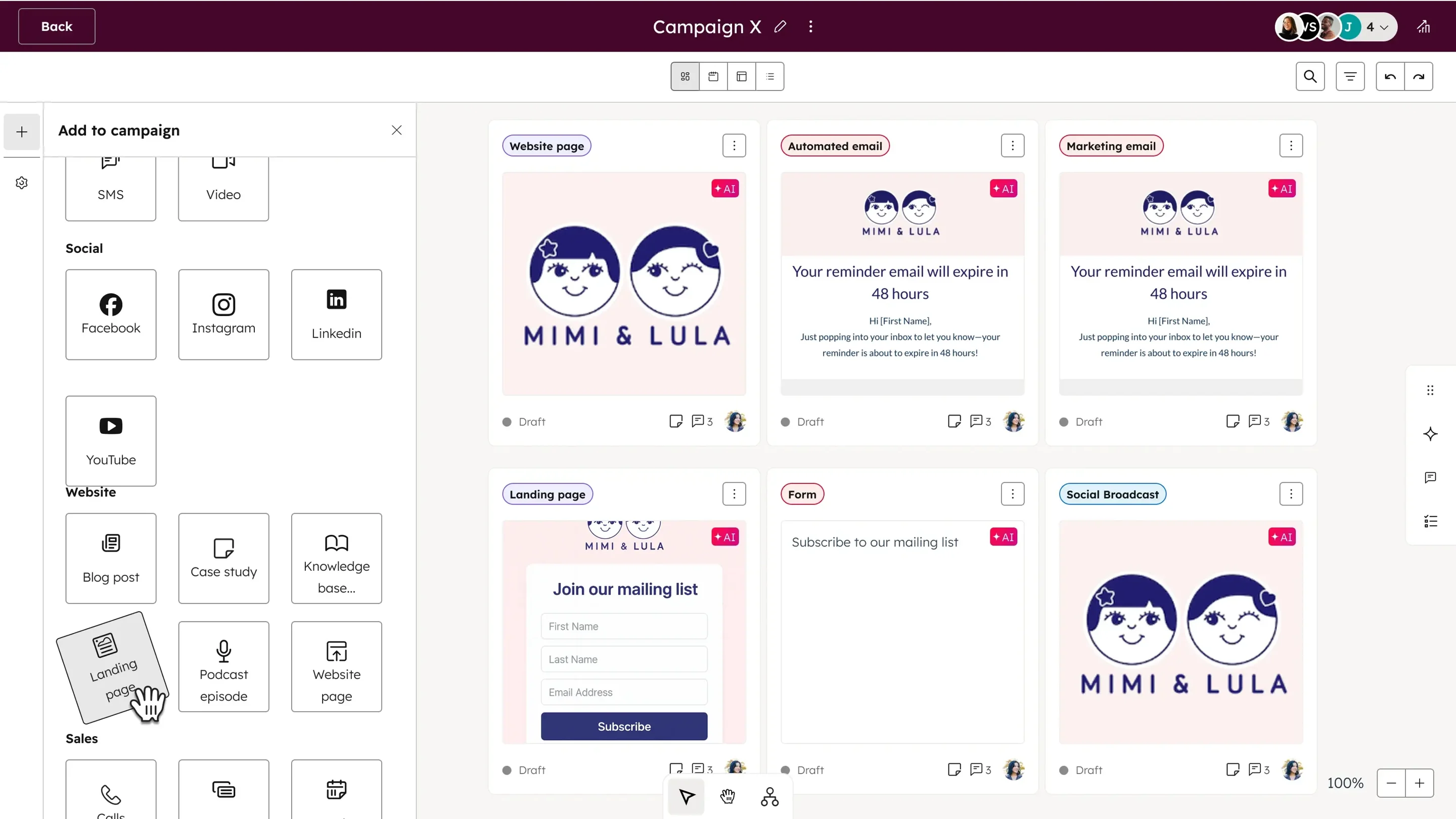
HubSpot’s Marketing Hub adds AI-powered content and campaign tools on top of a comprehensive CRM. The benefit is tight data integration; marketing actions connect directly to customer records, pipeline stages, and sales activity, making it easier to run targeted campaigns based on where leads are in the funnel.
The complexity and cost can be significant for businesses that don’t need the full CRM. HubSpot’s AI features are most powerful when you’re already using it to manage customers.
Notable Features
AI content generation for emails, landing pages, and social posts.
Deep CRM integration, including campaign actions that connect to customer records and sales pipeline.
Lead nurturing automation with smart segmentation based on CRM data.
Pros and Cons
✅ Extremely powerful when marketing and CRM data are connected
✅ Well-established platform with extensive integrations and support
❌ Expensive; the cost escalates quickly as you add contacts or features
❌ Overkill for businesses that don’t need a full CRM, as it has limited value as a standalone marketing tool
Pricing
HubSpot’s plans don’t include the required, one-time professional onboarding for a fee of $3,000.
Professional ($1,000/mo) | Enterprise (Starting at $3,800/mo) |
|---|---|
3,000 HubSpot credits | 5,000 HubSpot credits |
2,000 marketing contacts | 10,000 marketing contacts |
3 seats | 5 seats |
Smart content and reporting | Multi-touch revenue attribution |
Content remix | Customer journey analytics |
Campaign management | Journey automation |
5. Jasper
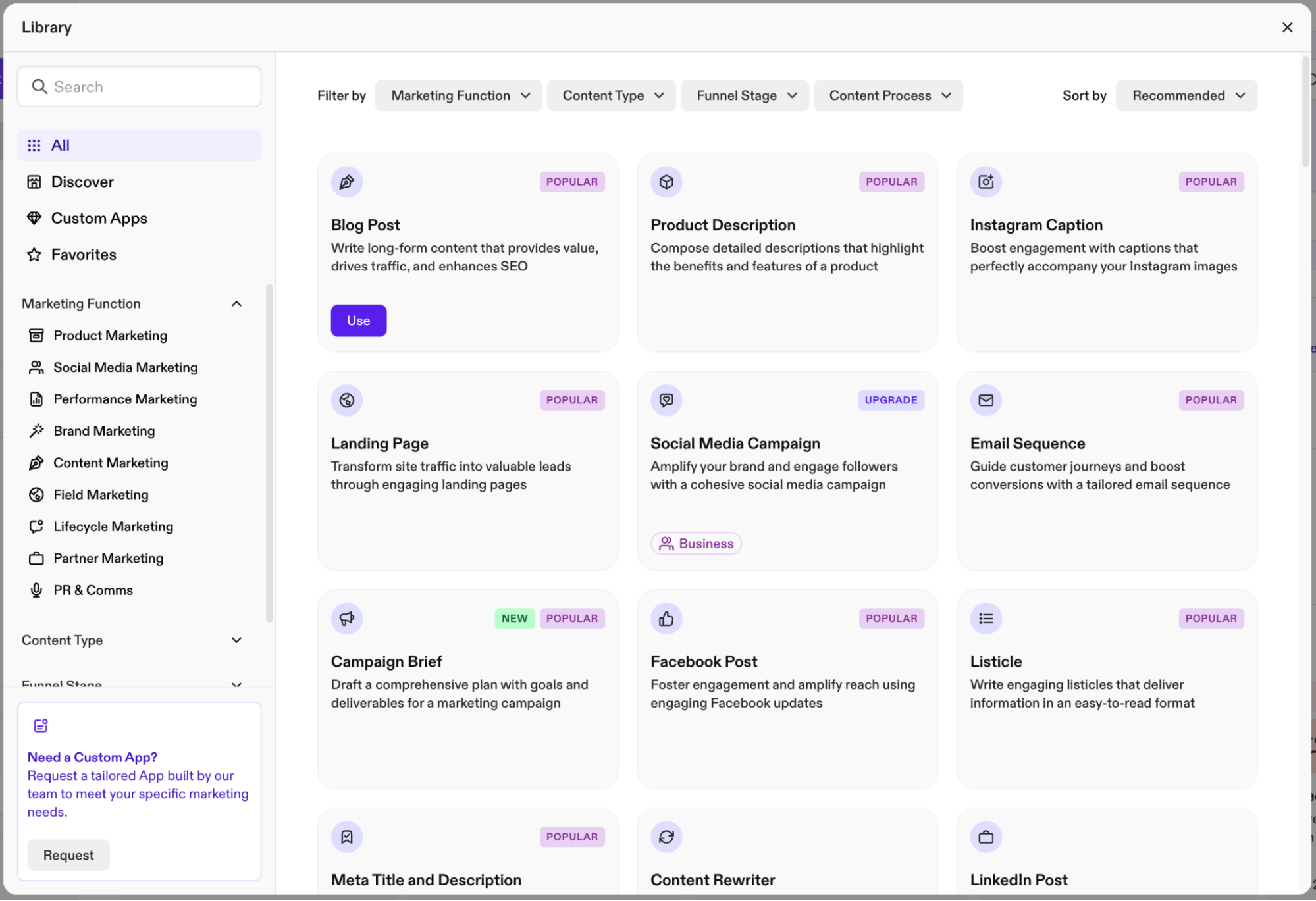
Jasper is a comprehensive AI marketing platform with content pipelines, brand intelligence, and autonomous agents. It’s built for teams that need scale, consistency, and enterprise-grade control. Businesses scaling at this level often pair it with a dedicated cloud engineering partner to ensure their marketing stack runs on a reliable, production-grade infrastructure.
Rating: ★★★★☆ (G2: 4.7/5 - 1,200+)
Jasper centers around Content Pipelines, an end-to-end system that connects data, creativity, and distribution in one intelligent workflow.
At its core are five components:
Agents (AI that understands your marketing needs and executes autonomously)
Studio (a no-code interface for building and customizing AI apps)
Canvas (a collaborative workspace for planning and creating at scale)
Grid (for systematic, brand-safe content execution in spreadsheet format)
Image Suite (proprietary vision models for pixel-perfect, on-brand visuals).
What separates Jasper from simpler content tools is Jasper IQ, a context hub that stores brand knowledge across Brand IQ (voice, visual guidelines, and style guide), Marketing IQ (audience insights and conversion best practices), and a Knowledge Base of company data and assets.
This means content is generated with deep brand and marketing context baked in. The platform also includes a Trust Foundation layer with LLM-optimized infrastructure, enterprise security, governance controls, and API access for workflow integration.
Notable Features
Content Pipelines: agents, studio, canvas, grid, and image generation in one system
Jasper IQ: brand voice, visual guidelines, marketing context, and knowledge base built in
Autonomous agents that adapt to your workflow and execute marketing tasks
Enterprise-grade governance, security, and API access
No-code app building via Studio for custom AI workflows
Pros and Cons
✅ Far more than a writing tool; it covers the full content lifecycle from brief to distribution
✅ Strong brand consistency infrastructure through Jasper IQ
✅ Scales well for marketing teams managing high content volume
❌ Heavier and more complex than SMEs with simple needs may require
❌ Primarily content-focused; it doesn't manage ad campaigns or take actions on ad platforms directly
Pricing
Pro ($69/mo/seat) | Business (Custom) |
|---|---|
1 Seat | Advanced Apps |
Canvas platform | No-code AI App Builder |
Essential Apps | Jasper Grid |
2 Brand Voices | Jasper Marketing Agents |
5 Knowledge assets | Unlimited IQ customization |
3 Audiences | API access |
How to Choose the Right AI Marketing Platform
The right platform depends on where the biggest drag on your marketing actually is. A few questions worth working through:
Do you need help with execution, not just creation? If your bottleneck is time spent launching, monitoring, and adjusting campaigns, not just writing content, look for platforms that take direct action on your behalf.
How much oversight do you want? Some business owners want full control over every action. Others want to set direction and let the platform handle the rest. Zaturn's approval-based model is designed for people who want AI to act, but only with sign-off.
Is marketing your only pain point, or one of several? If you need AI across your business (customer service, operations, and admin), a broader platform like Sintra might make more sense. If marketing is the core need, specialized wins.
What's your current tech stack? HubSpot's AI tools are most valuable if you're already using its CRM. Standalone platforms like Zaturn connect to your existing ad accounts and social channels without requiring a full ecosystem change.
What does your team look like? Solopreneurs with no marketing support need the most autonomous solution. Small teams with some marketing capacity might be happy with tools that assist rather than act.
How Does AI Marketing Compare to Traditional Options?
One of the strongest arguments for AI marketing platforms is the cost structure. Here’s how the numbers typically break down:
Option | Typical Monthly Cost | Included Expertise | Scalability |
|---|---|---|---|
Full-service marketing agency | $5,000–$20,000+ | Broad team of specialists | Limited by retainer scope |
In-house marketing hire | $3,500–$8,000+ | One specialism | Scales with headcount |
Freelancers (per function) | $1,000–$5,000+ | Narrow, project-based | Inconsistent |
Zaturn AI | Subscription (fraction of above) | 6 specialized AI assistants, user-controlled approval | Unlimited campaigns, channels |
By comparing standard agency retainers ($5,000+) to average AI software subscriptions (100–$300), businesses can access near-agency execution capacity at roughly 2–5% of the cost.
What AI Marketing Can’t Do Yet
Being clear about limitations matters as much as highlighting capabilities. AI marketing platforms handle execution, optimization, and consistency at a level most small teams can't match manually, but a few things still require human judgment:
Brand positioning and strategy: AI can execute against a strategy, but defining your market position, value proposition, and long-term narrative still requires human thinking.
Relationship-driven sales: Content and campaigns drive awareness; converting high-value deals or managing client relationships is still a people business.
Cultural nuance and timing: AI can schedule content around peak engagement windows, but navigating cultural moments, responding to trending conversations, or knowing when not to post requires human sensitivity.
Original creative direction: AI-generated content works well for routine posts and campaign copy. For brand-defining creative (the campaigns that really build a company's personality), human creative direction still leads.
The practical takeaway: AI marketing platforms don't replace marketing judgment. They free up the time and headspace to apply it more strategically.
How to Get Started with AI Marketing
If you’re evaluating AI marketing for the first time, the approach matters. A few principles that hold across platforms:
Start with your biggest time drain: If social media is consuming 10 hours a week, start there. If ad campaign management is the problem, prioritize platforms with strong advertising assistants.
Define your approval comfort level: Decide upfront how much you want the platform to act independently vs. flag actions for your review.
Run a trial with real campaigns: Most platforms offer free trials. Use them with actual marketing activity (not test content) so you can evaluate real performance.
Measure against time saved, not just results: In the early stages, the clearest ROI signal is often hours recovered per week. Track it.
The Bottom Line
AI marketing isn’t a trend; it’s the new baseline for how competitive small businesses operate. The question isn’t whether to adopt it, but which platforms give you the right mix of autonomy, oversight, and specialization for your specific needs.
For SMEs and solopreneurs who need a full marketing function without the agency bill, Zaturn AI’s 6 specialized AI marketing assistants offer a genuinely different approach: real actions taken on real platforms, with the business owner staying in control of what goes out.
The result is consistent, optimized marketing that runs whether or not you have time to manage it.
Ready to see what AI marketing looks like in practice? Try Zaturn and run your first AI-powered campaign.