Virtual Marketing Assistant: What It Is and Why AI Does It Better
Small business owners need to market consistently, but doing marketing properly requires skills that span multiple disciplines. Few can justify the cost of hiring a virtual marketing assistant that handles all channels, but an AI marketing assistant can handle the full scope better than a single human can at a fraction of the cost.
What Is a Virtual Marketing Assistant?
A virtual marketing assistant is a remote resource that handles marketing tasks on your behalf, including content creation, scheduling, email campaigns, ad management, and SEO.
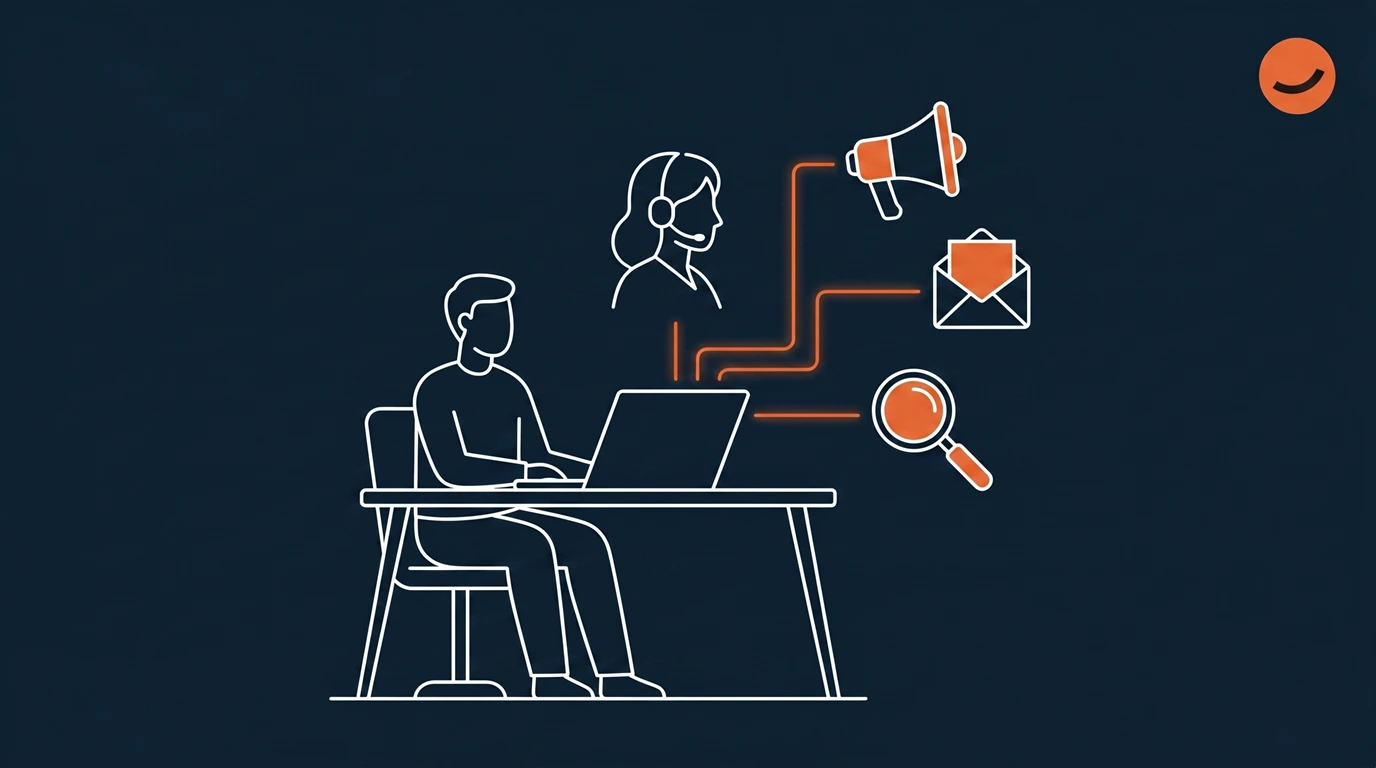
Human VAs cover one or two of these well, but AI marketing assistants cover all of them simultaneously, at a fraction of the cost, without office hours.
What Does a Virtual Marketing Assistant Do?
The term “virtual marketing assistant” gets used loosely. A virtual marketing assistant can mean anything from a freelancer who schedules your post to a fully remote marketing specialist who manages your campaigns across multiple channels.
In practice, most human VAs specialize:
A good social media virtual assistant handles content and scheduling.
A good email virtual assistant handles campaigns and automation.
Expecting one person to handle social media, SEO, paid ads, and website optimization at a professional level is asking for a generalist where specialists are needed.
Here’s what a virtual marketing assistant should cover:
Function | What it involves | Human VA |
|---|---|---|
Social media | Content calendar, caption writing, visual creation, scheduling, hashtag research, and analytics | Usually covers 1 to 2 platforms and rarely includes visual creation. |
Email marketing | Campaign strategy, copywriting, segmentation, automation, and A/B testing | Often limited to sending, not strategy or automation build. |
SEO | Technical audits, keyword research, on-page optimization, content creation, and rank tracking | Rarely offered. This is a specialist function with its own pricing. |
Paid advertising | Campaign planning, ad copy, targeting, optimization, and reporting | Almost never. Ad management is a separate agency or requires a specialist. |
Website/CRO | Conversion audits, copy improvements, and landing pages | Almost never. It requires specific technical and strategic skills. |
There’s a huge difference between what businesses need and what a single human VA delivers. That difference is where AI marketing assistants operate.
How Much Does a Virtual Marketing Assistant Cost?
Human virtual marketing assistants are typically priced by hours or retainer, and rates vary by skill level and specialization.
Type | Monthly Cost | What They Cover |
|---|---|---|
General marketing VA (offshore) | $500 to $1,500 | Basic social scheduling, email sending, and admin tasks |
Experienced marketing VA (US/UK) | $2,000 to $4,000 | Social management, some email, and limited strategy |
Specialist (social media manager) | $3,000 to $5,000 | Social only — strategy, content, scheduling, and analytics |
Specialist (email marketing) | $1,500 to $3,000 | Email only — campaigns, automations, and list management |
Specialist (SEO) | $2,000 to $5,000 | SEO only — audits, content, and rank tracking |
Specialist (paid ads) | $2,000 to $5,000 | Ads only — campaign management, creative, and reporting |
Covering all live functions with human specialists runs $10,000 to $18,000 per month. That’s before management overhead or the coordination time required to keep five different people aligned on the same brand.
⚠️ The hidden cost most founders overlook is opportunity cost. If you spend 15 hours a week on marketing execution and your time is worth $80 an hour, that’s $4,800 a month in founder time going to tasks an AI assistant handles for $69 a month.
Why Pick AI Over a Human Virtual Marketing Assistant?
Several things human AIs bring, such as judgment, relationships, and creativity, matter in some contexts.
But when it comes to executing marketing (the writing, scheduling, optimizing, and reporting that needs to happen consistently every week), AI has several advantages.
Full Coverage
A human VA who's great at social media is usually average at email and has no SEO capability.
→ ✅ An AI marketing platform covers all five channels at the level of a specialist simultaneously. There's no coverage gap and they won’t tell you, “That's not really my area," when you least expect it.
Independent Consistency
Human VAs get sick, take holidays, have bad weeks, and sometimes leave. Buffer's research found that consistent posting drives up to 5x more engagement than sporadic posting.
→ ✅ That consistency is hard to maintain with a human resource. An AI assistant works the same way every week regardless of what else is happening.
Persistent Brand Context
A new human VA takes weeks to understand your brand voice, your audience, and your positioning, but an AI platform stores that context permanently.
→ ✅ After an initial setup, every piece of content draws from the same brand brief without you re-explaining yourself.
Fair Pricing
Adding a sixth marketing channel to a human VA's scope usually means a new conversation about rates.
→ ✅ With an AI platform, the scope is fixed and the price doesn't change when you need more output.
How Zaturn Works as a Virtual Marketing Assistant
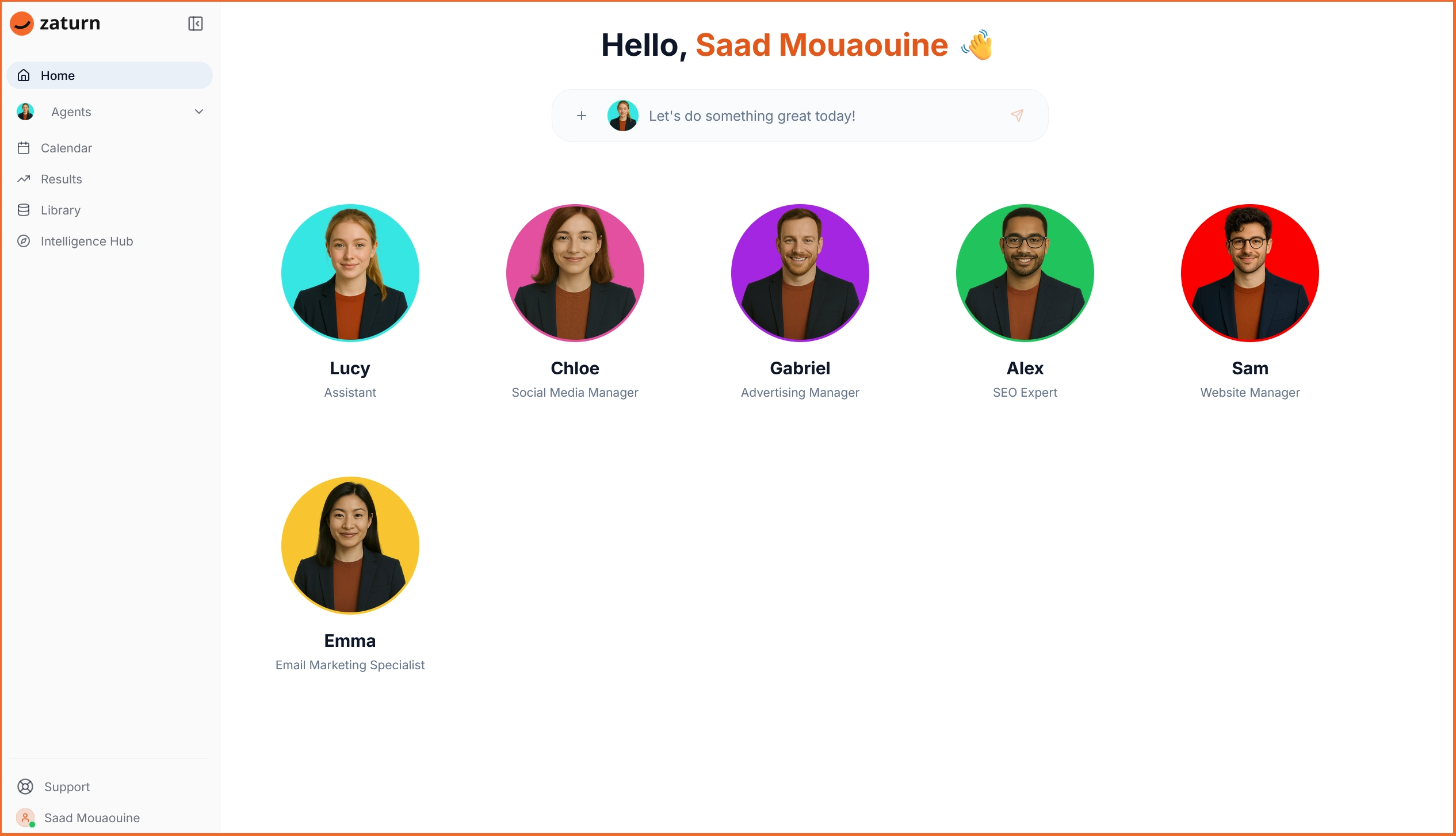
Zaturn is an AI marketing platform built around six specialized AI agents. Each one handles a specific marketing function, and they all draw from the same brand context.
With Zaturn, your social posts, emails, ad copy, and SEO content sound like the same brand rather than six different tools producing content in isolation.
AI Agent | Specialization | Features |
|---|---|---|
Chloe | Chloe plans your content calendar, writes platform-specific captions for LinkedIn, Facebook, Instagram, and X, generates on-brand visuals, and schedules posts for your approval. | |
Emma | Emma handles the full email workflow: strategy, copywriting, segmentation, automation sequences, and A/B testing. She integrates with Mailchimp, Brevo, Outlook, and Gmail. | |
Alex | Alex audits your site, identifies keyword opportunities, writes optimized blog posts and metadata, and tracks your rankings through a direct Google Search Console connection. | |
Gabriel | Advertising | Gabriel creates complete ad campaigns across Google and Meta, covering strategy, targeting, copy, visuals, and human expert review before launch. |
Sam | Website and CRO | Sam audits your website for conversion barriers and delivers specific recommendations with projected conversion lift estimates. He covers the function that human VAs almost never touch. |
Lucy | General assistant | Lucy routes your requests to the right agent, handles platform questions, and helps configure the Intelligence Hub during setup. She’s your starting point as a new Zaturn user. |
✅ Pro Tip: The most common setup mistake is being too vague about brand voice. “Professional” means nothing to an AI. “Direct, no corporate jargon; written for founders, not marketing managers” gives it something specific to work from. The more specific the brief, the less editing you do later.
Human vs. AI Virtual Marketing Assistant: Side-by-Side Comparison
Here’s how the two options compare across different aspects.
Human Virtual Marketing Assistant | Zaturn AI Marketing Assistant | |
|---|---|---|
Monthly cost | ❌ $500 to $4,000 (partial coverage) | ✅ $69 to $129 (full coverage) |
Channels covered | ⚠️ Typically 1 to 2 | ✅ Social, email, SEO, ads, website |
SEO capability | ❌ Rarely | ✅ Full audit, content, rank tracking |
Ad management | ❌ Almost never | ✅ Google and Meta, with expert review |
Availability | ❌ Office hours | ✅ Continuous |
Brand consistency | ⚠️ Depends on the person | ✅ Same context across every output |
Onboarding time | ❌ Weeks to calibrate | ✅ One setup session |
Your approval | ⚠️ Varies by arrangement | ✅ Required before anything goes live |
Scales with volume | ⚠️ More hours = more cost | ✅ Fixed monthly price |
Is a Virtual Marketing Assistant Right for Your Business?
The case is strongest for small businesses that know what they want to say but keep running out of time to say it consistently. If marketing keeps getting pushed to tomorrow, a virtual marketing assistant will solve your execution problem but not the strategy problem.
However, virtual marketing assistants don’t make sense for businesses that need relationship-driven work, including PR outreach, influencer partnerships, or community management. Those require human judgment in real time, and AI isn’t recommended for that.
Situation | Points |
|---|---|
You're handling all marketing yourself | 3 |
Marketing takes more than 8 hours of your week | 3 |
You've gone weeks without posting or emailing (not by choice) | 3 |
You're active on more than one channel | 2 |
You know your brand voice but can't execute consistently | 2 |
Your email list exists but rarely gets used | 2 |
Your website gets traffic but doesn't convert well | 2 |
Final Thoughts
A virtual marketing assistant reconciles between knowing you should be doing more marketing and actually doing it consistently. Whether that’s a human VA or an AI platform depends on your budget and how much coverage you need.
Most human VAs cover one or two channels well. Zaturn’s six AI agents cover all five, from social media to website optimization, at the level of a specialist. Try it for free for 14 days. No credit card is required.