AI Assistant for Small Business: Meet the Team You Can Actually Afford
Running a small business alone means wearing every hat. An AI assistant for small business handles your marketing and social while you focus on what matters.
Running a small business alone is about doing the work of six people with the budget of none. You’re the founder, the marketer, the copywriter, the ad buyer, the SEO person, and the customer service rep, usually all before lunch.
Hire a person for each of those tasks and you’ll be looking at $15,000–$35,000 a month. That’s a budget most small businesses will never be able to justify, so owners do it all themselves, imperfectly, at the cost of the time they should be spending on the business itself.
AI assistants built for small businesses exist to close that gap by handling the execution that’s currently eating your week while respecting your judgment. This guide introduces six of them, what each one does, and why together they function like the team you always needed but could never afford.
What Is an AI Assistant for Small Business?
An AI assistant for small businesses is a goal-driven agent that takes real actions on your behalf, including drafting content, launching campaigns, optimizing your website, and sending emails, and waits for your approval before anything goes live.
It’s not a chatbot that answers questions or a scheduler that publishes already written content. It’s closer to a staff member: one that works continuously, doesn’t need months of onboarding, and costs a fraction of a salary.
This distinction is worth making early because there’s a spectrum:
AI tools assist. They might generate a caption for you.
AI software automates specific tasks. They could schedule the posts you generate using AI tools.
AI assistants pursue goals. They plan your content calendar, write the captions, create the visuals, and bring everything ready for you to approve.
Pro Tip: The best AI assistants are goal-oriented, not task-oriented. Instead of asking, ‘Write me a caption,’ you tell them your objective (grow my LinkedIn following, generate leads from Google Ads, or rank for this keyword) and they build the execution plan. That’s the difference between a feature and a team member.
Why Small Business Owners Should Not Do Everything on Their Own
Small business owners are the wrong people to be doing marketing, social, and admin. This isn’t a criticism; it’s just reality.
The skills required to run great social media, manage paid advertising, execute SEO, maintain an email list, and optimize a website for conversions are each, individually, full-time specializations.
According to a VerticalResponse survey, 43% of small business owners spend 6 or more hours per week on social media marketing alone. That’s before ads, SEO, email, or anything else.
Intuit’s SMB research found that 37% of small businesses have the owner personally handling all marketing, not delegating or outsourcing it. The founder is the marketing department.
63% of small business owners say SEO is too complex to do themselves. 67% of small business ad campaigns fail due to poor targeting. 75% of users never scroll past the first page of Google, which means every week you’re not doing SEO is another week your competitors are taking traffic that should be yours.
The problem isn’t that small business owners aren’t trying. It’s that the execution gap (between knowing you should be posting, emailing, running ads, and optimizing and actually doing it consistently and well) is too wide for one person to bridge alone.
How Much Does It Actually Cost to Hire Specialists?
Let’s put the actual numbers on the table. If you were to hire a specialist for each core marketing and business support function, here’s what that looks like monthly:
Role | Monthly Cost (Freelance/Agency) | What They Handle |
|---|---|---|
Social media manager | $3,000 – $5,000 | Content, posting, community management |
Ad agency | $2,000 – $5,000 | Campaign planning, creative, optimization |
SEO agency | $2,000 – $5,000 | Rankings, technical audits, content |
Email marketing specialist | $800 – $1,500 | Sequences, newsletters, automation |
CRO / website consultant | $5,000 – $15,000 | Conversion audits, UX, testing |
General business assistant | $2,000 – $4,000 | Admin, research, coordination |
Total | $14,800 – $35,500/month | Still not talking to each other |
Only a fraction of small businesses can afford agency retainers at all. For the large majority, the choice has historically been to do it badly yourself or to not do it at all.
Zaturn’s six AI assistants are a third option.
Insight: The hidden cost most founders overlook is opportunity cost. If you’re spending 15 hours a week on marketing execution, and your time is worth even $80/hour, that’s $4,800/month in founder time spent on tasks that an AI assistant could handle for $55/month. The ROI calculation isn’t close.
Meet Your AI Team: Six Specialists, One Platform
Zaturn deploys six specialized AI assistants, each built around a specific marketing or business function. They’re not generic chatbots; each one connects directly to the platforms it works on, takes real actions on your behalf, and waits for your approval before anything goes live.
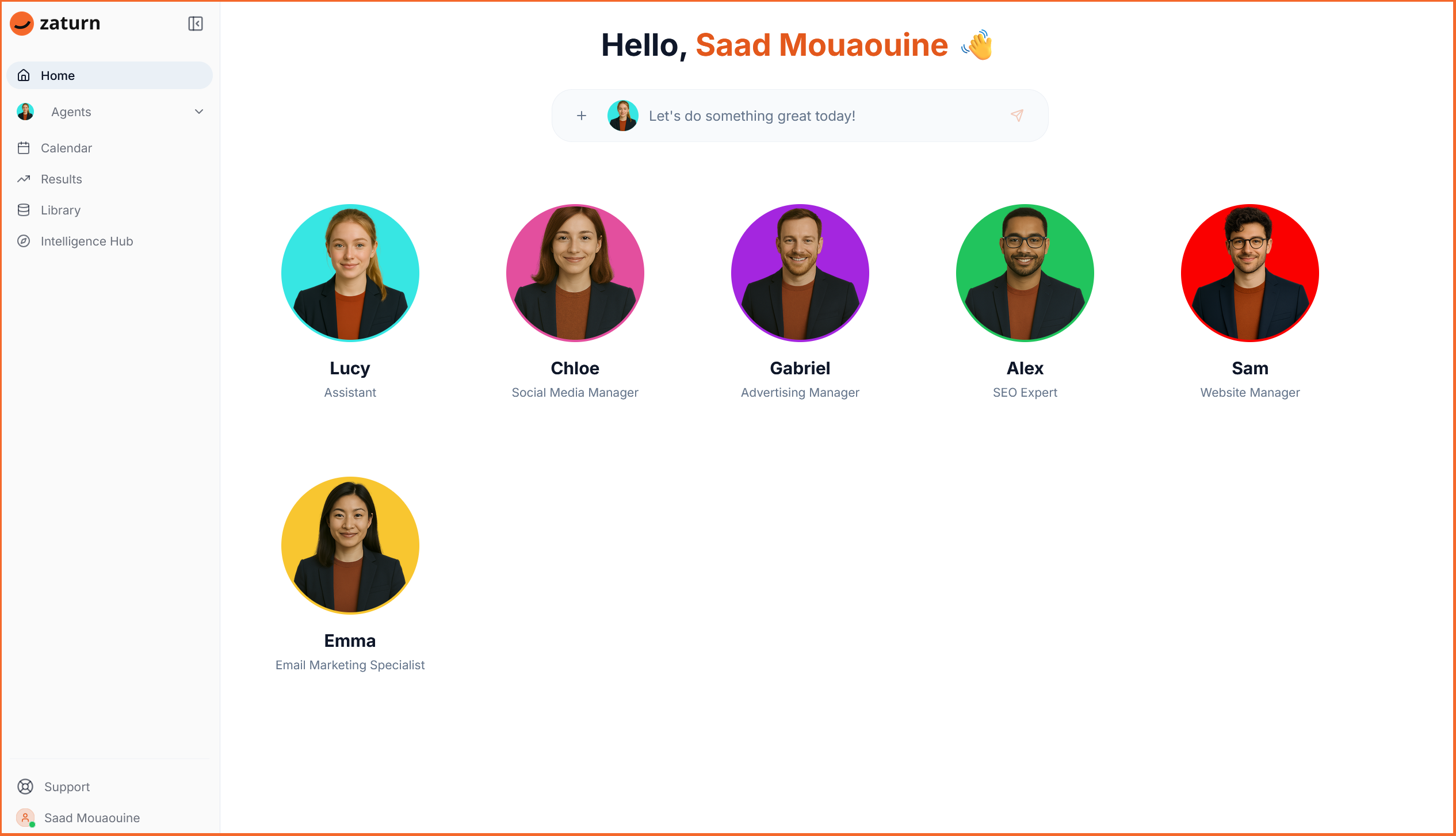
What makes them function as a team rather than six separate tools is the Intelligence Hub, a central workspace where your brand assets, tone guidelines, audience details, campaign files, and tool integrations are stored.
Every assistant draws from the same source and their output sounds like the same brand. That consistency is hard to achieve even with a human team.
Lucy - Your AI General Assistant
Lucy is the first person you should talk to at Zaturn. She’s the one who makes sure you always end up in the right place.
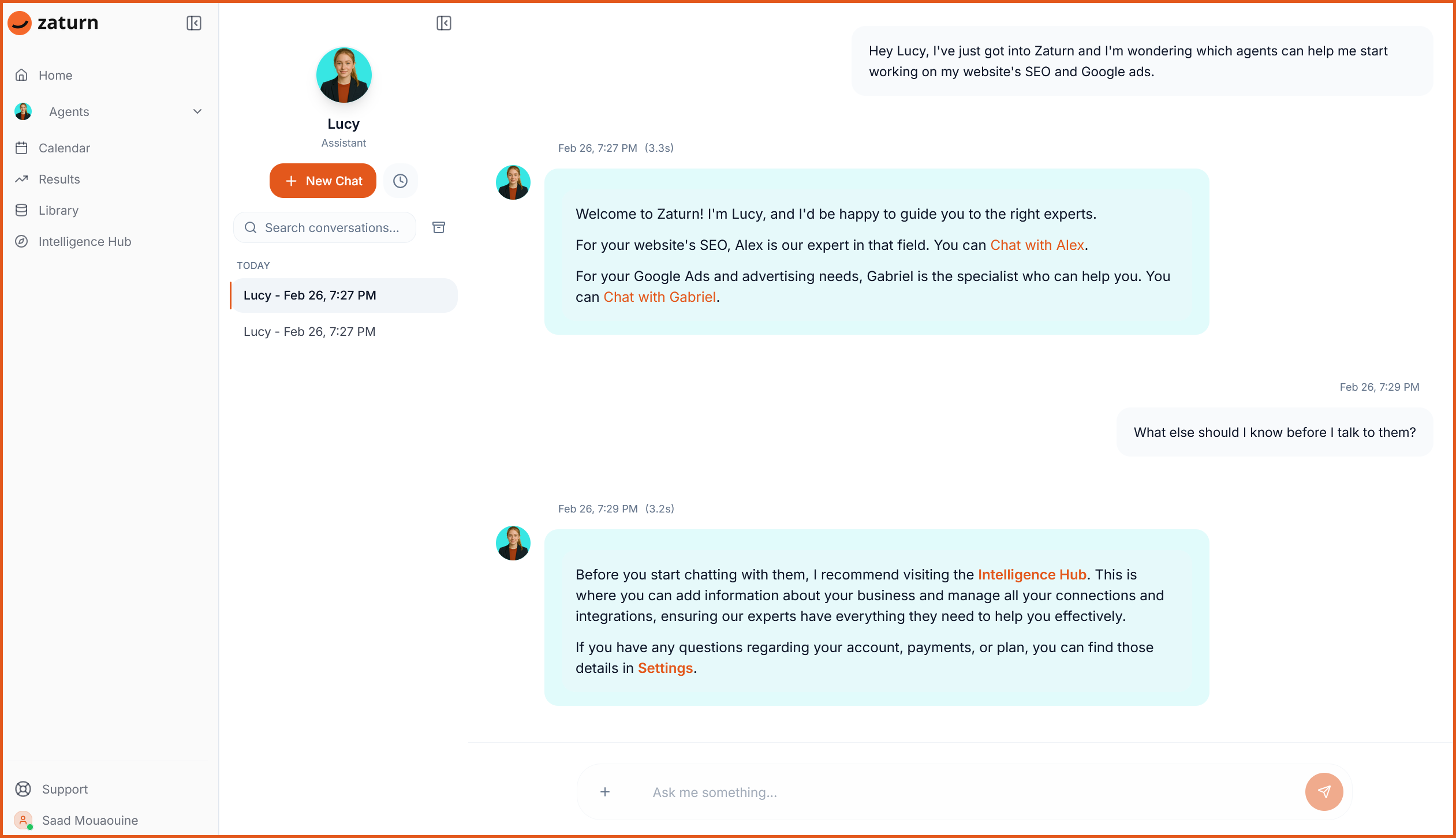
When you’re not sure which assistant to go to or you have a question that doesn’t belong neatly to social, ads, SEO, email, or your website, Lucy is your starting point.
Ask her anything. She’ll either answer it directly or point you to the right specialist. She’s essentially the receptionist, coordinator, and first point of contact—the person who makes sure nobody wastes time going in circles.
For new Zaturn users especially, she’s the fastest way to get oriented and start getting value from the platform.
What Lucy Does
Answers general questions about your Zaturn account, the platform, and which assistant is best suited for your specific need.
Routes you to the right specialist. Social media to Chloe, SEO to Alex, advertising to Gabriel, email to Emma, and website to Sam.
Guides account and billing queries toward the right settings without you having to hunt through menus.
Helps with Intelligence Hub setup, pointing you toward where to add business info, integrations, and brand assets so the other assistants have what they need to work well.
Chloe - Your AI Social Media Manager
Talk to Chloe for consistent, on-brand social media across LinkedIn, Facebook, Instagram, X, and other platforms. She plans, writes, and visualizes for you. You spend 30 minutes a week approving what goes live.
Social media is the marketing function that demands the most consistent attention and delivers the most visible results when done well. It’s also the one that collapses first when a founder runs out of time.
According to Buffer, highly consistent posters can see up to more than 5 times the engagement per post compared to those who post sporadically. Accounts that go quiet for a week see a measurable drop in reach that takes several consistent posts to recover from, meaning consistency is an algorithmic requirement.
Chloe handles the production work that makes consistency possible without it
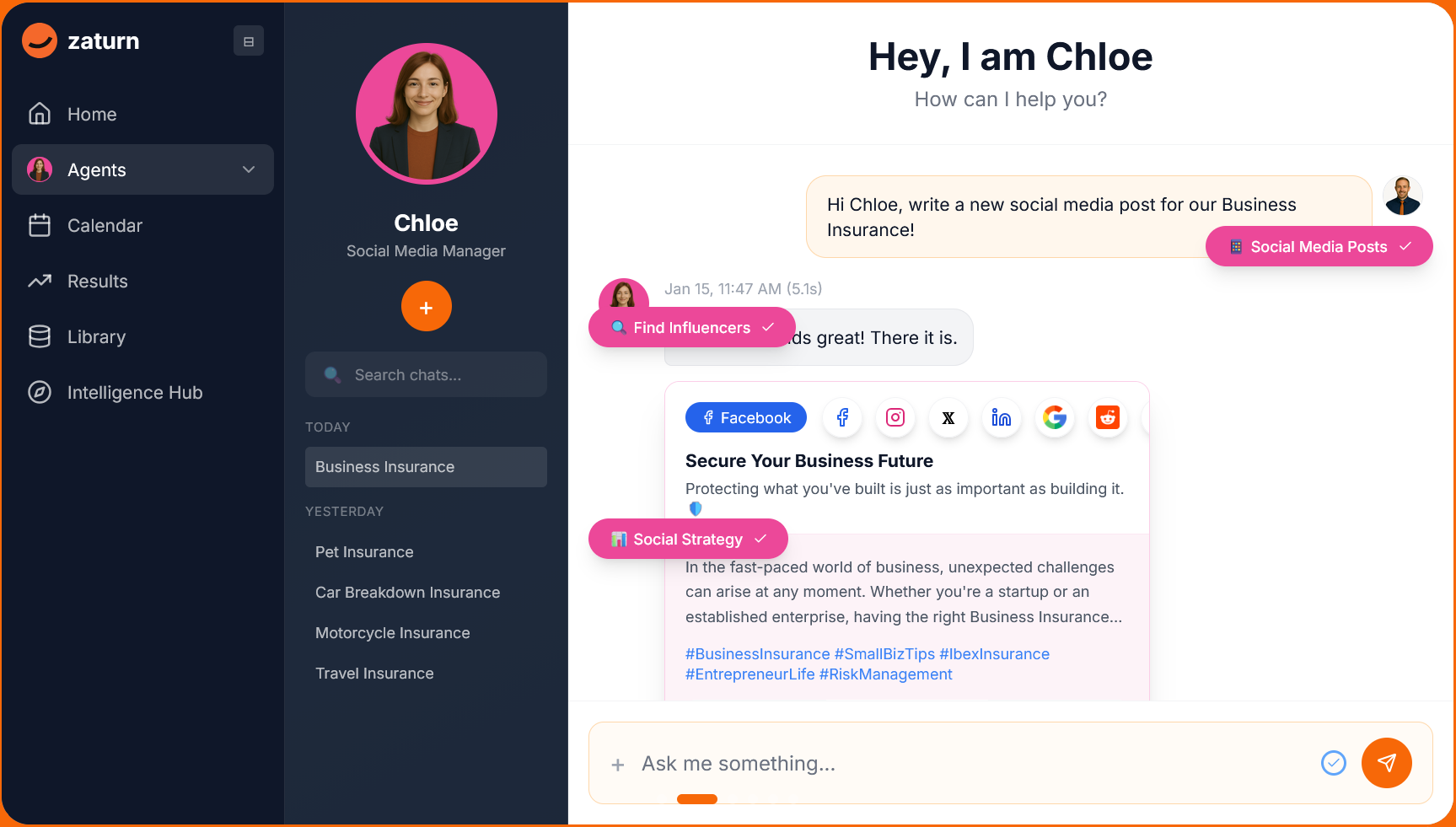
consuming your week. She plans, writes, generates on-brand visuals, researches hashtags, and prepares everything for your review. Nothing goes live without your sign-off.
What Chloe Does
Monthly content calendar planning: the right content mix, cadence, and timing, built around your goals and trending topics in your industry.
Caption writing in your brand voice: adapted per platform so your LinkedIn post reads differently from your Instagram caption even when they cover the same topic.
On-brand visual creation: scroll-stopping graphics using your logo, colors, and style preferences. No design skills required.
Hashtag research and optimization: per-post hashtag strategy based on current engagement patterns, not a saved generic set.
Multi-platform scheduling: LinkedIn, Facebook, Instagram, X/Twitter, and many more, with content auto-sized for each platform's requirements
Performance analytics: impressions, likes, comments, and shares tracked across all platforms in one dashboard, feeding back into future content recommendations.
Trend monitoring: timely content opportunities surfaced automatically, so your brand stays relevant without you having to watch the news.
Use Case
A small e-commerce brand founder is posting on Instagram twice a week (when she remembers). After setting up Chloe with her brand voice and product focus, she gets a full month of content ready to review on Monday morning.
She spends 30 minutes approving posts. Her posting frequency goes from twice a week to daily. Within 8 weeks, her follower count doubles and engagement triples.
“Chloe saves me 12 hours every week. My LinkedIn went from 2 posts a month to 20 — and engagement tripled. I review everything in 30 minutes on Mondays.” — Small Business Owner, using Chloe for 6 months
Pro Tip: The most common mistake when setting up an AI social media assistant is being vague about brand voice. The more specific you are (not just ‘professional’ but ‘direct, no fluff, talks to founders, not corporates’) the less editing you’ll do later. Most Zaturn users report only tweaking 5–10% of captions after the first few weeks.
Gabriel - Your AI Advertising Manager
Talk to Gabriel for complete ad campaigns, including strategy, targeting, copy, visuals, and expert review. Go from brief to launch in minutes, not weeks.
Paid advertising is one of the highest-leverage things a small business can do, and one of the easiest to do badly.
A poorly targeted ad campaign underperform
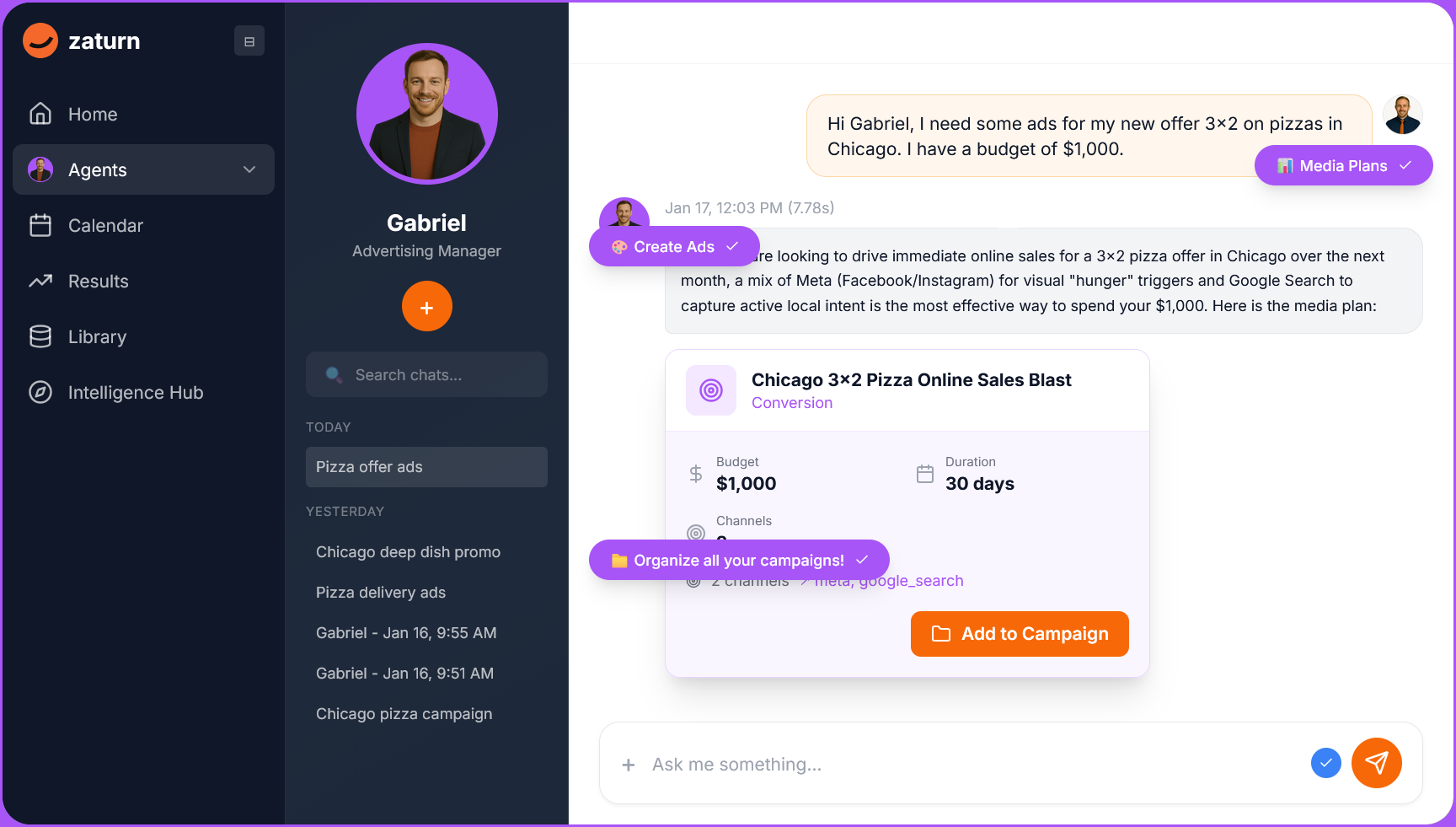
s and actively wastes money at scale. 67% of small business ad campaigns fail due to poor targeting because campaign strategy, audience building, creative, and budget allocation are four separate specializations that typically live inside an agency.
Gabriel collapses all of that into one assistant. You tell him your objective (leads, sales, awareness, a product launch, etc.) and he generates a complete media plan with targeting recommendations, budget allocation, and platform strategy.
He then produces 5–10 ad variations with proven copy hooks, CTAs optimized for conversions, and AI-generated visuals. Human advertising specialists review the campaign before launch, and Gabriel monitors performance after it and doubles down on what works.
What Gabriel Does
Complete media planning: strategy-driven ad plans with targeting, budgets, and platform recommendations.
Ad copy and visual creation: 5–10 ad variations with proven hooks, CTAs optimized for conversions, and AI-generated visuals.
Expert review before launch: human advertising specialists check your campaign for strategy, compliance, and brand alignment before a single penny is spent.
Laser-focused audience targeting: AI-powered audience building based on your ideal customer profile (demographics, interests, and behavior signals).
Automatic optimization: Gabriel monitors ROAS and conversions, pauses underperformers, and reallocates budget to winning ads in real time.
Platform coverage: Google Ads and Meta Ads, with real-time performance dashboards that don't require an analytics degree to read.
Use Case
A SaaS founder needs to generate leads for a new product launch. He’s tried running Google Ads himself and burned through $2,000 with no conversions. With Gabriel, he shares his objective and ideal customer profile.
Gabriel generates a media plan and five ad variations and recommends splitting the budget between Google Search and Meta. An expert reviews the campaign before launch. In the first month, the cost per lead drops from $45 to $22.
“We cut our cost per lead from $45 to $22 in the first month. The expert review caught issues we would have missed.” — Marcus T., SaaS Founder
Pro Tip: Most small business owners launching ads independently skip the compliance check (and Meta and Google reject or limit campaigns for policy violations more often than most people realize). Having a specialist verify before launch avoids wasted ad spend on campaigns that never fully serve.
Alex - Your AI SEO Expert
Alex will help you go from invisible to page one without learning technical SEO, signing a 6-month agency contract, or spending $3,500/month.
SEO is the marketing channel with the best long-term ROI and the highest barrier to entry for small businesses. 75% of users neve
r scroll past the first page of Google search results, which means if you’re not on page one for the terms your customers are searching, you effectively don’t exist online.
The problem is that SEO involves keyword research, technical audits, on-page optimization, content strategy, link building, and ongoing monitoring. Each of these is a specialization in its own right. The alternative (an SEO agency) typically runs $2,000–$5,000/month on a 6–12 month contract, meaning you're committing $12,000–$60,000 before you see a single ranking improvement.
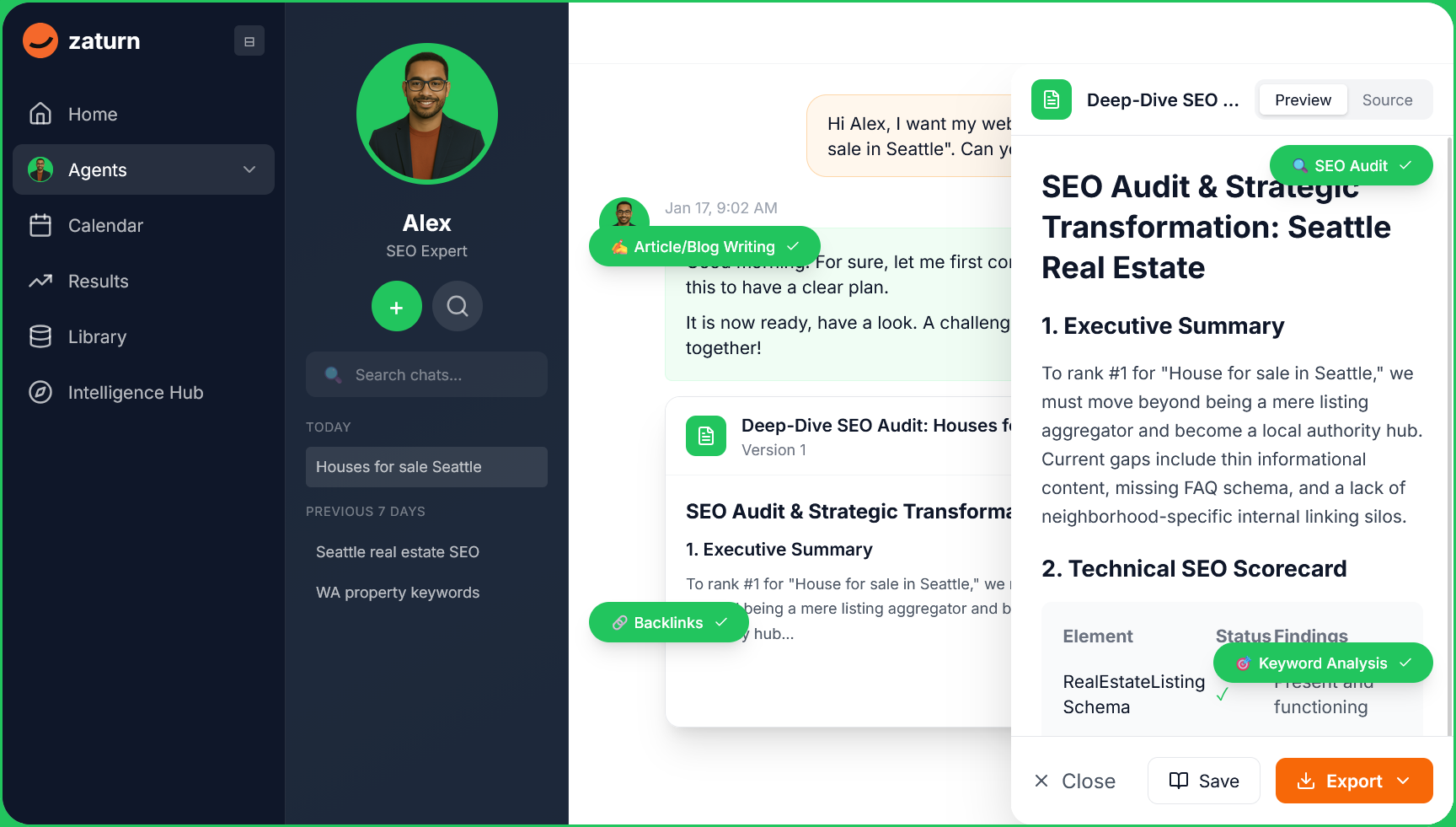
Alex handles the full SEO workflow. He starts with a comprehensive audit of your site. He then identifies high-value keywords your business should target, optimizes your title tags, meta descriptions, headers, and content, and monitors your rankings continuously as algorithms shift. You approve changes before they go live. Alex does the rest.
What Alex Does
Technical SEO audit: site speed, mobile optimization, broken links, crawl errors, and everything else that’s holding your rankings back.
Keyword research and strategy: high-value keywords ranked by opportunity, including long-tail and local SEO terms your competitors are missing.
On-page optimization: title tags, meta descriptions, header structure, and content, all optimized and submitted for your approval before going live.
SEO content creation: blog posts, landing page copy, and metadata written to rank, not just for search engines but for the humans who find you there.
Competitor analysis: what your competitors rank for, where their gaps are, and how to take ground from them systematically.
Ongoing monitoring: keyword ranking tracking, traffic monitoring, competitor movement alerts, and algorithm update adaptations. Continuous, not quarterly.
Use Case
A local service business (a plumber in a mid-size city) has a website but gets no organic traffic. His competitors dominate the first page for every relevant search term. Alex runs a full audit, identifies 14 technical issues and a list of high-opportunity local keywords, and optimizes the site's on-page elements within two weeks.
Within 60 days, the business appears on page one for three local search terms and organic inquiries increase by 40%.
Pro Tip: SEO compounds. A ranking you earn in month three keeps delivering traffic in month twelve without additional spend. This is the difference between SEO and paid advertising: ads stop the moment you stop paying; organic rankings keep working. The sooner you start, the sooner the compounding begins.
Emma - Your AI Email Marketing Specialist
Your email list is already your most valuable marketing asset. Emma turns it into a revenue channel without the blank screen, the 3-hour writing sessions, or the $1,500/month specialist.
Email marketing consistently delivers the highest ROI of any digital marketing channel. The challenge for small businesses isn’t knowing that; it’s the execution.
Most founders have an email list sitting cold because writing emails feels hard, time-consuming, and anxiety-inducing. Email lists decay at 22.5% per year when not regularly engaged. Every month you’re not emailing your list, you’re losing subscribers who’ll never come back.
The writing problem is real too: the average time to write a single marketing email is 3–4 hours. For a business that should be sending weekly, that’s 12–16 hours a month before you’ve touched anything else. Emma removes entirely.
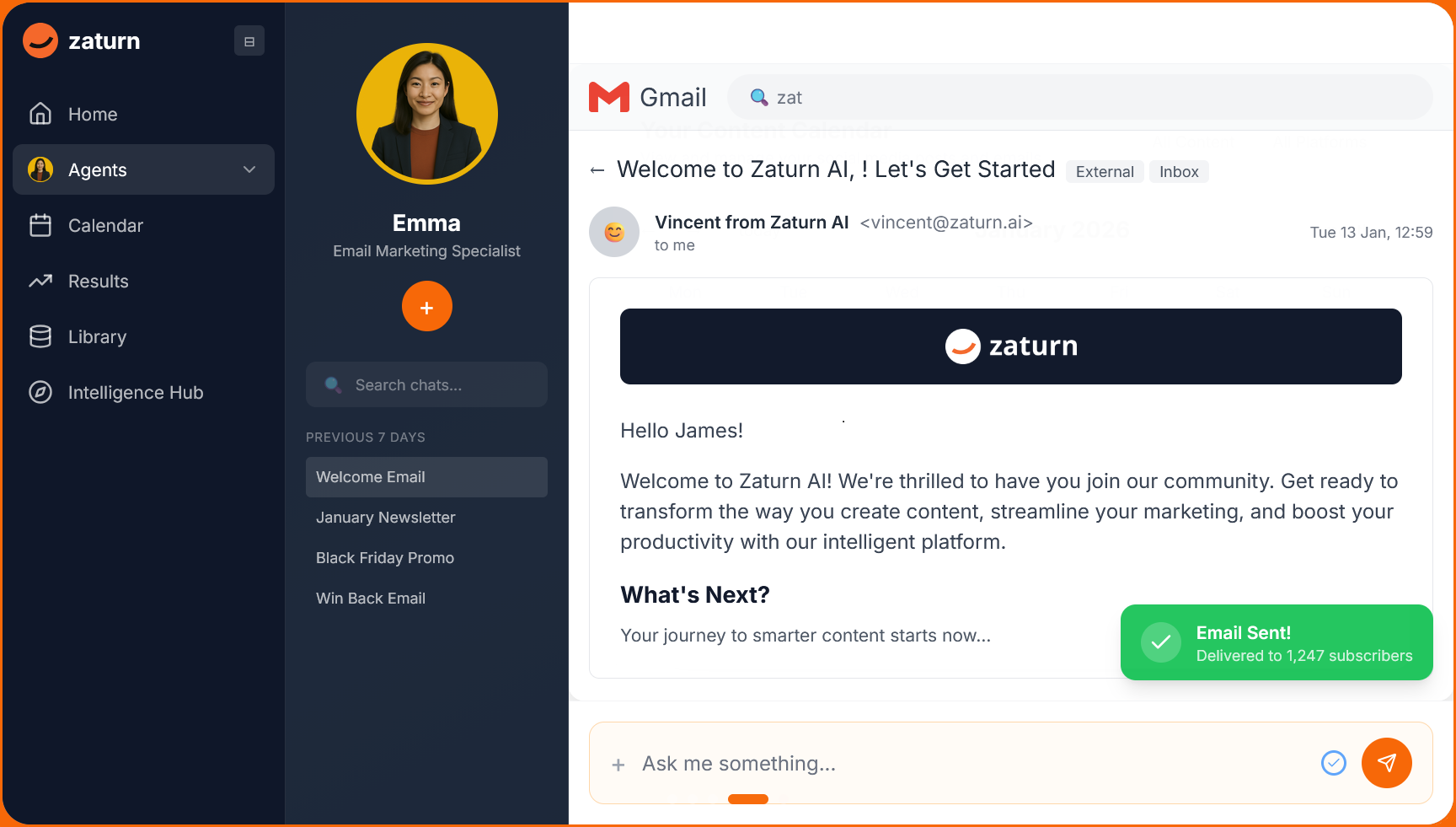
Emma plans your email strategy, writes campaigns in your brand voice, builds automation for welcome sequences, cart abandonment, and re-engagement, and handles A/B testing to continuously improve performance. Every email comes to you for review before it’s sent. You decide what goes out and when; Emma handles everything that leads up to that moment.
What Emma Does
Email strategy and calendar: a content plan for your list (what to send, when to send it, and why) built around your business goals.
Campaign copywriting: compelling subject lines, on-brand email copy, and clear CTAs written in your voice, with multiple variations to test.
Automated sequences: welcome flows for new subscribers, cart abandonment recovery, post-purchase follow-ups, and re-engagement campaigns for inactive subscribers.
Smart segmentation: right message to the right people. Emma segments your list and personalizes content for maximum relevance and conversion.
A/B testing: subject lines, send times, and content variations tested systematically so performance improves over time rather than guessing.
Platform integration: works with Mailchimp, Brevo, Outlook, and Gmail. It connects to what you already use rather than requiring a platform switch.
Use Case
An e-commerce brand has 3,200 email subscribers and hasn’t sent a single email in four months. The founder is worried about people unsubscribing. Emma plans re-engagement sequence, writes a three-email series that acknowledges the gap without making it awkward, and follows up with a promotional campaign.
Open rates hit 34%. Revenue from the re-engagement campaign pays for six months of Zaturn.
“I was spending 4 hours on every single email. Now I spend 20 minutes reviewing what Emma wrote. My open rates are actually higher because the copy is better than what I was writing myself.” — E-commerce Founder, Using Emma for 4 months (2x revenue from email)
Pro Tip: The most valuable email sequence any small business can have is a strong welcome sequence (the automated series that goes out to every new subscriber). Most businesses never build one because it feels like a big project. Emma builds it in minutes during setup. A well-structured welcome sequence alone can increase subscriber lifetime value by 30–40%.
Sam - Your AI Website Manager
Gabriel’s ads and Alex’s SEO bring people to your website. Sam makes sure they don’t leave empty-handed.
Most small business websites leak conversions because the copy is vague, the ca
lls-to-action are weak, and visitors can't immediately see why your business is worth their time. 73% of visitors never scroll below the fold, meaning your headline has roughly 8 seconds to convince someone to stay.
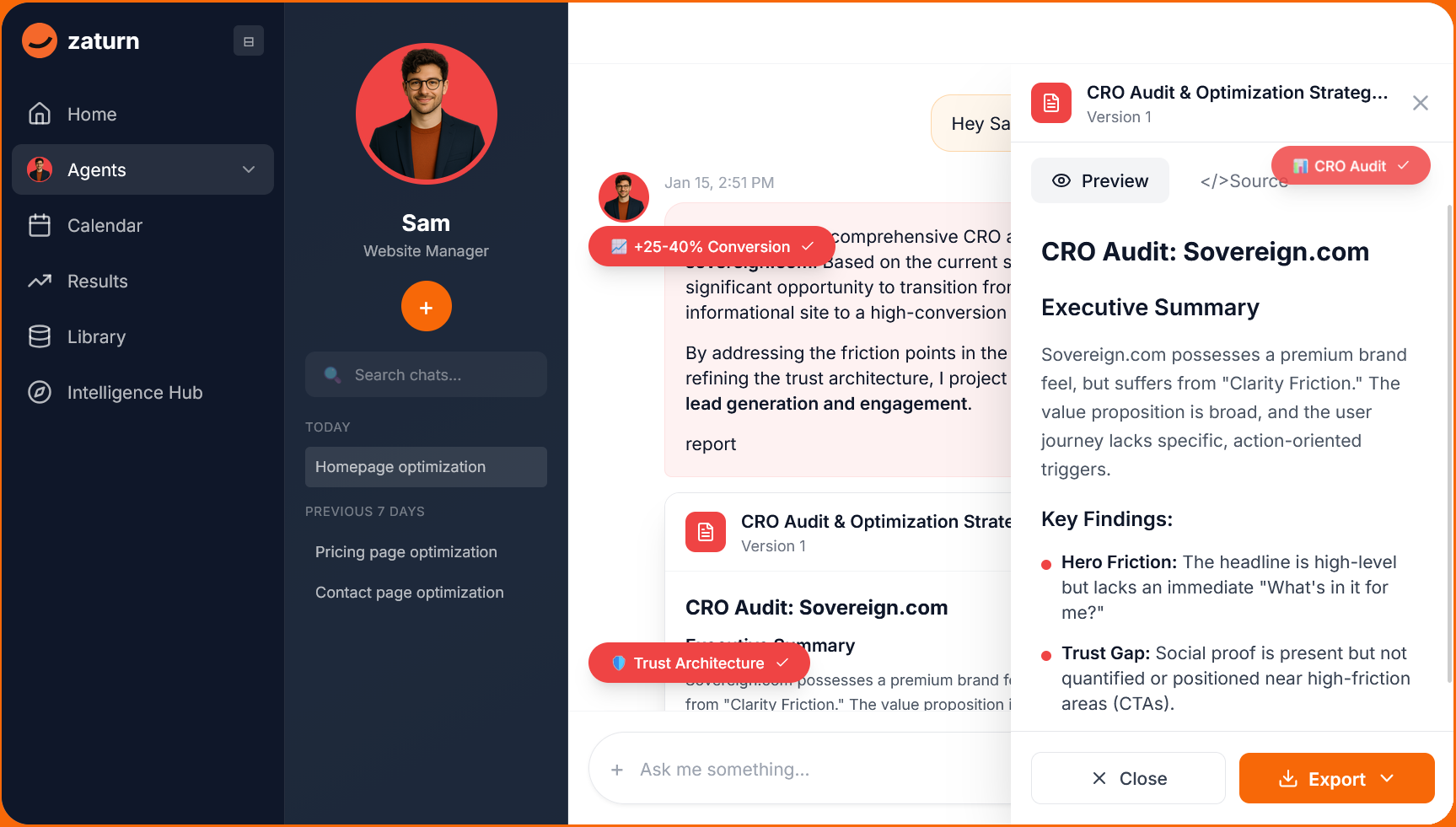
Sam's role is different from the other assistants. He's a conversion rate optimization (CRO) expert. He analyzes your website section by section, identifies exactly what's killing conversions, and delivers a step-by-step roadmap to fix them, complete with before/after mockups and projected conversion lift percentages for every recommended change.
This makes Sam the multiplier. Every dollar Gabriel spends on ads, every visitor Alex earns through SEO, and Sam makes those efforts more valuable by ensuring the website they land on is built to convert. A 35% improvement in conversion rate means 35% more value from every other marketing investment.
What Sam Does
Section-by-section CRO audit: your entire site analyzed for conversion barriers, including missing trust signals, weak CTAs, unclear value propositions, friction points, and mobile issues.
Contextual CTA analysis: Every call-to-action evaluated based on user intent at that specific page position. Not generic advice, but specific guidance for each moment in the visitor journey.
Before/after visual mockups: exactly what to change and what it will look like after. Implementation-ready recommendations your designer can execute immediately.
Projected conversion lifts: conservative, data-driven estimates for every recommended change with cumulative impact calculations so you can prioritize what to fix first.
Implementation roadmap: prioritized by impact. Quick wins first, then medium-term improvements, then long-term optimization strategies.
Trust signal analysis: identifying where social proof, reviews, certifications, and credibility markers should appear to reduce bounce and increase conversion.
Use Case
A B2B service business gets reasonable traffic from Google but a conversion rate of 0.8%, which is well below the industry average of 2–3%.
Sam audits the site and identifies 12 conversion barriers, including a vague headline, three generic CTAs, and no social proof above the fold. The founder implements the quick-win recommendations over three days. The conversion rate rises to 2.1%, meaning the same traffic now generates 2.5x the inquiries without a single extra pound spent on ads or SEO.
“Sam found 14 conversion barriers we completely missed. After implementing just the quick wins, our signup rate increased 38% in two weeks.” — Marcus Chen, Founder @ TechFlow SaaS
Pro Tip: Most small businesses optimize for traffic before they optimize for conversion, which is backward. Doubling your traffic with a 1% conversion rate gives you twice as many visitors and the same poor results. Fixing conversion first means every future investment in traffic, ads, and SEO delivers proportionally more.
How Much Do AI Assistants for Small Business Cost? Full Comparison
Here’s the number that matters most.
Option | Monthly Cost | Coverage | Your Time/Week | Brand Control |
|---|---|---|---|---|
DIY (you do everything) | Free (your time) | Whatever you can manage | 15–20+ hours | Full (you do it all) |
Hire specialists | $14,800 – $35,500 | Full coverage | Management overhead | Depends on agency |
Zaturn (Starter) | $69/month | All 6 functions | ~1–2 hours review | Full (you approve everything) |
Zaturn (Growth) | $129/month | All 6 functions + advanced analytics | ~1–2 hours review | Full (you approve everything) |
The DIY column isn’t really free. If you were to spend 15 hours per week on marketing execution, assuming your time is worth $80/hour as a founder, you’d be effectively throwing away $4,800/month in opportunity cost.
According to Salesforce research, marketers save an average of 5 hours per week using AI tools. Vendasta’s analysis puts it higher: 95% of marketers report that AI reduces time spent on manual work. For small business owners handling all six functions alone, the recovery is considerably larger.
66% of small businesses now view AI adoption as essential for competitiveness, according to PayPal’s 2025 SMB survey. The question is no longer whether AI assistants belong in a small business. It’s which ones and how fast.
How It All Works Together: The Intelligence Hub
Six AI assistants working independently would still be six separate tools. What makes Zaturn function as a team is the Intelligence Hub, a centralized workspace where your brand assets, tone guidelines, audience details, campaign context, and tool integrations are stored and shared across every assistant.
→ In practice, this means Chloe’s social captions, Gabriel’s ad copy, Alex’s SEO content, and Emma’s email campaigns all draw from the same understanding of your business. The voice is consistent, the audience targeting is aligned, and the brand assets appear correctly across every format. Your brand presence will never feel fragmented with Zaturn.
Pro Tip: Spend time on the Intelligence Hub setup. The quality of what every assistant produces is directly proportional to the richness of the context you give them. A detailed brand voice description, well-organized brand assets, and a clear audience profile will produce noticeably better output from day one.
Is an AI Assistant Right for Your Small Business?
The honest answer is that it depends on where you are. Use this table below; add up your points and see where you stand.
Situation | Points |
|---|---|
You’re handling all your marketing yourself | 3 |
Marketing is taking 10+ hours of your week | 3 |
You’ve gone weeks without posting, emailing, or running ads (not by choice) | 3 |
You’re paying an agency or freelancer and quietly questioning the ROI | 3 |
You’re active on more than one marketing channel (social, email, ads, SEO) | 2 |
You know your brand voice and audience but struggle to execute consistently | 2 |
You want to grow, not just maintain your current presence | 2 |
You’ve tried AI tools (ChatGPT or schedulers) but still can’t keep up | 2 |
Your website gets traffic but doesn’t convert well | 1 |
Your email list exists but rarely gets emailed | 1 |
Here’s what your score means:
0–5: Not the right moment yet. Define your brand and strategy first.
6–10: You’d benefit from one or two assistants; no need to activate the full team yet.
11–16: Strong fit; you’d see immediate, measurable time savings across multiple project workflows.
17–22: You’ve been missing out. Every week without it is costing you growth.
The businesses that get the most from AI assistants are ones that have clarity on what they’re trying to say but are drowning in the work of saying it consistently across six channels. If that’s you, the ROI case is immediate.
The Bottom Line
You can’t afford six specialists. You also can’t afford to keep doing it all yourself, not at the level your business needs to grow, and not without burning out in the process.
Zaturn’s six AI assistants aren’t a replacement for business strategy or creative judgment. They’re a replacement for the execution gap that keeps founders busy without moving the business forward.
Lucy guides you; Chloe runs your social media; Gabriel manages your ads; Alex handles your SEO; Emma nurtures your email list; and Sam makes sure the website all of that traffic lands on is built to convert. Together, they function like the marketing team most small businesses will never be able to hire at a price that makes the decision straightforward.
Ready to meet your team? Try Zaturn and start talking to your assistants today.