Zaturn vs ChatGPT: Why Prompting Isn't Marketing Automation
For small business owners and solopreneurs, time is a precious commodity. Efficient marketing is crucial, but dedicating hours to crafting prompts and managing campaigns can be overwhelming. Zaturn and ChatGPT are two AI-powered tools that can assist, but they serve different purposes. Understanding their capabilities can help determine which aligns best with business needs.
You’ve probably used ChatGPT for marketing at some point. Maybe you still do. You open a new session, paste in your brand guidelines, explain your audience, generate a week of captions, and copy them into your scheduler one by one. ChatGPT did its job, but you did everything else.
So when you hear about AI marketing platforms like Zaturn, a reasonable question is, isn’t that just the same thing with a fancier interface? The short answer is no. The longer answer is what this Zaturn vs ChatGPT article is about.
Short Answer
ChatGPT is a powerful text generator that does nothing without a prompt, remembers nothing between sessions, and executes nothing on your behalf.
Zaturn is a marketing operations platform that runs your channels continuously. One creates content when you ask, but the other runs your marketing whether you're there or not.
What Does ChatGPT Actually Do for Marketing?
To be fair, ChatGPT is excellent at what it does. As of February 2026, it holds roughly 80% market share globally among AI tools for a reason. It can brainstorm campaign concepts, draft email copy, rewrite your LinkedIn bio, generate ad variations, and help you think through strategy at any hour of the day.
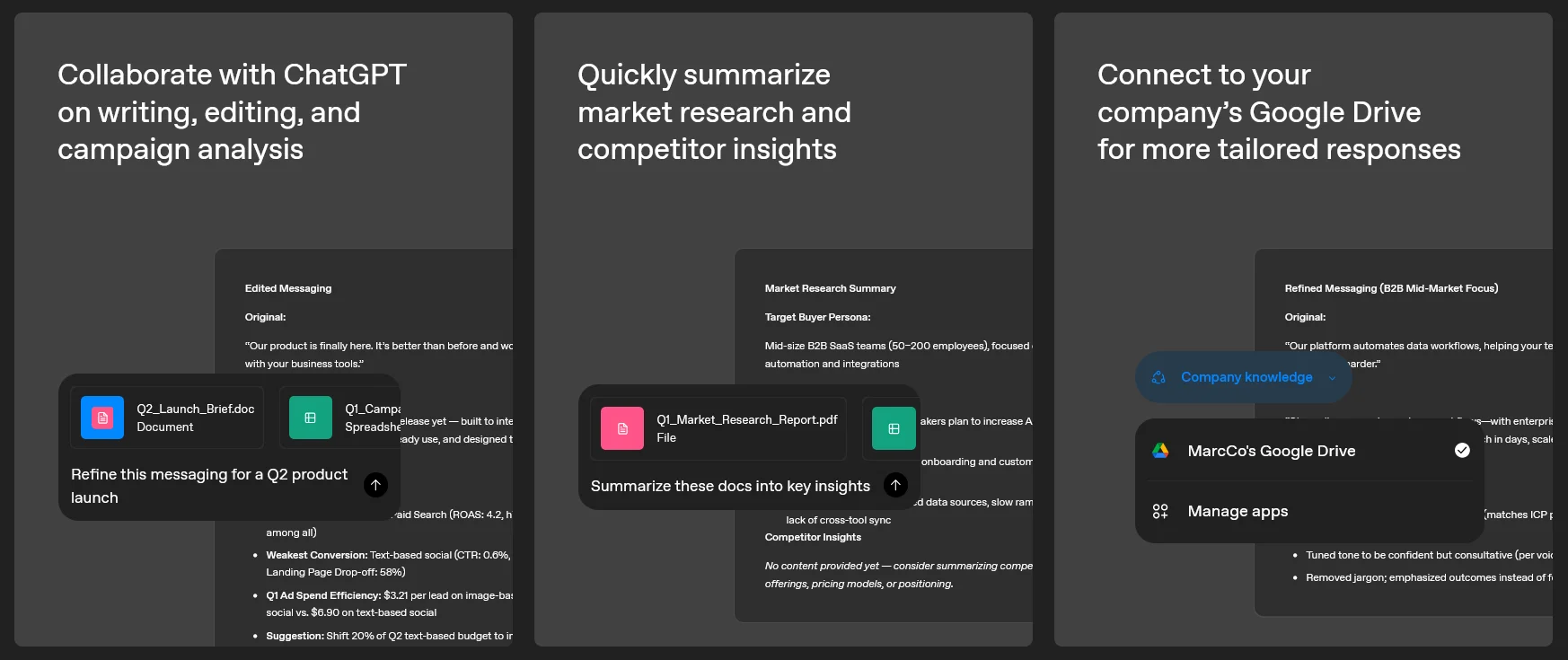
For many early-stage businesses, it’s more than enough. If you’re figuring out your messaging, testing creative angles, or writing one-off content pieces, ChatGPT is hard to beat for the price.
But it has four structural limitations that start to matter the moment you need your marketing to run consistently:
No memory → no continuity
No execution → no output
No integrations → no leverage
No autonomy → no consistency
Does ChatGPT Remember Your Brand Between Sessions?
No, it doesn't. ChatGPT has limited and inconsistent memory. While it can store some preferences, it doesn’t reliably maintain a structured understanding of your brand across sessions.
With ChatGPT, every time you start a new session, you're likely starting from scratch. That means re-explaining your brand voice, re-describing your audience, and re-pasting your product details. It's just how the tool is designed. But for marketing, where consistency is everything, it adds up to a real-time cost.
Does ChatGPT publish or execute anything for you?
No. ChatGPT produces text. Everything that happens after the text appears is your job. You copy it to Buffer, paste it into Mailchimp, upload it to Meta Ads Manager, or resize the image for each platform.
ChatGPT generates while you execute; any integrations require additional setup and tooling. That distinction sounds minor until you're doing it every single week.
Does ChatGPT connect to your marketing platforms?
No, not natively. ChatGPT operates entirely inside a chat window. It has no native connection to your Instagram, your Google Ads account, your email list, or your website.
To get anything ChatGPT generates into the real world, you either do it manually or build a Zapier stack. Zapier helps, but it adds cost, complexity, and maintenance overhead on top of an already manual workflow.
Will your marketing keep running if you stop prompting ChatGPT?
No. ChatGPT is reactive by design. It works when you work. If you're busy, traveling, or just having a bad week, your social media goes quiet, your email list goes cold, and your ad campaigns stop getting attention.
There's no concept of a posting schedule, no awareness of your content calendar, and no mechanism to keep things moving on your behalf.
❌ ChatGPT is a powerful assistant, but it isn’t a system. Marketing breaks the moment consistency depends on you showing up every time, and for many businesses, that’s the real problem.
What Does Zaturn Do That ChatGPT Can’t?
Zaturn is a different category of tool entirely. It's not a chatbot you prompt for content. Rather, it's a marketing operations platform built around six named AI agents.
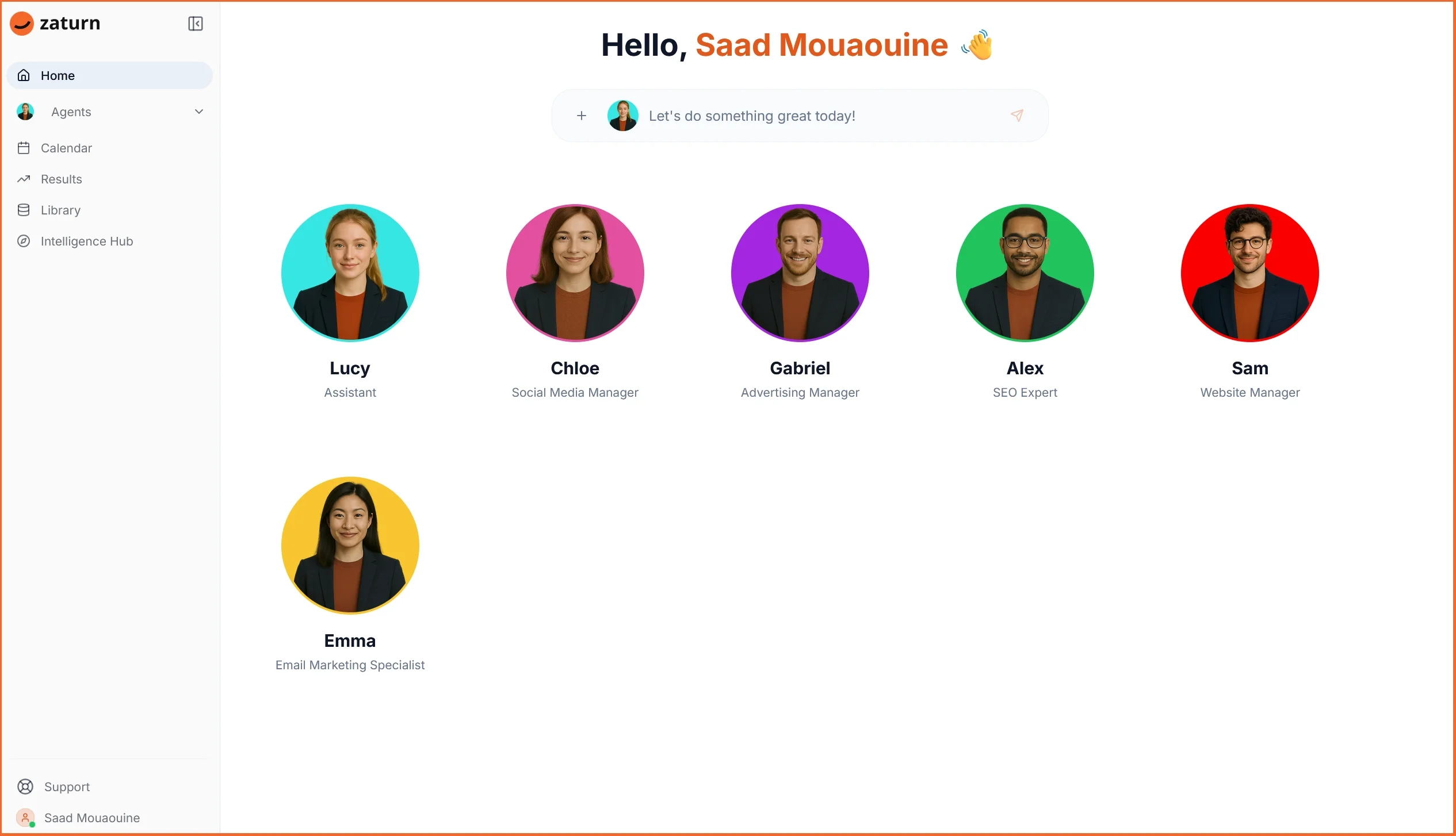
Each agent is responsible for a specific channel:
Chloe (social media)
Gabriel (advertising)
Alex (SEO)
Emma (email marketing)
Sam (website and CRO)
Lucy (general assistant).
They connect directly to the platforms they operate on and take real actions on your behalf. Here's what that means in practice.
Does Zaturn Remember Your Brand Permanently?
Yes. The Intelligence Hub is a central workspace where your brand voice, visual assets, audience details, goals, and platform integrations are stored permanently.
Every agent draws from the same context every time without being told. You set it up once and you never re-explain your brand again.
Does Zaturn Execute Marketing Actions or Just Generate Content?
Zaturn executes. Chloe plans your content calendar, generates platform-specific posts with on-brand visuals, and queues everything for your review; Gabriel builds a full media plan, creates ad variations, and launches the campaign after your approval and an expert compliance check; and Alex audits your site, optimizes your pages, and tracks your rankings continuously.
The output isn't text in a chat window. It's a scheduled post, a live campaign, an optimized page, or a sent email sequence. The work gets done without you needing to intervene at every step.
Does Zaturn Keep Running When You’re Not Actively Using It?
Yes. Once your agents are configured, they work continuously. Chloe has your month planned; Emma's welcome sequence fires for every new subscriber; Alex monitors your rankings and flags opportunities; and Gabriel tracks campaign performance and reallocates budget to what's working.
You check in, review, and approve while the rest keeps moving.
Are You Still In Control of What Goes Live?
Completely. Nothing publishes without your explicit approval. Every post, email, ad, and SEO change comes to your review queue first. You can edit, reject, or approve as-is. Zaturn handles the production. You stay in control of the brand.
What Does the Weekly Marketing Workflow Look Like for Zaturn and ChatGPT?
The clearest way to see the difference is to walk through what a typical week looks like with each tool.
Task | ChatGPT | Zaturn |
|---|---|---|
Brand context setup | Every session | Once, stored permanently |
Social media captions | You prompt + copy + paste | Chloe drafts + queues for approval |
Visual creation | ❌ | ✅ Generated on-brand automatically |
Scheduling | Manual (Buffer, Later, etc.) | Built in, multi-platform |
Email campaigns | You prompt + paste to tool | Emma writes, sequences, and sends |
Ad campaign creation | You prompt + build manually | Gabriel builds, expert reviews, launches |
SEO optimizations | You research + implement | Alex audits, optimizes, monitors |
Platform connections | ❌ | ✅ Native integrations, all channels |
Runs without you | ❌ | ✅ |
Approval before publish | N/A (you do it all) | Yes, every piece of content |
Weekly time investment | 6 to 10 hours | 20 to 30 minutes |
Let’s assume it’s the same business with the same goals. Note how different the experience is:
What Does a Week of Marketing Look Like with ChatGPT?
Open ChatGPT, start a new session, and paste your brand voice document.
Prompt for a week of social captions, edit the ones that don't land, and copy them one by one into Buffer.
Open a new session, re-explain your brand, prompt for an email newsletter, paste it into Mailchimp, and format it manually.
Open another session, generate ad copy variations, paste them into Meta Ads Manager, and set up targeting yourself.
Manually check your Google Analytics for SEO performance. There’s no connection and no insights; you work with raw data.
Repeat next Monday.
The total time is somewhere between 6 and 10 hours, whereas the total execution rests entirely on you. And if you miss a week, everything stops.
What Does a Week of Marketing Look Like with Zaturn?
Open Zaturn. Chloe has your week of content ready in the review queue, including captions, visuals, and hashtags that are platform-sized for each channel.
Spend 20 to 30 minutes reviewing, approve what you like, and edit anything that needs adjusting.
Check Gabriel's campaign dashboard. Performance is up, and he's already shifted budget to the winning ad.
Emma flagged that your re-engagement sequence is running and open rates are at 31%.
Alex identified a keyword gap and has a page optimization ready for your approval.
That's it. Close the tab; your marketing keeps running.
The biggest shift isn’t time saved; it’s what happens when life gets busy. With ChatGPT, a hectic week means your marketing goes dark. With Zaturn, your marketing keeps running regardless.
Is ChatGPT Cheaper Than Zaturn?
On paper, yes. ChatGPT Plus is $20/mo. Zaturn starts at $69/mo. But that comparison ignores the full cost of the ChatGPT marketing stack.
Tool | Monthly Cost | What It Covers |
|---|---|---|
ChatGPT Plus | $20/mo. | Content generation only |
Buffer or Later (scheduler) | $6/mo. — $25/mo. | Social scheduling only |
Zapier (basic automation) | $29.99/mo. | Connecting tools, limited actions |
Mailchimp (email) | $13/mo. | Email sending only |
Your time (10 hrs @ $50/hr) | $500/mo. | All the execution ChatGPT skips |
Total | $568.99+/mo. | Still requires manual work |
Zaturn Starter | $69/mo. | All 6 channels, fully integrated, execution included |
ChatGPT is the cheaper tool, but the ChatGPT marketing workflow isn’t cheaper. Most people don't account for the time cost of being the execution layer, but at even a modest hourly rate, those hours add up fast.
ChatGPT is $20/mo. The ChatGPT marketing workflow (with scheduling, email, and your own time included) easily runs $500/mo. or more. Zaturn at $69/mo. covers all of that in one pace
When Is ChatGPT the Right Tool?
ChatGPT genuinely is the right choice in certain situations. Here's when it makes sense to stick with it.
You're still figuring out your strategy: ChatGPT is an excellent thinking partner for early-stage business decisions, messaging experiments, and creative exploration. Before you have a clear brand voice and consistent channels, you need flexibility more than automation.
You need one-off creative work: Writing a pitch deck, brainstorming a product name, or drafting a press release are tasks that happen once and don't need to run on a schedule. ChatGPT handles them brilliantly.
Budget is a hard constraint: $20/mo. is $20/mo. If you're pre-revenue and every dollar counts, ChatGPT covers the content generation basics without committing to a platform.
You want a creative collaborator, not an operator: If you enjoy the writing process and want AI to assist rather than replace your involvement, ChatGPT's interactive model is more satisfying than an approval queue.
When Is Zaturn the Right Tool?
Zaturn makes sense when the problem is execution capacity. Here's the specific profile:
Your marketing stops when you get busy: If a hectic week or a vacation means your social media stops and your email list goes cold, that's a tool problem.
You're spending more time prompting than running your business: If ChatGPT plus manual deployment is eating 6 to 10 hours a week, the ROI of that time doesn't make sense compared to a platform that handles execution for you.
You need multiple channels running consistently: Social media, email, SEO, and paid ads all require different cadences and different expertise. Keeping all of them moving manually is a full-time job.
You've tried the ChatGPT plus Zapier stack and it still feels like you're the engine: Automation stacks help, but they're brittle, require maintenance, and still depend on you feeding them prompts. Agents that work from persistent context are a different level of reliability.
You want your marketing to compound: Consistent posting, ongoing SEO, and live ad campaigns all compound over time. That compounding only happens if the work keeps getting done. Zaturn makes consistency the default instead of the goal.
If you're posting 2 to 3 times a week when you remember and going quiet for stretches, that inconsistency is costing you more reach than any content quality issue. Consistency is the highest-ROI change most small businesses can make, and it's the one Zaturn addresses directly.
Can You Use Both ChatGPT and Zaturn Together?
Yes, and for many users, it makes sense.
→ Zaturn handles your operations: consistent social media, email sequences, ad campaigns, SEO, and CRO.
→ ChatGPT handles the creative side: brainstorming campaign concepts, writing long-form content that needs a human touch, working through strategy decisions, or drafting anything that doesn’t fit a repeating pattern.
Essentially, Zaturn runs your marketing while ChatGPT helps you think about it.
Zaturn vs ChatGPT: Final Thoughts
ChatGPT is one of the most useful tools ever built for generating content on demand. That's not the same as running a marketing operation, and most small business owners need the second thing more than the first.
If you're the engine in your marketing workflow (prompting, copying, pasting, scheduling, and checking), the question isn't whether ChatGPT is good enough. It's whether the model is costing you more in time and inconsistency than you realize.
Zaturn's six agents handle the execution layer that ChatGPT leaves entirely to you. Chloe runs your social media. Gabriel manages your ads. Alex handles your SEO. Emma takes care of your email list. Sam makes sure your website converts. You only need to spend 30 minutes a week reviewing what they've prepared.
Ready to see what your marketing looks like when it actually runs? Zaturn’s 14-day free trial requires no credit card. Set up your agents and see the difference between generating content and executing marketing.