6 Best AI Email Marketing Tools That Actually Save Time in 2026
We compared the 6 best AI email marketing tools that actually change how much time you spend on email, not just slap a subject line generator on top. One of them doesn’t need you to write a single word.
What Are the Different Types of AI Email Marketing Tools?
Before we get into our list, it helps to understand that not all tools work the same. Knowing what you’ll come across will help you decide which platform to invest in.
Type | What it means | Examples |
|---|---|---|
Platform AI | Traditional email platform with AI features bolted on, such as subject line suggestions, send time optimization, and content generation. You still run the campaign. | Mailchimp, Brevo, Klaviyo, ActiveCampaign |
Agentic AI | An AI agent that handles the full email workflow, including strategy, writing, segmentation, and sending, and submits everything for your approval before it goes out. | Zaturn, Sintra |
The tools in the first category make you faster, but the tool in the second category gets email off your plate.
Best AI Email Marketing Tools at a Glance
Here’s how the five tools stack up on the features that actually matter for small businesses.
Tool | Starting Price | Rating | Writes emails for you | Full automation | Strategy planning | Approval workflow |
|---|---|---|---|---|---|---|
Zaturn (Emma) | $69/mo. | 4.0/5 (Trustpilot) | ✅ | ✅ | ✅ | ✅ |
ActiveCampaign | $15/mo. | 4.4/5 (G2) | ❌ | ✅ | ❌ | ❌ |
Klaviyo | $20/mo. | 4.6/5 (G2) | ❌ | ✅ | ❌ | ❌ |
Brevo | $9/mo. | 4.5/5 (G2) | ❌ | ⚠️ | ❌ | ❌ |
Mailchimp | $13/mo. | 4.4/5 (G2) | ❌ | ⚠️ | ❌ | ❌ |
Sintra | $48.5/mo. | 4.8/5 (Trustpilot) | ✅ | ✅ | ✅ | ✅ |
1. Zaturn (Emma) — Best AI Email Marketing Assistant
Zaturn’s AI email assistant, Emma, writes your emails, plans the strategy, handles the automations, and sends everything after you approve. At $69/mo. for the full platform, it gets email off your plate entirely.
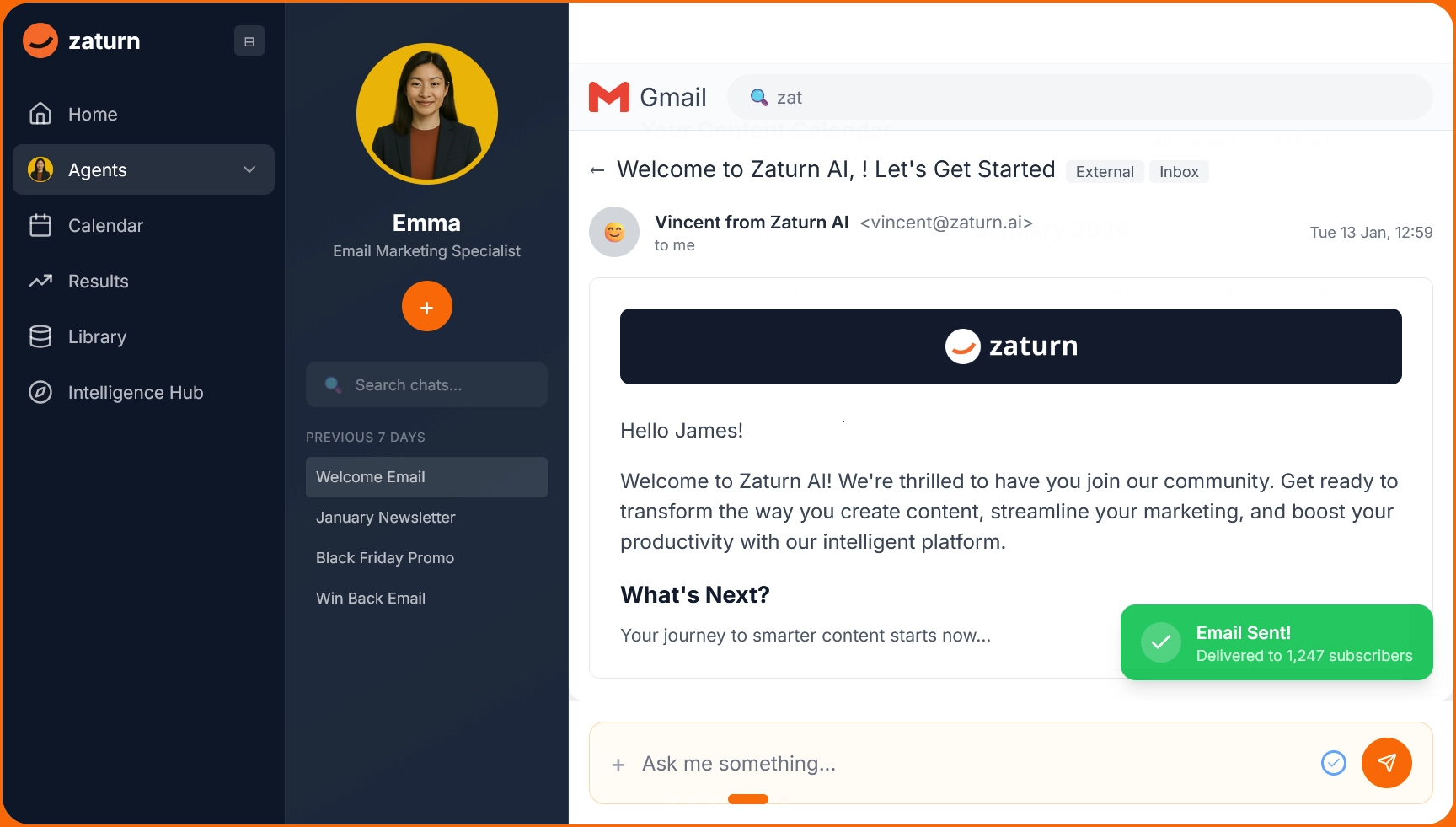
Email platforms with AI features ask you to do the work. You have to open a campaign, hit a button to generate a subject line, rewrite half of it, then figure out the send time yourself. That’s AI assistance, and it’s not the same as AI execution.
Emma is Zaturn's email marketing agent. You tell her your goal (grow the list, re-engage inactive subscribers, or launch a product), and she plans the campaign calendar, writes the copy in your brand voice, sets up the automations, and puts everything in a queue for you to approve.
Nothing is sent without your sign-off. She integrates directly with Mailchimp, Brevo, Outlook, and Gmail so you keep whatever email service provider (ESP) you're already using.
Notable Features
Email strategy and calendar: Emma plans what to send, when to send it, and why. She’s built around your actual business goals rather than generic best practices.
Campaign copywriting: Subject lines, email body, CTAs, and multiple variations to test. Written in your brand voice, not a generic template.
Automated sequences: Welcome flows, cart abandonment, post-purchase, re-engagement. Emma builds these during setup so they're running from day one.
Smart segmentation: The right message to the right people. Emma segments your list and personalizes content based on behavior and subscriber data.
A/B testing: Subject lines, send times, and content variations are tested continuously so performance improves over time.
Approval queue: Every email gets reviewed before it sends. You can edit, reject, or approve as-is.
Pros and Cons
Pros | Cons |
|---|---|
✅ She handles the full email workflow, not just suggestions | ❌ Newer platform, so there are fewer third-party reviews than established tools |
✅ Emma is part of a team of agents, a Zaturn subscription gets you SEO, ads, social media, and website CRO | ❌ Approval is required before sending emails; it’s not ideal if you want 100% autonomous sending |
✅ She works with your existing ESP (Mailchimp, Brevo, etc.) no migration is required | |
✅ Strategy, copy, automations, and segmentation are all included at $69/mo. | |
✅ Everything goes through approval, nothing sends without you |
Pricing
Plan | Price | What's included |
|---|---|---|
Starter | $69/mo. | All 6 agents including Emma, all integrations, 1 workspace, 1 user, unlimited content, 14-day free trial |
Growth | $129/mo. | Everything in Starter, 3 workspaces, 3 users, priority support, onboarding call |
Custom | Talk to Sales | Unlimited campaigns, white-label, dedicated success manager |
📌 If email is the channel you keep putting off because there’s never enough time to do it properly, Emma is the answer. Try it for free for 14 days; no credit card is required.
2. ActiveCampaign — Best Email Marketing Automation Platform
ActiveCampaign has the most powerful automation builder in the category. If you need complex, branching behavioral flows tied to CRM data, nothing on this list goes deeper.
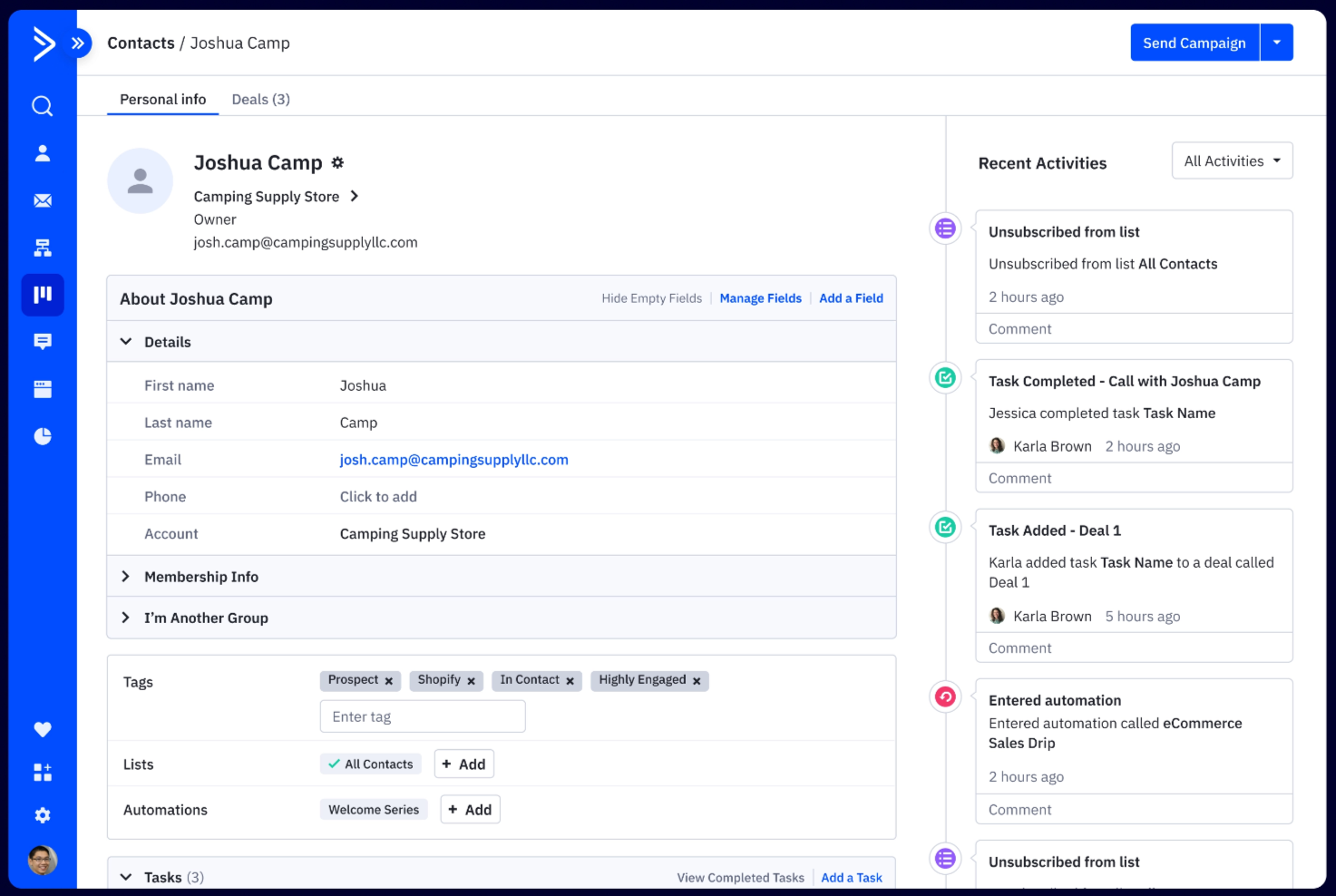
ActiveCampaign’s Active Intelligence monitors customer behavior and campaign performance in real time, then adjusts your strategy automatically. It suggests segments you wouldn't have thought to create, builds complete workflows from a plain language description, and adapts send timing per individual contact based on their engagement history.
The automation builder lets you build conditional logic across dozens of paths, trigger emails based on CRM deal stage, predict win probability on open deals, and run split tests on up to five variants simultaneously.
If you’ve outgrown the basics, then it’s a serious tool you should consider. However, it’s complex. The learning curve is huge, and getting full value from it without a marketing background takes time.
Notable Features
Active Intelligence: Monitors behavior and performance in real time, proactively adjusts strategy, and surfaces AI-suggested actions based on billions of data points from similar businesses.
AI-suggested automation workflows: Describe your goal and Active Intelligence builds the workflow. It launches with the right messaging, timing, and next steps already structured.
Predictive sending: Determines the best send time per individual contact based on their historical engagement.
CRM-native: Email and CRM are in one platform. Automations can trigger based on deal stage, contact activity, or pipeline movement.
Split testing up to 5 variants: Test subject lines, content, and send times simultaneously. It’s more sophisticated than the standard A/B test most platforms offer.
Pros and Cons
Pros | Cons |
|---|---|
✅ It has the best automation depth in the category | ❌ It’s expensive for startups and small teams |
✅ The AI-powered segmentation finds high-value audiences automatically | ❌ Its feature set is limited, particularly when it comes to personalization and customization |
❌ It learning curve is very steep |
Pricing
Plan | Starting price (1,000 contacts) | What's included |
|---|---|---|
Starter | $15/mo. (billed annually) | Active Intelligence (limited), email marketing, basic automation, 5 actions per automation |
Plus | $49/mo. (billed annually) | Unlimited automation actions, standard segmentation, landing pages, CRM integrations |
Pro | $79/mo. (billed annually) | Advanced segmentation, predictive content, attribution tracking, 3 users |
Enterprise | $145/mo. (billed annually) | Premium segmentation, custom objects, SSO, dedicated account team |
📌 ActiveCampaign is the strongest pick if you need behavioral automation tied to CRM data and you have the patience to learn it. If you just want solid email marketing without the complexity, the tools below are easier starting points.
3. Klaviyo — Best E-Commerce Email Marketing Platform
Klaviyo was built for e-commerce from the ground up. If you run an online store, its Shopify and WooCommerce integration, as well as the behavioral flows it enables, are unmatched at this price point.
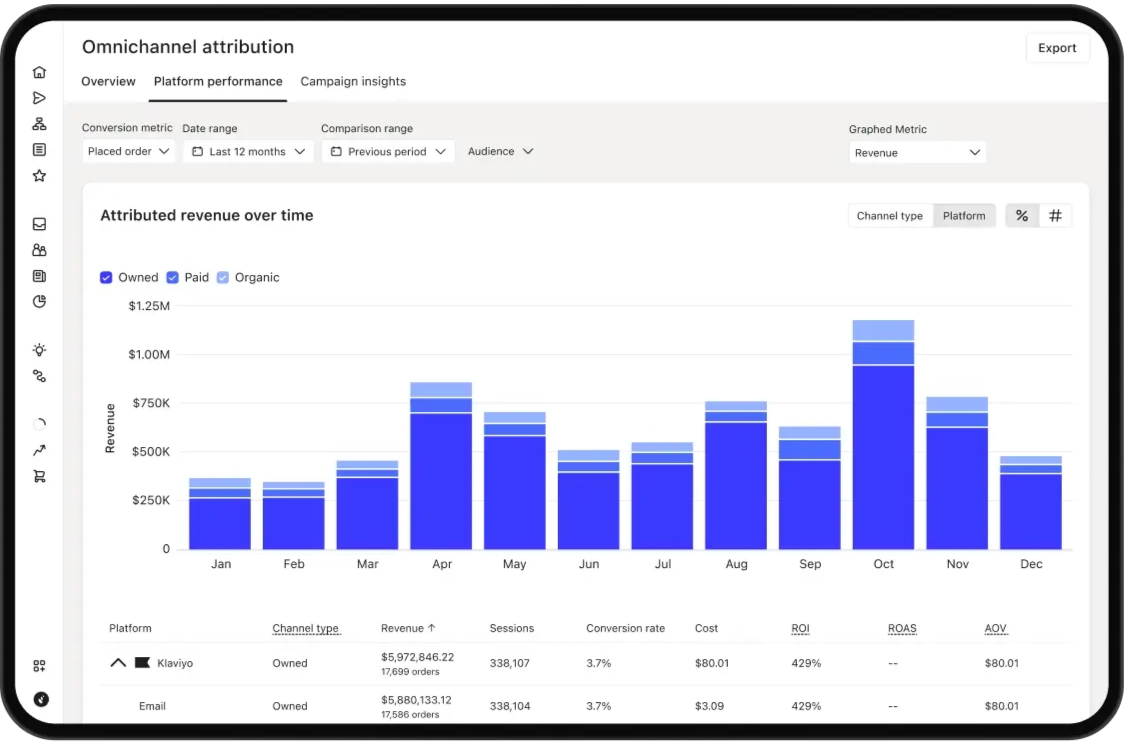
Klaviyo treats e-commerce as a use case. The customer profiles feature pulls in real-time purchase data, browsing behavior, and predictive metrics like customer lifetime value and churn risk.
Flows trigger on actual store events (price drops, abandoned carts, post-purchase, and back-in-stock), with the kind of granularity that generic ESPs require workarounds to achieve.
Klaviyo’s AI side has matured. Now, Flows AI builds automation sequences from plain language. Smart Time Send finds the optimal delivery window per subscriber. The Marketing Agent (available on paid plans), can generate campaign briefs, suggest segments, and create launch-ready flows.
It doesn’t write campaigns for you the way Emma does, but it does cut down the setup time for store owners who know what they want but hate building it manually.
Notable Features
Ecommerce-native flows: Pre-built triggers for abandoned cart, browse abandonment, post-purchase, win-back, and price drop notifications. All of these are connected directly to your store data.
Predictive analytics: Customer lifetime value, churn risk, and expected next order date are calculated per subscriber. This helps you prioritize who to re-engage and when.
Flows AI: Describe the flow you want and Klaviyo builds it. It works well for standard e-commerce sequences and saves the manual setup time.
Smart Send Time: It delivers emails at the optimal time per individual subscriber based on their engagement history.
350+ integrations: Shopify, WooCommerce, Magento, and most major e-commerce platforms have deep native integrations that sync customer and purchase data automatically.
Pros and Cons
Pros | Cons |
|---|---|
✅ It has the best ecommerce integration in the category | ❌ It’s expensive for beginners |
✅ It has powerful automation capabilities with real purchase and behavioral data | ❌ Its learning curve is steep; you need to invest time to fully understand it |
✅ It’s relatively easy to use considering its features and depth | ❌ Many users complain about the platform’s customer support, noting it takes long to get answers during critical times |
❌ The platform has limited tempates and intuitive editing features |
Pricing
Plan | Starting price (251–500 profiles) | What's included |
|---|---|---|
Free | $0/mo. | Up to 250 profiles, 500 emails/mo., basic reporting, email support |
From $20/mo. | Unlimited emails, all integrations, predictive analytics, AI segments, Marketing Agent | |
Email + SMS | From $45/mo. | Everything in Email plus SMS/MMS marketing |
📌 If you run an e-commerce store, Klaviyo is probably the right tool. If you don’t, the e-commerce-specific depth is wasted and something simpler will serve you better.
4. Brevo — Best Budget Multi-Channel Email Marketing Platform
Brevo’s pricing model charges by email volume rather than contact count, which makes it genuinely affordable for businesses with large lists. The AI features are limited, but the multi-channel coverage (email, SMS, WhatsApp, and push) is unusually strong for the price.
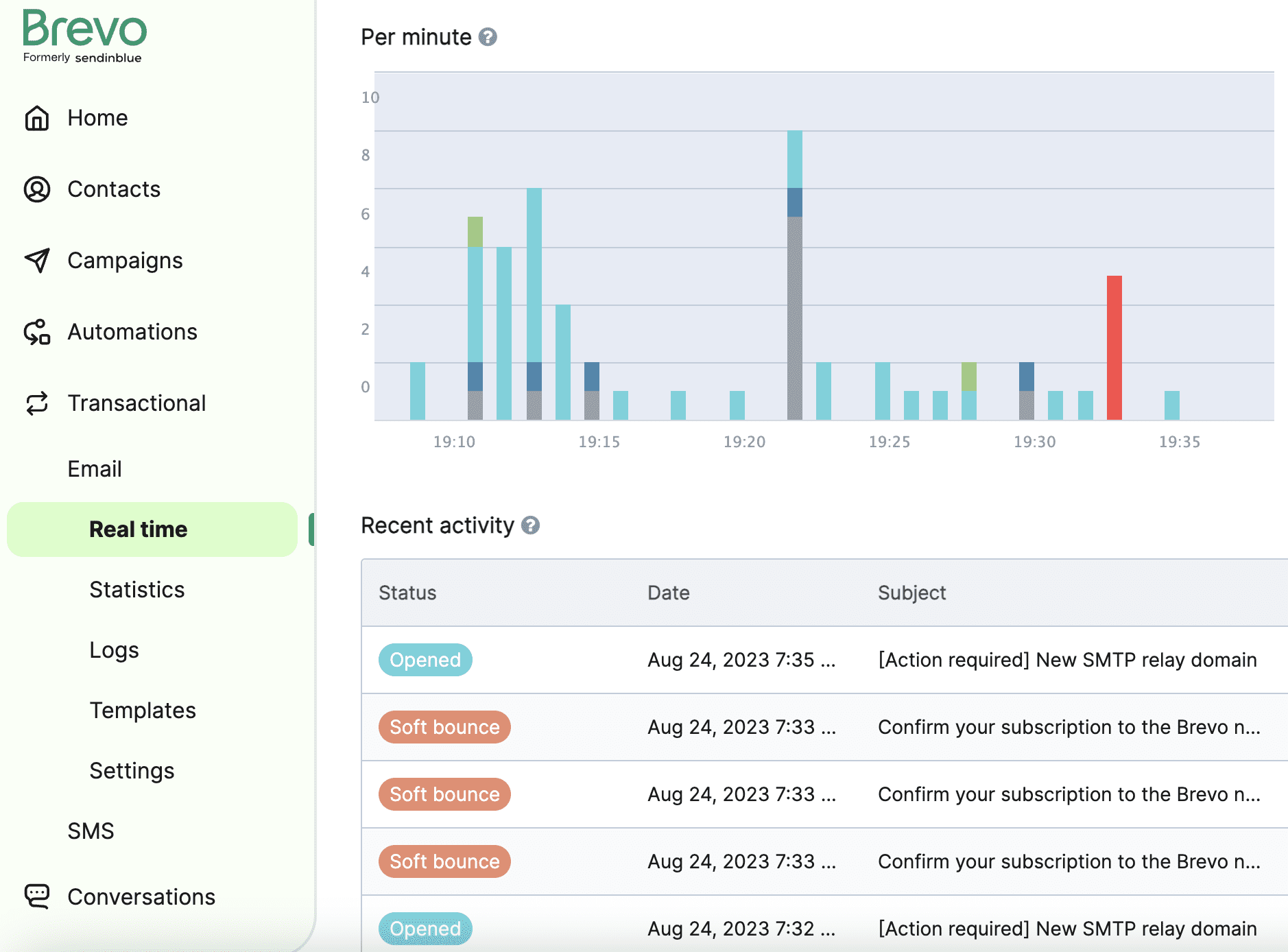
ESPs charge based on how many contacts you have, but Brevo charges based on how many emails you send. If you have a large email list but email it infrequently, that’s a meaningful cost difference.
The free plan lets you send 300 emails per day to unlimited contacts, which is almost unique in this category.
The AI features are limited. Subject line suggestions and send time optimization work well enough. The automation builder covers the basics (welcome sequences, abandoned cart, and re-engagement) but doesn't have the conditional branching depth of ActiveCampaign or the ecommerce-native triggers of Klaviyo.
Where Brevo stands apart is multi-channel: email, SMS, WhatsApp, and web push all run from the same workflow, which is normally something you'd need multiple platforms to cover.
Notable Features
Volume-based pricing: Pay for emails sent, not contacts stored. The free plan allows 300 emails/day to unlimited contacts.
Multi-channel workflows: Email, SMS, WhatsApp, and web push are triggered from a single automation. Most competitors require separate platforms for this coverage.
AI subject line generator and send time optimization: They’re practical and functional. They won't blow you away but they cover the basics well.
Transactional email included: Order confirmations, password resets, and other transactional sends from the same platform as your marketing email; no separate service is needed.
Unlimited contacts on all plans: No cap on list size regardless of plan tier.
Pros and Cons
Pros | Cons |
|---|---|
✅ Volume-based pricing makes it the most affordable option for large, infrequently emailed lists | ❌ Design flexibility and template customization are limited |
✅ The integration with WooCommerce is deep and smooth | ❌ The automation depth is shallow compared to ActiveCampaign |
✅ Multi-channel coverage in one platform is rare at this price | ❌ Many users struggle with the platform’s flexibility and bureaucracy as their needs grow |
✅ It’s easy to set up and has an intuitive, beginner-friendly interface |
Pricing
Plan | Price | What's included |
|---|---|---|
Free | $0/mo. | 300 emails/day, unlimited contacts, basic automation, Brevo branding on emails |
Starter | $9/mo. | From 5,000 emails/mo., no daily limit, remove Brevo branding |
Standard | $18/mo. | From 5,000 emails/mo., landing pages, marketing automation, A/B testing |
Professional | $499/mo. | 150,000 emails/mo., 2M contacts, 10 seats, advanced features |
📌 Brevo makes the most sense if you have a large list you email occasionally, you need multi-channel without paying for multiple platforms, or you want free tier functionality that’s actually useful.
5. Mailchimp — Best Enterprise Email Marketing Platform
Mailchimp is the platform most people have heard of, and that recognition isn’t accidental. It’s easy to use, the free plan is generous, and the AI features are competent. However, the pricing gets punishing fast as your list grows.
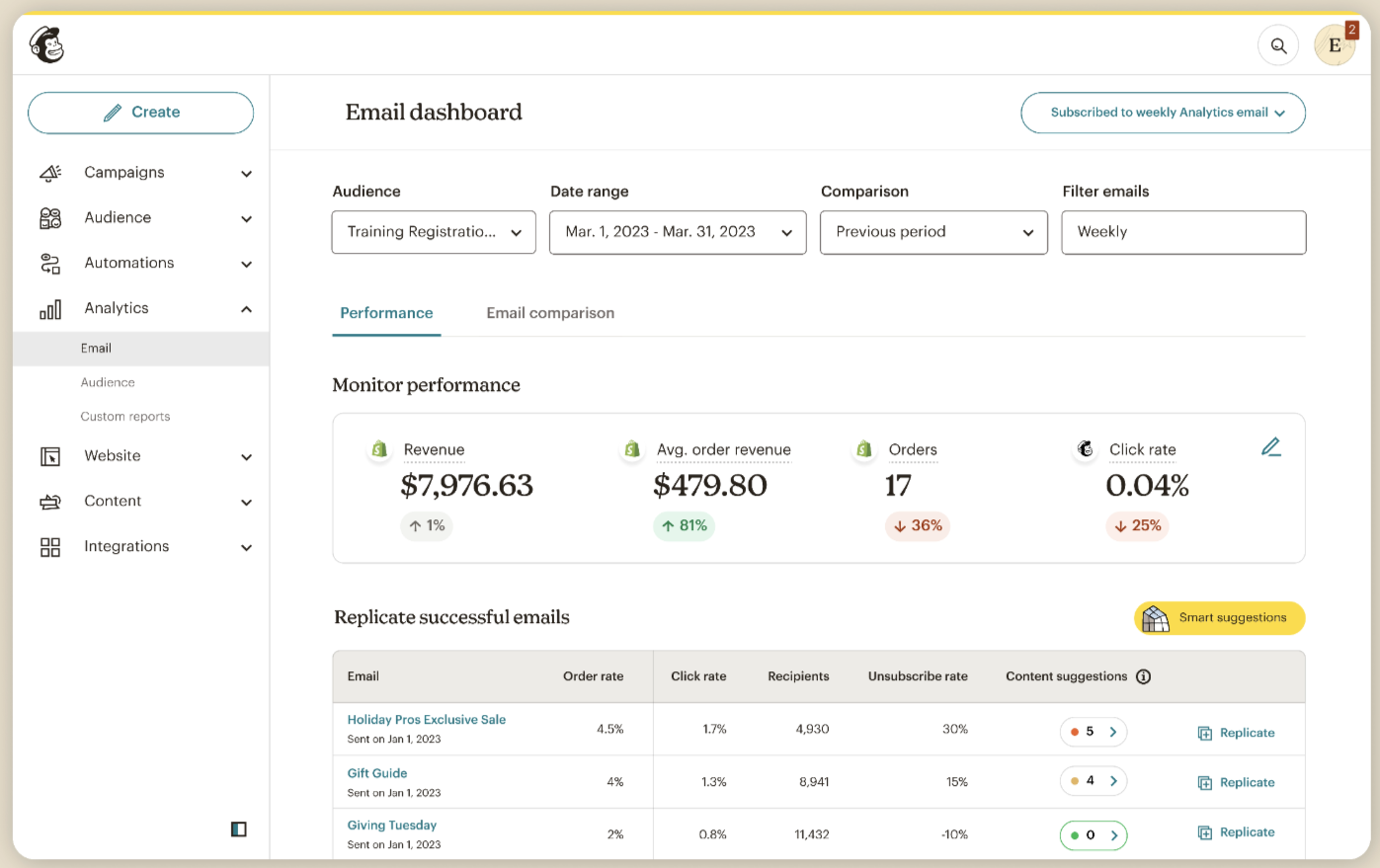
The interface is still the most approachable on this list. The Creative Assistant pulls your brand colors and assets and generates email designs on the fly. The AI subject line tool and send time optimization work as advertised.
But Mailchimp’s issue is pricing. It charges by contact count, and the jump from the free to the paid plan (and paid to the next tier) happens faster than most people expect. At 10,000 contacts, you’re looking at $135+/mo. for capabilities that other tools on this list include for less.
The automation depth also lags behind ActiveCampaign and Klaviyo. Most users who outgrow Mailchimp end up at ActiveCampaign; it’s rarely the other direction.
Notable Features
Creative Assistant: It pulls your brand colors, fonts, and logos to generate on-brand email templates automatically. It’s useful for teams without a designer.
AI subject line suggestions and send time optimization: It’s functional and well-implemented. It analyzes past campaign performance to recommend what works for your specific audience.
Content Optimizer: It reviews your email content and suggests improvements based on engagement data from similar campaigns.
Generative AI copywriting: You can generate subject line variations and email body copy inside the campaign builder. It’s not as deep as a dedicated writing agent, like Zaturn’s Emma, but it covers the basics.
Large template library: It comes with hundreds of pre-built templates covering most email types. That’s a good starting point if you don't want to build from scratch.
Pros and Cons
Pros | Cons |
|---|---|
✅ It has one of the easiest interfaces in the category | ❌ Pricing scales aggressively as your list grows |
✅ The email marketing features are intuitive and easy to use, particularly for campaign management and performance tracking | ❌ The free version has meaningful feature restrictions |
✅ The Creative Assistant generates on-brand templates without design skills | ❌ Contact import and social media link management aren’t intuitive to use |
Pricing
Plan | Starting price (0–500 contacts) | What's included |
|---|---|---|
Free | $0/mo. | Up to 500 contacts, 1,000 emails/mo., basic templates, Mailchimp branding |
Essentials | From $13/mo. | 3 audiences, A/B testing, scheduling, 24/7 support |
Standard | From $20/mo. | Automation, behavioral targeting, send time optimization, custom templates |
Premium | From $350/mo. | Unlimited audiences, advanced segmentation, multivariate testing, priority support |
📌 Mailchimp is a reasonable starting point if you’re new to email and want a gentle learning curve, but once your list hits a few thousand contacts, the cost-to-value ratio tips towards alternatives.
6. Sintra — Best for Existing Sintra Users
Sintra’s Emmie is closer to Zaturn’s Emma on this list. She’s an AI agent that runs email marketing in the background; all you have to do is set the email strategy once. The credit cap at 250/month is the main constraint for high-volume senders.
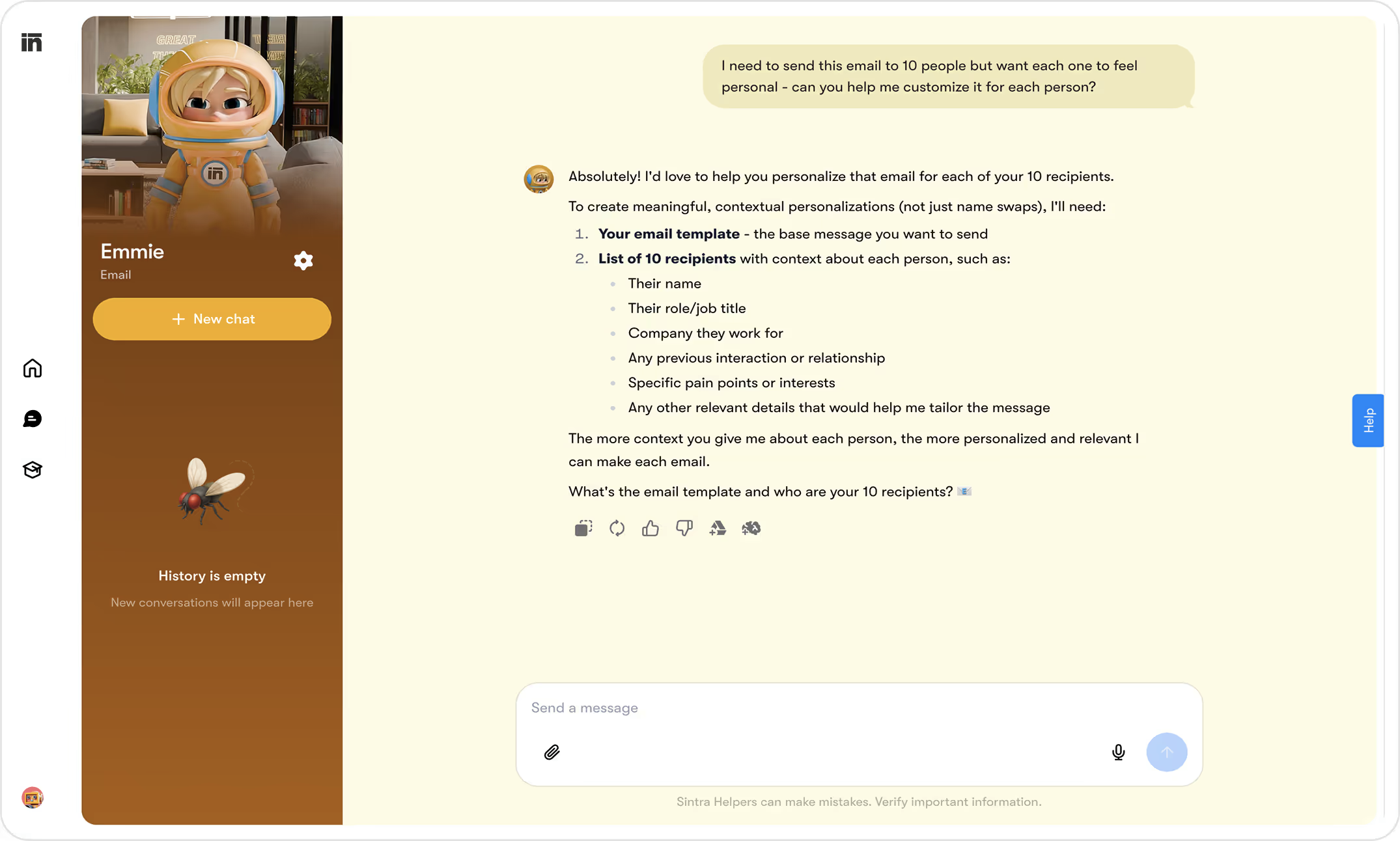
Emmie operates like a dedicated email agent. You brief her once (brand, audience, goals, and tone), and she runs campaigns, builds flows, schedules sends, and reviews performance without needing constant input.
The Brain AI memory system stores your strategy and past decisions so context doesn't reset between sessions. She connects to Gmail and Outlook natively and handles over 150 languages, which is useful for businesses selling across markets.
The main limitation is Sintra's credit system. At 250 credits per month, high-frequency senders will hit the ceiling. Emmie is also part of Sintra's broader AI employees platform. If you only need email, you're paying for a lot you won't use, unless you invest in Emmie alone for $39/mo.
Notable Features
Consistent memory: Brain AI memory stores brand, audience, and campaign context permanently. You don’t need to re-brief between sessions
Autonomous triggers: Abandoned cart, welcome, win-back, and holiday campaign flows are built autonomously.
Easy integrations: Gmail and Outlook natively integrate with Sintra, and the platform supports 150+ languages.
Approval workflow: There’s an approval queue before anything sends. It’s the same model as Zaturn that keeps the AI agent under your control.
Full AI team: Emmie is part of a broader 12-agent team. She can collaborate with Sintra’s other AI agents for copy refinement and research.
Pros and Cons
Pros | Cons |
|---|---|
✅ Emmie is genuinely agentic. She runs email in the background without constant prompting | ❌ 250 credit/month cap restricts high-volume senders |
✅ The Brain AI memory means no re-explaining your brand every session | ❌ Unless you pay for Emmie alone, you’ll be investing in 12 helpers — it’s overkill if email is all you need |
✅ 150+ language support with native tone adaptation | ❌ The e-commerce integrations aren’t as deep as Klaviyo |
❌ Approval is required before sending emails; it’s not ideal if you want 100% autonomous sending |
Pricing
Plan | Pricing | What’s included |
|---|---|---|
1-month plan | $48.50/mo. | All 12 helpers, 250 monthly credits, 15+ integrations, 24/7 support |
3-month plan | $23.60/mo. | All 12 helpers, 250 monthly credits, 15+ integrations, 24/7 support |
12-month plan | $15.60/mo. | All 12 helpers, 250 monthly credits, 15+ integrations, 24/7 support |
Emmie (Individually) | $39/mo. | Emmie, the email marketing assistant, only |
📌 Emmie handles email marketing autonomously, and the Brain AI memory is useful. However, the 250 credit cap and bundled pricing make it harder to justify as a standalone email tool, especially when Zaturn’s Emma covers the same function with no credit limits and deeper integrations.
How to Pick the Right AI Email Marketing Tool
Your situation is what should drive the choice, not which platform has the longest feature list. Regardless, here’s a quick list that might help.
If you need this... | Go with this |
|---|---|
Email marketing done for you — planned, written, and sent while you approve | Zaturn — $69/mo. |
Deep behavioral automation tied to CRM data | ActiveCampaign — from $15/mo. |
Email built around ecommerce data and purchase behavior | Klaviyo — from $20/mo. |
Multi-channel coverage at the lowest cost | Brevo — from $9/mo. |
Familiar interface with solid AI features and minimal setup | Mailchimp — from $13/mo. |
A free tier that's actually useful for an email list you don’t email often | Brevo or Mailchimp free |
Get Email off Your To-Do List Today With Zaturn
The tools above all make email marketing easier, but none of them make it disappear from your to-do list.
ActiveCampaign, Klaviyo, Brevo, and Mailchimp are still platforms you run. You write the campaigns, manage the flows, and decide what sends. The AI speeds that up, but it doesn’t replace it.
Zaturn’s Emma plans, writes, and queues everything. All you have to do is approve what goes out. For a business owner who’s been meaning to get serious about email marketing for months, that’s the solution you’ve been looking for.
Try Emma for free for 14 days — no credit-card is required →