Virtual Assistant for Marketing: What They Do and When AI Is Best
If you're a small business owner who has too marketing to do by yourself and not enough revenue to justify a full marketing hire, a virtual assistant for marketing is the answer you've been looking for. Here's why.
What Is a Virtual Assistant for Marketing?
A virtual assistant for marketing is a remote professional who handles the recurring execution work behind your campaigns.

Among other things, they:
Schedule posts,
Build email sends,
Update content, and
Prepare reports.
They’re generalists who coordinate marketing activity rather than specialists who execute any single channel in depth.
AI marketing assistants cover the same work across all five channels simultaneously, without the coordination overhead, for a fraction of the cost.
What Does a Virtual Assistant for Marketing Do?
It depends on who you hire and what you agree on. The role is broad by design. A marketing virtual assistant is typically a generalist: someone who can turn your strategy into executed tasks across multiple channels without you managing every detail.
In practice, most marketing virtual assistants cover a mix of the following:
Task category | What's typically included | What's usually not included |
|---|---|---|
Scheduling pre-written content, basic engagement, and posting to platforms | Content strategy, caption writing, visual creation, and performance analysis | |
Building sends in your email platform, list management, and basic reporting | Campaign strategy, copywriting, segmentation, and automation setup | |
Content | Uploading and formatting blog posts and updating pages | Writing the content, SEO optimization, and keyword strategy |
Basic keyword research assistance and metadata updates, if briefed | Technical audits, content creation, and rank monitoring | |
Advertising | Reporting on existing campaigns and basic admin | Campaign strategy, creative, audience targeting, and optimization |
Reporting | Pulling data into dashboards or spreadsheets | Interpreting data and making strategic recommendations |
The pattern is consistent across hiring platforms and VA services: marketing VAs coordinate and execute tasks you've already defined.
They don't usually set strategy, write the copy, build the campaigns from scratch, or run technical SEO. That's specialist work, and specialists cost considerably more.
How Much Does a Marketing Virtual Assistant Cost?
Rates vary depending on the assistant’s experience level, location, and whether you’re hiring through an agency or directly.
Bruntwork’s offshore marketing VAs (Philippines and Latin America) start at around $5.5/hour and can reach $15/hour.
US/UK-based marketing VAs range from $25 to $75/hour, which translates to $4,000 to $12,000/month full-time.
Managed VA services via MyOutDesk start at $1,988/month and cover dedicated part-time support.
Companies using virtual assistants reduce operational expenses by up to 78% vs. in-house equivalents.
The cost looks attractive until you account for what’s not included.
An offshore VA at $1,500 a month handles execution tasks you’ve already defined and briefed. If you need someone who can write your email campaigns, optimize your site for SEO, build ad campaigns, and analyze performance, that’s a different hire at a different price.
The hidden cost of a marketing VA is the time you spend briefing, reviewing, and connecting their work. For a generalist VA handling five channels, that management overhead often runs 3 to 5 hours a week. That time has to come from you.
Why Are Marketing Virtual Assistants Limited?
If you’re hiring a marketing virtual assistant expecting full coverage, you might be disappointed to find out that you’ll be mostly getting execution support for tasks you’ve already figured out.

Beyond that, here’s what makes marketing virtual assistants limited:
Specialist depth: A VA who handles social, email, SEO, ads, and content is a generalist in all of them. They’re good enough for basic execution but not deep enough for strategy or complex optimization in any single channel.
Continuity: VA turnover is a risk. When someone leaves, they take your briefing documents, your platform access history, and their understanding of your brand voice with them. Starting over costs time and quality.
Coverage gaps: Most marketing VAs don't touch technical SEO, paid advertising management, or conversion rate optimization. Those functions usually require separate specialists or agencies.
Time zone and availability: Offshore VAs work in different time zones. Urgent tasks, real-time engagement, and same-day turnarounds are harder to coordinate than the job description implies.
What Makes an AI Marketing Assistant Better?
For a large percentage of small businesses, the job they’re trying to fill isn’t “someone to manage tasks I’ve already defined.” They’re looking for someone to handle the marketing they’re not doing.

A human virtual assistant helps you bring your ideas to life, but an AI marketing assistant handles everything independently. They can:
Plan a calendar,
Write content,
Build campaigns, and
Surface everything for your approval.
You’re not briefing it on what to do; it figures out what needs doing based on your brand context and goals.
Human marketing VA | AI marketing assistant (Zaturn) | |
|---|---|---|
Monthly cost | ❌ $640 to $3,500 | ✅ $69 |
Channels covered | ⚠️ Generalist across 2 to 3 | ✅ Specialist across all 5 |
Writes content independently | ❌ Rarely — needs briefing | ✅ Yes, in your brand voice |
SEO capability | ❌ Basic at best | ✅ Full audit, content, rank tracking |
Ad campaign management | ❌ Admin only | ✅ Full campaign creation and monitoring |
Brand context retention | ❌ Needs re-briefing over time | ✅ Stored permanently in Intelligence Hub |
Availability | ⚠️ Agreed hours, time zone dependent | ✅ Continuous |
Your approval required | ⚠️ Varies by arrangement | ✅ Always — nothing goes live without sign-off |
Turnover risk | ❌ High — 18 to 24 month avg. tenure | ✅ None |
❓ A marketing VA is right when you have a defined process and need someone to run it. However, an AI marketing assistant might be the better option when you don’t have consistent marketing happening at all and need someone to own the execution from scratch.
How Does Zaturn Work as a Virtual Assistant for Marketing?
Zaturn’s six AI agents each handle a specific marketing channel. They draw from the same central brand context (the Intelligence Hub), so everything your business produces sounds consistent, without you coordinating between six different people or tools.
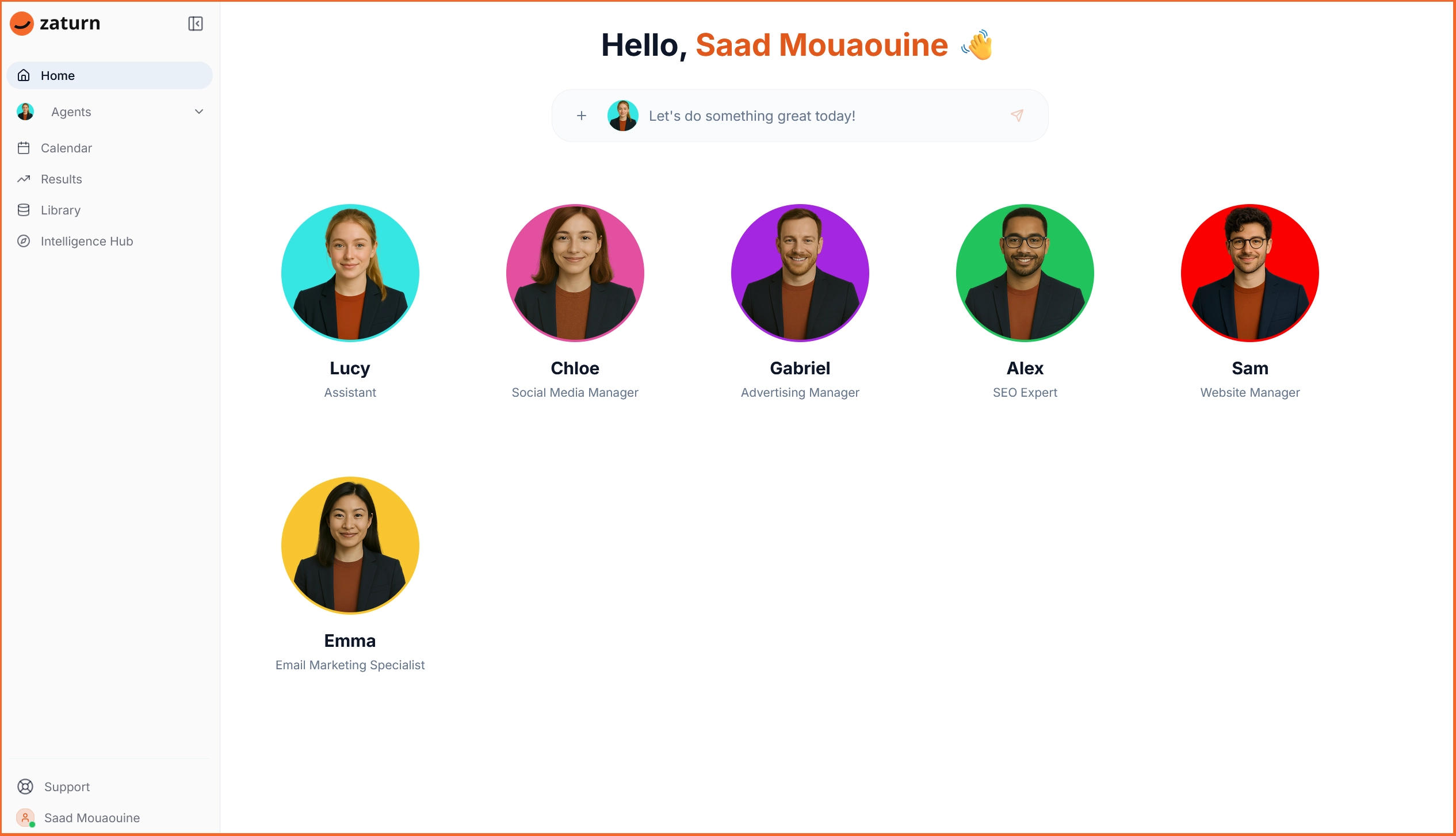
Chloe (Social Media): She handles the content calendar, platform-specific captions, on-brand visuals, scheduling, and analytics across LinkedIn, Facebook, Instagram, and X.
Emma (Email): She covers campaign strategy, copywriting, segmentation, automation sequences, and A/B testing. Integrations include Mailchimp, Brevo, Outlook, and Gmail.
Alex (SEO): He covers technical audits, keyword research, optimized blog posts, on-page optimization, and rank tracking via Google Search Console.
Gabriel (Advertising): He handles media plans, ad copy variations, audience targeting, and campaign monitoring across Google and Meta, with expert human review before launch.
Sam (Website/CRO): Covers conversion audits and prioritized recommendations with projected impact estimates.
Lucy (General): She routes requests and answers platform questions.
Everything goes through an approval queue. You review, edit if needed, and sign off before anything reaches your audience. For a full breakdown covering pricing and what each agent does, see our virtual marketing assistant guide.
Try Zaturn for free for 14 days; no credit card is required. Most users have their first week of content and an email campaign ready to review in the first session.