SEO AI Agent: The Secret to Beating SEO Tools In 2026
Semrush tells you your site has 14 technical issues. Then what? You still have to fix them. An SEO AI agent is different. It finds the problems, writes the fixes, and tracks whether they worked. Here’s how it works and when it makes sense.
What’s the Difference Between an SEO Tool and an SEO Agent?
The two are often confused, and choosing the wrong one means paying for data you can’t act on or execution without the strategy behind it. Here’s what you need to know.
SEO Tools (e.g., Semrush, Ahrefs, Moz) | SEO AI Agent (e.g., Alex) | |
What it does | Analyzes, reports, and recommends | Analyzes, decides, acts, and reports back |
Who executes | You, after interpreting the data | The agent, after your approval |
Output | Dashboards, reports, keyword lists | Fixed meta tags, published content, tracked rankings |
Runs continuously? | ❌ Only when you log in and query it | ✅ Monitors and acts on an ongoing basis |
Requires SEO expertise? | ✅ To interpret and prioritize findings | ❌ Prioritization and execution are handled |
Best for | SEO professionals who need data depth | Business owners who need SEO done |
📌 Think of it this way: An SEO tool is a dashboard. An SEO AI agent is a colleague. One shows you what needs doing.
How Does an SEO AI Agent Work?
Traditional SEO tools are query-based. You ask, they answer. An SEO AI agent is loop-based. It runs a continuous cycle without waiting for you to trigger each step.

Step 1: Observe
The agent connects to your live data sources: Google Search Console, Google Analytics, your CMS, and your site's crawl data.
It monitors rankings, impressions, click-through rates, crawl errors, and competitor movements continuously, not monthly, and not when you remember to check.
Step 2: Plan
Based on what it observes, the agent prioritizes opportunities and issues:
A page with high impressions but low CTR gets a title tag rewrite surfaced as a priority.
A keyword your competitor ranks for that you don't becomes a blog post brief.
A cluster of pages with thin content gets flagged for consolidation.
The agent doesn't wait for you to spot these; it finds them and queues them for action.
Step 3: Act
This is the main difference from a tool. The agent drafts the title tag rewrite, writes the blog post, optimizes the meta description, and submits everything for your approval.
You review the proposed action, which takes minutes rather than hours, and approve, edit, or reject. Nothing touches your site without your sign-off.
Step 4: Report
After the changes go live, the agent tracks whether the action worked:
Did the title tag rewrite improve CTR?
Did the new blog post gain impressions?
Which keywords moved?
The data feeds back into the observation layer, closing the loop and informing the next round of prioritization.
Step 5: Repeat
SEO compounds over time. An agent running this loop continuously produces compounding results. Each optimization builds on the previous one, rankings earned in month three keep delivering traffic in month twelve, and the agent's understanding of your site deepens with every cycle.
What Can an SEO AI Agent Handle?
It helps to understand what SEO AI agents can handle to create a strategy that can best use their capabilities.

Technical SEO Audits
A good SEO AI agent scans for issues and prioritizes them by impact and drafts the fixes. Broken internal links, missing schema markup, slow Core Web Vitals, duplicate title tags, pages blocked from indexing, and crawl errors all surface with proposed resolutions rather than just error codes.
❌ Without an agent: You run a Semrush audit, export a spreadsheet of 140 issues, try to figure out which ones matter, and hand them to a developer who has other priorities.
✅ With an agent: The audit runs automatically, the top 10 issues by ranking impact are surfaced with draft fixes, and the ones within your CMS capabilities go live after your approval.
Keyword Research and Gap Analysis
Rather than handing you a list of 2,000 keywords to sort through, an SEO AI agent identifies the specific opportunities your site can realistically target, accounting for your current domain authority, existing content, and competitive landscape, such as the following:
Keywords your competitors rank for that you don't.
Long-tail terms with commercial intent and low difficulty.
Local variations your service pages aren't capturing.
On-Page Optimization
Title tags, meta descriptions, header structure, internal linking, and content optimization are all handled by the agent.
They identify which pages need attention, draft the changes, and submit them for approval. For a site with 50 pages, this would take a human SEO consultant days. An agent surfaces the highest-impact changes within the first session.
SEO Content Creation
An SEO AI agent writes your blog posts for you. These posts are keyword-targeted, properly structured, with internal links to your existing content, and written in your brand voice.
The post is submitted for your review before publishing. Nothing goes live without your sign-off.
Rank Tracking and Opportunity Monitoring
Rather than logging into a rank tracker weekly to check whether anything moved, the agent monitors continuously and surfaces meaningful changes.
A page that jumped from position 11 to position 8 gets flagged as an opportunity for further optimization to push it to page one. A competitor gaining ground on a key term triggers a review of your competing content.
What Can’t an SEO AI Agent Do?
Although SEO AI agents handle execution pretty well, there are a few areas where human judgment is indispensable.
Link building outreach: Identifying link opportunities is something an agent does well, but actually earning the links requires personalized outreach and relationship building that's fundamentally human work.
Major site migrations: If you're rebuilding your site from scratch or moving platforms, get a human technical SEO specialist involved. The stakes are high enough that continuous autonomous action is the wrong approach.
Brand positioning and competitive strategy: Deciding which market position to pursue, how to differentiate from competitors, and what the long-term content strategy should be are judgment calls that require business context the agent doesn't have.
Algorithm crisis response: When a Google core update drops and traffic falls 40% overnight, a human needs to diagnose the cause and lead the recovery strategy. The agent surfaces the data; the interpretation is yours.
Highly specialized content: For medical, legal, or financial content that must demonstrate genuine subject matter expertise, human expert review before publishing is non-negotiable regardless of how good the agent's draft is.
SEO AI Agent Use Cases
The clearest way to understand what an SEO AI agent does is to see it applied to real scenarios.
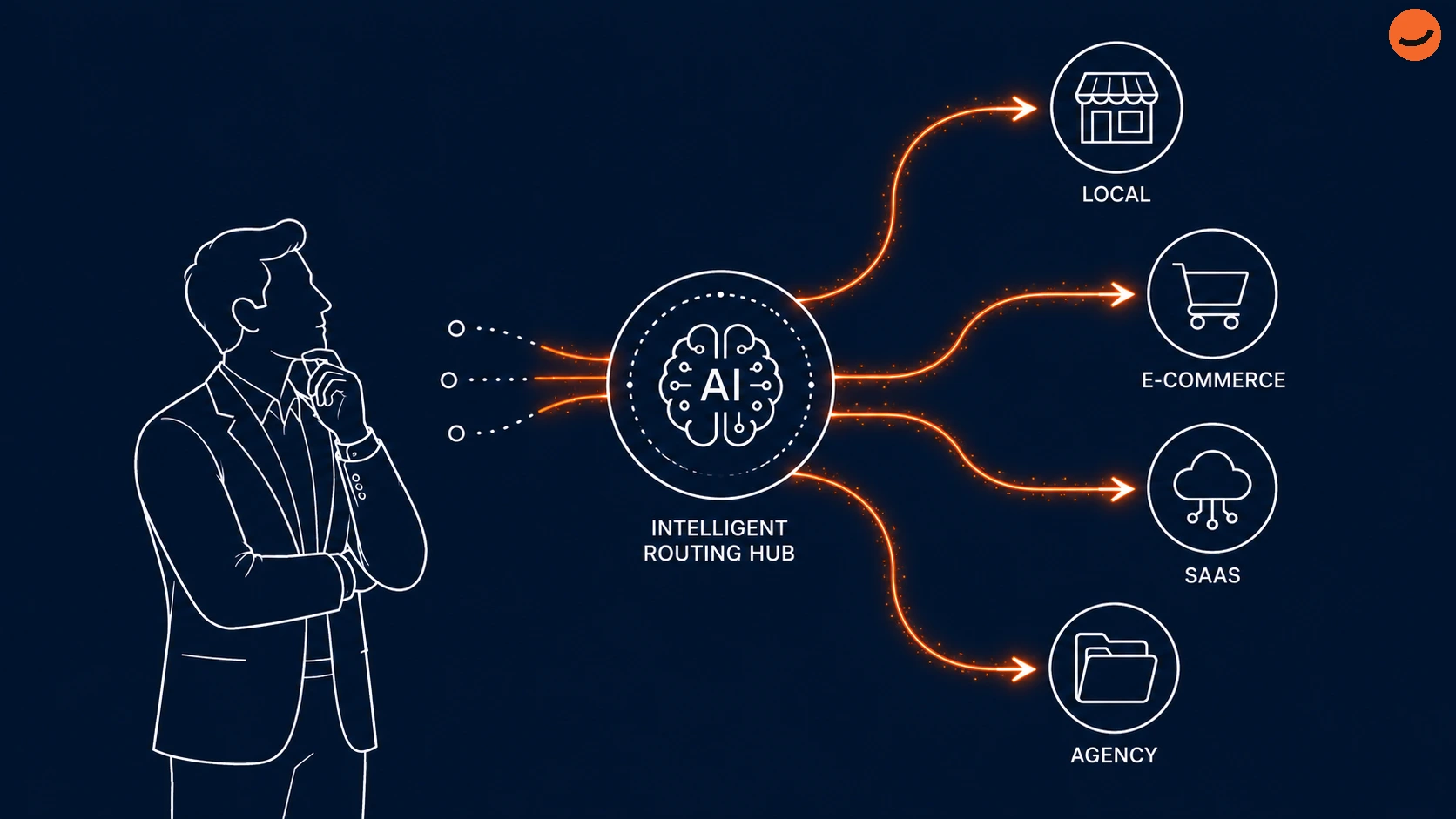
Here are four common situations where the agent/tool distinction makes the practical difference.
Use Case 1: The Local Service Business With Technical Issues
💭 Scenario: A plumbing company in Austin has been invisible in local search despite five years of operation. They know they should rank for “emergency plumber Austin” but consistently appear on page three. They’ve never had an SEO audit.
❌ What a tool shows them: Missing Google Business Profile schema markup. 23 pages with duplicate title tags. 6 pages blocked from indexing. Page speed score of 43/100 on mobile. A competitor ranking #1 with 40 more indexed pages.
✅ What an SEO AI agent does: Drafts schema markup for the homepage and service pages for approval. Rewrites 23 title tags with local keyword targeting. Identifies and fixes the indexing blocks. Generates a content brief for six new service area pages (Round Rock, Cedar Park, and Georgetown) that the competitor has and they don't. Submits everything for review; the owner approves or edits each item.
With a tool, the plumber has a spreadsheet of problems and no time to solve them. With an agent, the fixes are drafted and the content is written. The owner's job is to review, not to execute.
Use Case 2: The E-Commerce Store With Content Gaps
💭 Scenario: A Shopify store selling home office furniture gets traffic on product pages but nothing on informational searches. People searching “best standing desk for small spaces” or “how to set up a home office on a budget” aren’t finding them, and those searchers convert at higher rates than product visitors.
❌ What a tool shows them: Zero blog content indexed. Competitors ranking for 847 informational keywords they don't target. A content gap analysis showing the top-performing topics across three competitors.
✅ What an SEO AI agent does: Identifies the 12 highest-opportunity informational keywords based on search volume, difficulty, and commercial intent. Writes the first four articles targeting the best opportunities. Structures each with proper H1/H2 hierarchy, internal links to product pages, and schema markup for potential featured snippet capture. Submits each for review before publishing.
As a result, four SEO-optimized articles go live within the first two weeks. Each links to product pages with contextual anchors. The agent monitors impressions weekly and flags which posts are gaining traction for further optimization.
Use Case 3: The SaaS Company With Keyword Cannibalization
💭 Scenario: A project management SaaS has 60+ blog posts accumulated over three years. Traffic has plateaued despite regular publishing. A content audit reveals that seven articles are all targeting variations of “project management templates,” and none of them ranks above position 15 because they're competing with each other.
❌ What a tool shows them: A cannibalization report showing seven overlapping pages. Keyword data for each. No clear recommendation on which to keep, consolidate, or redirect.
✅ What an SEO AI agent does: Analyzes the seven pages by traffic, backlinks, and content quality. Recommends consolidating into two authoritative pieces: a template gallery page and a how-to guide. Drafts the consolidated content incorporating the best material from all seven originals. Proposes 301 redirect mappings for the five deprecated URLs. Submits the full plan for approval before touching anything.
What would take an SEO consultant a full day of analysis and a week of content work is handled in a single session. The owner reviews the plan, makes edits, and approves; the agent handles the implementation.
Use Case 4: The Agency Managing Multiple Client Sites
💭 Scenario: A five-person marketing agency manages SEO for eight small business clients. One team member handles all SEO work: monthly audits, keyword research, content briefs, and reporting. As the client roster grows, the quality of work degrades because there aren't enough hours in the week.
❌ What a tool shows them: Data for each client site, requiring interpretation and action for each one separately.
✅ What an SEO AI agent does: Runs continuous monitoring across all eight client sites simultaneously. Surfaces the three highest-priority actions per site each week. Drafts the content, title tag rewrites, and technical fixes for each client. The team member's job shifts from doing the SEO work to reviewing and approving what the agent produces, which is a fundamentally different time requirement.
One person can manage the output for eight clients when the agent handles the execution. Without the agent, four clients is realistic. The agency's capacity effectively doubles without adding headcount.
How Zaturn Works as an SEO AI Agent
Alex is Zaturn’s AI SEO agent. He connects directly to Google Search Console for real ranking data (not third-party estimates), runs full technical audits of your site, identifies keyword opportunities your site can realistically rank for, writes SEO-optimized blog posts targeting those keywords, and monitors how everything moves over time.
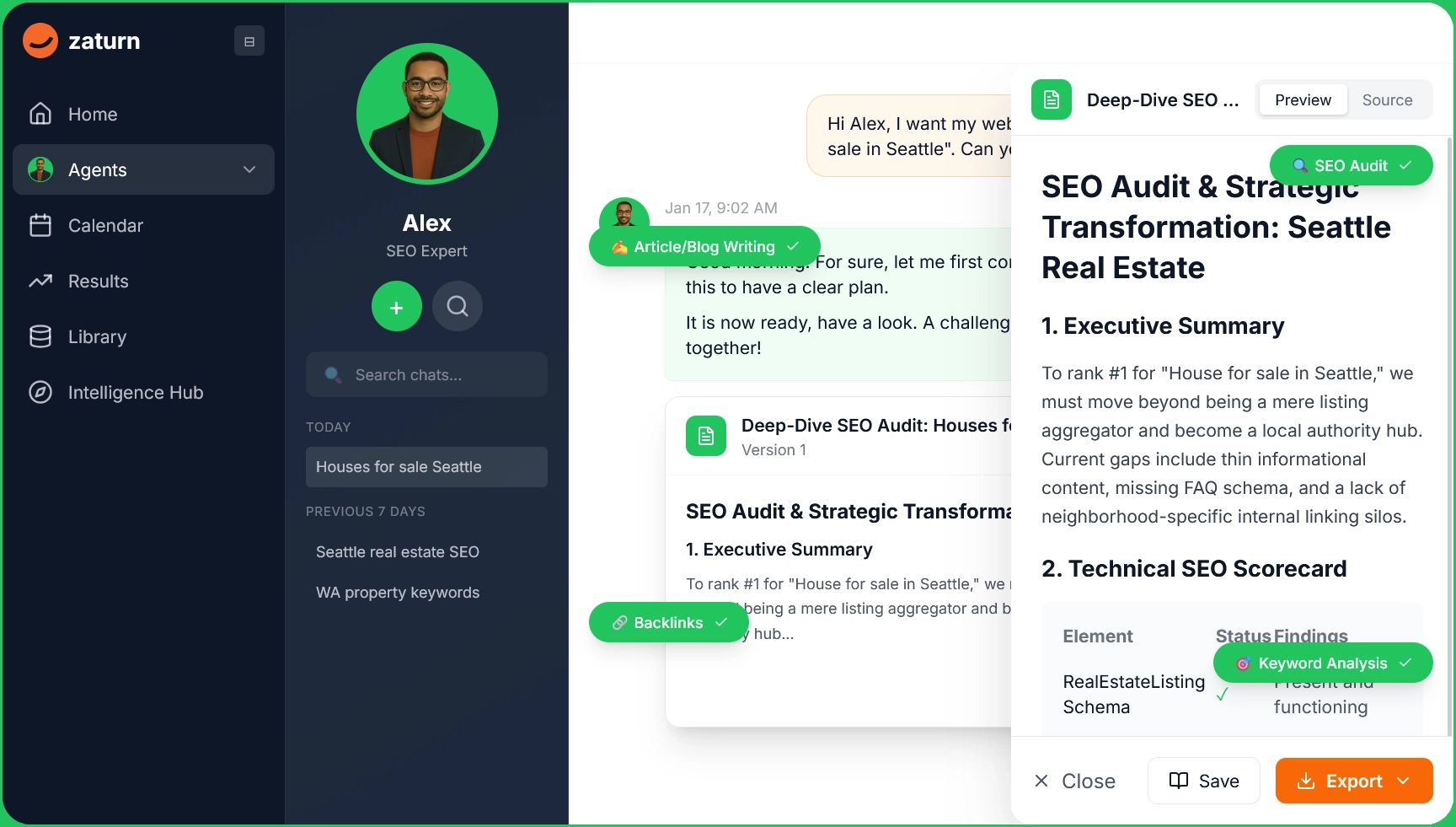
The setup is conversational; you tell Alex what you want to rank for in plain language, he runs the audit, surfaces his findings, and starts executing with your approval on every step. Nothing touches your site without your sign-off.
What Alex does in a typical first session:
Site audit: A full technical scan covering page speed, mobile usability, crawl errors, missing meta tags, duplicate content, internal linking gaps, and schema markup, prioritized by ranking impact, not severity.
Keyword opportunity map: Based on your target market, existing content, and current rankings, Alex identifies the top keyword opportunities ranked by how achievable they are given your current domain authority.
First blog post brief and draft: Alex writes the first SEO-optimized post targeting your highest-opportunity keyword. They’re structured, internally linked, and submitted for your review before publishing.
Rank tracking setup: Google Search Console connected, baseline impressions and average position recorded, rank tracking running from day one.
Competitor gap analysis: A snapshot of what your top three competitors rank for that you don't, which is the clearest indication of where the content opportunity is.
Alex is part of Zaturn's AI marketing platform alongside five other agents: Chloe (social media), Gabriel (ads), Emma (email), Sam (website CRO), and Lucy (platform assistant).
All six draw from the same Intelligence Hub storing your brand context, so the blog posts Alex writes are consistent with the social content Chloe produces and the emails Emma sends.
Try Alex free for 14 days. Connect Google Search Console, tell him what you want to rank for, and have your first audit and blog post ready to review in your first session. No credit card required.
SEO Tool, SEO AI Agent, or SEO Agency?
Either of these options might be the solution you’re looking for, depending on your bottleneck.
SEO Tool | SEO AI Agent | SEO Agency | |
Starting cost | $99–$299/mo. | $69/mo. (Alex) | $1,500–$5,000/mo. |
Who does the work | You | The agent (with your approval) | Agency team |
Requires SEO knowledge | ✅ | ❌ | ❌ |
Content creation | ❌ | ✅ | ⚠️ Sometimes (extra cost) |
Technical execution | ❌ | ✅ | ✅ |
Rank tracking | ✅ | ✅ via GSC | ✅ |
Runs continuously | ❌ Only when you log in | ✅ | ⚠️ Monthly check-ins |
Best for | SEO professionals | Business owners | Businesses with complex needs |
📌 As a small business, the choice isn’t between an SEO tool and an SEO AI agent; it’s between having SEO done and not having it done. Tools require someone with the time and expertise to act on what they show. Agents handle the acting.
Is an SEO AI Agent Right for You?
An SEO AI agent makes sense if:
You know SEO matters for your business but don't have the time or expertise to execute it yourself.
You've paid for an SEO tool and the data sits unused because no one has time to act on it.
You've worked with an agency and felt the output didn't justify the retainer.
You want SEO running continuously rather than in quarterly project sprints.
You need content produced alongside the technical work, not as a separate engagement.
It might not be the right fit if:
You're planning a major site migration in the next 90 days; get a human specialist for that specific project first.
Link building is your primary bottleneck; agents identify opportunities but outreach is human work.
You're in a highly regulated industry where every piece of content needs legal review before publishing.
You need a strategic partner who can advise on brand positioning and market differentiation.
If you're unsure whether an SEO virtual assistant or a dedicated SEO tool is the better starting point, the comparison comes down to whether you need data to act on or execution of work you've already identified. If it's the latter, an agent is the right category.